Being An Interesting, but Meager, Account of an Early-day Settlement; Its Peculiar Advantages Religiously, Educationally and Socially; with Notes of Some of the People
Including A Brief Biography of the Author
(Published for a Friend by) The Phrenological Era Print Bowerston, Ohio 1928
(Annotated by) Kevin Borland Camden, New Jersey 1999
Publisher's Note
Reminiscences of ordinary pioneer times are interesting. We like to think back, as it were, and contrast the advantages, hardships and enjoyments of the early days with those of the present. But in the case of a special locality or landmark, as is here represented, there is an unusual delight enjoyed. The village of New Hagerstown, Carroll County, Ohio, seems to have been like an oasis in the trend of civilization; and this lady writes very happily, so far as she goes, of the conditions and scenes of this noted educational and religious center. To have been born there is an honor. Many of the thousands who knew this place and the majority of those who attended school and church here have passed away; yet their many friends and children, together with the older ones still living, will feel a thrill of pleasure in reading these lines. It is a way of doing good. The only wish can be that our good friend, Mrs. Price, had written more. And would it not be well if other good writers should prepare similar recitals of their respective settlements!
A few typographical errors occur. It has been said that it takes several editions to eliminate all mistakes of a book in print, grammatical expression, and whatnot; and as this is the first issue, it is not so bad. We think every one can easily understand what is meant.
Respectfully, M. Tope, Bowerston, O., June 30, 1928
New Hagerstown, A Pioneer Settlement of Ohio
No early settlement in America has had a more unique history than old New Hagerstown, Ohio.
Laid out in 1816 by Samuel Dunlap, and named after Hagerstown, Md., it was destined to become one of the peculiarly notable spots of the United States.
In its growing and noontide days many remarkable events transpired;
especially since it was a sort of halfway place on the stage route through this section of the country,
and an active center of trade close to the making of No. 10 tunnel and the Panhandle railroad through Bowerston—a little hamlet
then of only a few houses a mile to the southward.
All the early trades, as blacksmithing, coopering, tanning, etc., were carried on here.
At the west end were four taverns or stage-houses—one on each corner where the streets or highways cross,
and at all of them good liquor was sold at a very cheap price. The stage route was from Steubenville to New Philadelphia and other points west.
Dr. Stockton taught and trained medical students.
But New Hagerstown was chiefly famous for its educational and religious activities.
Thousands of young men and young women were thoroughly educated here and went out to hold high positions and aid in the up-building of mankind.
One who was born and reared here, and taught in the Academy, Mrs. Rev. B. M. Price (nee Margaret E. Morrison)1,
has written a fine sketch of its primitive days and some of those who figured in its interests; to which we have added other notes of information
and seven pictures of note, making a rare bit of history of pioneer days to be handed down to future generations.
A great honor is due the founders for what they did for the benefit of those of our day, and this little book is a tribute to their goodwill,
as well as a record of achievements and happy days under difficulties.
Other communities and sites are honored for unusual circumstances of one kind or another as the birthplace or grave of some distinguished individual,
the home of Indians, some cult practiced or a tragic occurrence;
but where the chief interest of a pleasant little cluster of people has been to build up morals,
manners and music along with the important branches of learning, and to prepare cultured men and women to go out into society and the world
to dispense their ennobling influences to those with whom they associate and come after them, is a "labor of love" too often not appreciated as it should be.
We humbly remind the friends who had friends living here or who went to school or church here not to forget their early benefactors.
For the photos herein, we desire to express our thanks to J.C. Lyons and daughter Eloise; the zinc etchings were made by the West Virginia Engraving Company,
H.E. Stupp manager, Wheeling, W. Va.; and acknowledgment is due to A.J. Morrison2, of Lorain, O., for kindly favors.
Very truly, M. Tope.
"ANOTHER LITTLE GIRL" A Story of Life in an Educational Center of Pioneer Days
"My boast is not, that I derive my birth From Loins enthroned and great ones of the earth; But higher yet—my proud pretensions rise, The child of parents passed into the skies."
On Friday, September 13th, 1850, a little girl came into the house of a Godly Scotch-Irish couple living in the village of New Hagerstown, Carroll County, Ohio.
The father3 was American born, but could trace his ancestry back to the Stuarts of Scotland. The mother4 was born in Ireland,
coming to America when she was eleven years of age. They came to Ohio from Westmoreland County,
Pennsylvania5. They settled first in Tuscarawas County, where the oldest child6, a son was born in 1837.
Shortly afterwards they moved to Carroll County, where they lived for forty years; that is, some of the family, and occupied the same house,
except for a short time during which the family home was being repaired.
The father was the "village blacksmith," a good man and, like his predecessor, made famous by
Longfellow's poem,
"He went on Sunday to the church and sat among his boys. He heard the parson pray and preach."
It was told of him that when the dirt and grime were washed away, he was often taken for a preacher.
There were five members of the family when the little girl made her appearance. They were named respectively: Samuel M., Martha B., John T.,
Nance E.7, and Mary J.8 and the little girl was named Margaret E.
She grew up, as all do, in the atmosphere of a loving, Christian home. Almost the only recollection she had of her father was upon the day
of his funeral when she was about three years old and her oldest sister lifted her up to look upon his face for the last time.
The same sister told her how fond he was of her, how he held her in his arms, rocking her and singing the dear old familiar hymns of
Isaac Watts.
Another child had come into the home, a son named Alexander J., who was only three months old at the time of the father's death.
There was nothing unusual nor striking in her early years. She was fond of music and early learned to sing. She also loved books,
and it is related of her that one day as she was holding a book and pretending to read, some one observed that the book was upside down,
and told her so. "Oh." she said, "I read heels foremost." She learned to read early, and before starting to school at the ageof five,
had read through McGuffey's First Reader. Her childhood and school days were happy ones. She was a regular attendant at the old schoolhouse on the hill
and having a very retentive memory, made good progress in learning, especially in spelling; and, when on Friday afternoons, as was the custom then,
the time was spent in spelling, she was always the first one chosen by the captain.
She was not a model pupil, nor the teacher's pet, for she was too full of fun and eager to talk to always please the teacher,
but was commended for knowing her lessons. In those early days, the pleasures were simple, but various.
In summer the girls would build play houses, modeled after the home, carpet them with the green, velvety moss brought from the adjacent woods,
furnish the home-made cupboards with broken, discarded dishes brought from home, and then play at keeping house. The cups and saucers were acorns.
Then, as now, the girls skipped the rope and had much the same games. In the evenings the boys and girls of the neighborhood gathered together
in front of one's home, on the beaten-down, hard earthen pavement (no concrete pavement then), and played the same old games as now.
In the winter they rode on sleds, snowballed, waded in the snow, and made photographs therein. Oh, those were the happy days!
Then at night there were writing schools, literary societies, and spelling bees. As they grew older and aped the ways of the older folk,
one leap year Margaret and her chum, Mary, made bold enough to ask two of the neighbor boys if they could see them home;
but they, more timid and perhaps afraid of the laughter of others, started to run,
and the girls catching hold of their coat-tails, ran too until they reached their homes.
The mother of the little girl was a wonderful woman--not great as the world calls great, not blessed with much of this world'sgoods, and her education limited.
She was blessed by Nature and grace, with a large fund of good, Christian common sense, and impressed one favorably as one who knew. She was a great reader,
a good talker, and active in all home and community duties. She was one how "lived by the side of the road and was a friend to man."
Her home was always open to all, and was the rendezvous of the young people. Like the only woman called great in the Bible,
she had a prophet's chamber in her home, and when traveling ministers came to preach, they found a home there. She was a helper to her pastor,
one upon whom he could always rely. Early left a widow with seven children, she brought them up in the nurture and admonition of the Lord.
Early were they sent to Sabbath school and church, and whenever possible, she went with them. Three times a day a blessing was asked upon the food,
and night and morning she gathered her family together for family prayers. The children were taught to pray, read the Bible, and learn the catechism.
On Sabbath afternoons they remained at home, no gadding about, but reading some good literature; and in the evening the mother examined them
in the catechism--and later the children rose up and called her blessed. All were members of their father's and mother's church,
the Presbyterian. Left alone as she was, she had to work hard to provide for her family, and many were the sacrifices she made for them,
and I am glad to pay this tardy tribute to her memory.
The village boasted of an Academy, founded in 1837 by the Godly men of the church. It was a great advantage to the neighborhood,
and she counted among its Professors many able men; and was well patronized by people for many miles around. This mother sent all her children to the Academy,
after finishing school in the public school, and thus they were enabled to secure a good education and developed
into a teaching family, six of the seven becoming successful teachers--some of them at a very early age, and the eldest and youngest
daughters not only taught in the public schools, but in the Academy as well.
The years rolled on and brought the Civil War. The two elder sons, who had left home and were teaching in the western part of
the State, enlisted in the Union Army, one as Captain, the other as Orderly Sergeant.
They fought at Fort Donelson,
Shiloh, and other places;
later were transferred to a gunboat and were in the vicinity of Vicksburgh, at the time of the surrender. The older son9 was
wounded, took sick with pneumonia, and his life was sacrificed for his country. He was then a Major.
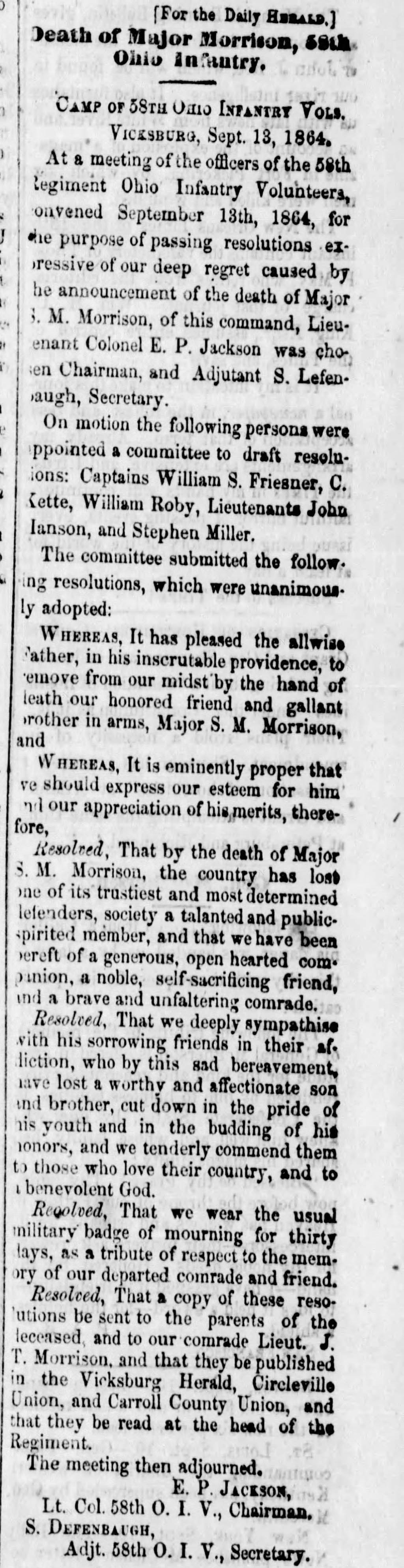
This clipping from the Vicksburg Herald honors Major Samuel M. Morrison, detailing his service,
bravery, and the impact of his loss on the 58th Ohio Infantry Regiment.
OCR of relevant newspaper article by ChatGPT. The contents of this box are an annotation by Kevin Borland and were not included in the original publication.
Death of Major Morrison, 58th Ohio Infantry.
CAMP OF 58th OHIO INFANTRY VOLS.,
Vicksburg, Sept. 13, 1864.
At a meeting of the officers of the 58th Regiment Ohio Infantry Volunteers, convened September 13th, 1864, for the purpose of passing resolutions expressive of our deep regret caused by the announcement of the death of Major S. M. Morrison, of this command, Lieutenant Colonel E. P. Jackson was chosen Chairman, and Adjutant S. Derenbaugh, Secretary.
On motion, the following persons were appointed a committee to draft resolutions: Captains William S. Friesner, C. Kette, William Roby, Lieutenants John Hanson, and Stephen Miller.
The committee submitted the following resolutions, which were unanimously adopted:
Whereas, It has pleased the all-wise Father, in his inscrutable providence, to remove from our midst by the hand of death our honored friend and gallant brother in arms, Major S. M. Morrison, and
Whereas, It is eminently proper that we should express our esteem for him and our appreciation of his merits, therefore,
Resolved, That by the death of Major S. M. Morrison, the country has lost one of its trustiest and most determined defenders, society a talented and public-spirited member, and that we have been bereft of a generous, open-hearted companion, a noble, self-sacrificing friend, and a brave and unfaltering comrade.
Resolved, That we deeply sympathize with his sorrowing friends in their affliction, who by this sad bereavement have lost a worthy and affectionate son and brother, cut down in the pride of his youth and in the budding of his honors, and we tenderly commend them to those who love their country, and to a benevolent God.
Resolved, That we wear the usual military badge of mourning for thirty days, as a tribute of respect to the memory of our departed comrade and friend.
Resolved, That a copy of these resolutions be sent to the parents of the deceased, and to our comrade Lieut. J. T. Morrison, and that they be published in the Vicksburg Herald, Circleville Union, and Carroll County Union, and that they be read at the head of the Regiment.
The meeting then adjourned,
E. P. JACKSON,
Lt. Col. 58th O. I. V., Chairman.
S. Derenbaugh,
Adjt. 58th O. I. V., Secretary.
The other son10 served through
the three years, re-enlisted, became a Captain, and at the close of the war returned home. After a short time at home, he, with other
pioneers, went to the new State of Kansas, where they founded a town. He was active in all the affairs of his adopted State, was a
member of the State Legislature, and finally died in Kansas. The wife and three children remain.
Annotation by Kevin Borland: John Tullis Morrison was one of the founders of the town of Cedar, located in Smith County, Kansas.
During the war, in 1864, the second daughter11 married a well-to-do man12 of her own village who owned a farm
on the outskirts. She lived at this place until her death. Only one of this family is now living13.
The oldest daughter14 married a Presbyterian minister who preached in Ohio for seven years, then removed to Pennsylvania,
where he served the same charge forty years, then retired.
Just prior to the 50th anniversary of their marriage, he was called home, and his grave is in the cemetery where two former pastors had served
the same church the same length of time. His wife survived him about seven years; then God called her. Five children survive.
But two of the family remain, the youngest daughter--the writer--and the youngest son15. This daughter is the "other little girl," and
she is so thankful to the Heavenly Father that her home was in this family and that her life has been spared so long, and has been such a
happy one. Before she was eighteen she became a teacher and always found pleasure in the work. She loved it, and had many pleasant experiences which would be interesting to record, if there were time. She made many friends and has the blessed assurance that she has
helped many among whom she worked to lead a better life. She feels greatly indebted to many of her old pastors for the lessons they
taught her in early life, which have helped to influence her later life. She taught different public schools in Carroll, Tuscarawas and Harrison counties, Ohio; then for several years in the New Hagerstown Academy,
which she left to become the wife of a Presbyterian minister16, to share his work in bringing souls to Christ.
The life was a trying one, but had many pleasures and rewards. The work began in Ohio, our native State, then among the warm-hearted Nebraska people,
back in Ohio, then to Pennsylvania, and back to Ohio. She worked in missionary societies--local church societies;
and feels grateful that she was permitted to do so, and her prayer is that her work was not in vain.
In 1921, her husband was not;--for God took him while he was still in the prime of his usefulness.
Since then, she has passed through many trials, but not alone, for God has been kind to her, and her three children do all possible for her comfort and happiness.
She and daughter live together in Shadyside, Ohio.
The youngest son17 of the parent family is a good Christian man. For years he has been an elder in the Presbyterian Church, and
his one aim is to serve God and advance His Kingdom. His wife18 is dead, and he has left a fine family of four.
As said before, The Other Little Girl early learned to read. In those days children started to school at the age of five, and before then
she had read McGuffey's First Reader, and could repeat "See the fox," "I like to see a little dog," "Twinkle, twinkle, little star," and others
of like nature. One of the first books was "Mother Goose's Rhymes," gotten up in rebus style; and she was early introduced to "The New England Primer,"
with the picture on the front of John Rogers being burnt at the stake, and inside, the alphabet illustrated with pictures and rhymes conveying to youthful minds such lessons as "In Adam's fall, we sinned all," and "Zaccheus he did climb a tree, his Lord to see,"
and others between. The same book furnished the knowledge of "Who was the first man?" "The oldest man?" "The wisest man?" "The
meekest man?" and so forth, which knowledge was never forgotten, and proved of much profit. She was early taught "Now I lay me"
and "The Lord's Prayer" and to read the Bible and study the catechism; and before she was nine, had conquered both "The Child's" and
"The Shorter Catechisms" which the good mother insisted on her learning. It was done with much opposition and sometimes with tears,
but how many times since she has had occasion to thank the dear mother, for it has proved a mine of Scriptural information, doctrine and comfort.
She early read "The Pilgrim's Progress,"
but could not always understand John Bunyan's figures of speech.
She was enraptured with "The Scottish Chiefs,"
which the Scotch-Irish mother early allowed her to read, and was on of the mother's favorite books.;
and she could explain and make clear many things found in it. But candor compels me to say that not all of her readings were of this strictly orthodox kind.
She never cared much for fairy tales, but did like "The Arabian Nights," "Robinson Crusoe" and
"Swiss Family Robinson,"
and I must confess that some writings, known in those days as "Yellow back," she liked. Also wild Indian tales and tales of adventure, but I am free
to say that none of those tales ever left as bad impressions as some of the so-called popular fiction of today. The school she attended, for
she grew up in the same village where she was born, was typical of the public schools of the day, undraded, and made up of children of
every age and type, from the abecedarian to the few who aspired to History and the higher branches. One room, one school-teacher--
sometimes male, sometimes female, some good, some not so good, some liked, some disliked, very little equipment for work, nothing
done to make it attractive; yet, in defiance of all, much good was done.
McGuffey's Spellers and Readers were used, and I want to pay a tribute to them in passing. I have never seen better, and the
lessons learned from the Readers abide with us forever. Ray's Arithmetic
Ray's Arithmetic
A popular series of math textbooks authored by Joseph Ray, first published in the 1830s. The series emphasized practical arithmetic skills and became widely used in American schools throughout the 19th century. They focused on mental math and real-world applications, providing clear explanations of mathematical concepts for students of all levels. Part of the Eclectic Education Series, it shaped generations of students in the United States.
, Pinneo's Grammar
Pinneo's Grammar
Authored by Timothy Stone Pinneo, a 19th-century educator and textbook author, *Pinneo's Grammar* was a foundational series focused on teaching English grammar and composition. It emphasized clear rules and principles to help students master sentence structure, punctuation, and grammar through extensive examples and practice exercises. It was widely adopted in American schools for its systematic approach to language instruction.
, and I do not recall whose Geography, but all were expected to be able to find the States, name and locate capitals, rivers, lakes and bays, no matter how small nor in what
division of the world; and the little girl can still remember the thrill when Lake Tehad was correctly placed in Africa and the desert of
Gobi in Asia, and not vice versa. Every day was full. The little ones had to be taught their letters, and when it came to spelling and reading
there were almost as many classes as pupils; and when it came to other branches, it was not much better. There was not much time for
the higher branches, but those who wanted them made good headway in spite of difficulties. Of course, there were the dull scholars, the
"I don't care" scholars; but, all things considered, progress was made. The old school-house stood at the upper end of the old pastor's
apple orchard, and in the summer time it was often granted as a reward of merit to the best scholars,
one or two at a time could be given permission to withdraw from the school-room, betake themselves unto the orchard and oh! what a pleasure it was to climb a tree,
ensconce oneself amid the leafy branches of a tree, book in hand presumably for the purpose of studying, but at any rate--rest,
look about and hear the birds sing.
Perhaps I should say something about the early home of "The Other Little Girl." Not quite like Rome, seated on her seven hills, yet
the village was surrounded by seven hills, all of some height, but one especially was called "The Big Hill," and was a gathering place for
the young people on summer evenings The village was a small one. In its palmist days it might have boasted a population of two or three hundred. It was founded a good many years ago by a sturdy set of Presbyterians who preserved their traditional love for church and school,
and early in its existence it had both. It was founded long before the advent of the iron horse in its neighborhood, but was on the highway traveled by the farmers of Pennsylvania, to a port on the canal a few miles farther on, where their grain was shipped on the canal and carried
to its destination. Even in the little girl's time, some of those large, old Conestoga wagons loaded with grain and drawn by from six to eight strong, beautiful horses, decorated with gaudy harness and ringing bells, would drive through the village to the shipping port, causing much excitement. There was one long street leading north and south, which was intersected by three short ones. At the southern extremity there was an old Baptist church building where services had been held by a resident of the village, but in the little girl's time no service was held in it. At the other extremity was a cooper shop. On the right and on the left a few yards away was God's acre, where "the rude forefathers of the hamlet slept."
"Perhaps some mute, inglorious Milton there may rest,
Some Cromwell, guiltless of his country's blood,"
"Let not Ambition mock their useful toil,
Their homely joys and destiny obscure;
Nor grandeur hear, with a disdainful smile,
The short and simple annals of the poor."
The streets were not paved; neither were there any sidewalks--only earth trodden smooth and solid by the tramp of feet. Perhaps there
were one or two exceptions where formerly flagstones had been laid. The houses on either side were mostly small frame ones, with an occasional one of brick between. Where the first street crossed the long one, on one corner stood the brick Academy, founded in 1837.
The founders built better than they knew. It was the joy and pride of the village, and was an uplifting blessing, giving an education to many
who otherwise would not have had it. Its Professors were Godly, Christian men, many of them ministers, and one left there to become a missionary in what was then known as the Sandwich Islands. Though the teaching was solid, practical and Christian, not only was instruction given in English, but in Latin, Greek, and other languages; and thus students were fitted to occupy positions of trust and honor. Students
came from all directions, near and far, in great numbers, and not only was the home community benefited, but other communities as well.
Ministers, lawyers, doctors, missionaries, teachers, home-makers, and at least one
Judge of the Supreme Court of Ohio
James Latimer Price was born in New Hagerstown, Carroll County, Ohio, on March 27, 1840. He served as a judge in Ohio's Third Judicial Circuit and later as a judge on the Supreme Court of Ohio., obtained part of their education here.
Across from the Academy on the other corner was a large brick building which, in the parlance of those days,
had been a tavern; later it housed many of the students. In these days it would be called a dormitory; then it was known as a students' lodging-house.
On out that street stood the Presbyterian Church--another brick building. This church was a power for good in the community; always had good pastors,
good Sabbath school and prayer meetings; and as there were many good singers in the congregation, there was
always good music. As in olden times all roads led to Rome, so here all roads led to the church. Everybody went to Sabbath school and
church, and on Sabbath morning people could be seen coming from all directions, some in wagons, some in buggies--some so ancient as
to be dubbed arks--other on horseback, and some afoot. On communication days the house was packed. In these days the service extended
over several days, and of the country families--where there were a goodly number--some would come one day and spend the night with the good people of the village,
then return home the next day, and others come, and thus all would get a share of the feast. The same dear old
pastor preached there for twenty-one years before he gave up his work. the little girl with the rest of the family, was seldom absent from
these services, and many were the good lessons to be learned there; and even to this day she can see the families coming into the church
and filling the family pews, as was the custom in those days.
On the other end of this street stood a few houses, and at the extreme end, on the hill-side, stood the old school house, which has been spoken of in another place. Coming down the street further was another cross street. On one corner was the house where the little girl's
parents had settled when they came to the village, and where all the children but the eldest son was born; and it was their family home
for forty years or more, till the mother was taken to "the house not made with hands." Across the street was a building used as a residence
and for other purposes. At one time in the little girl's remembrance there was a saddler's shop, and oh! the beautiful things she saw in there! Shiny leather, bright colored flosses of all hues, used for stitching; and what lovely designs were worked into the saddles, and how she
wished she could have one on which to ride. A store stood on the corner, and near it was a well from which water was drawn with a
windlass to slake the thirst of those in the immediate neighborhood.
Around the corner was a dwelling-house and a cabinet shop, where the children loved to go and get the clean, pine shavings to use
for curls. A little farther out, on the opposite side of the street, stood a stone building known as "The Young Ladies' Seminary," for the
village boasted of that, at one time, where refined, cultured women presided. Later it was transformed into an Episcopal church, and
still later, used as a dwelling-house. Still further out was the residence of the old pastor. A few acres adjoined, which were mostly used
for pasture. The orchard has already been spoken of, and many a basket of fruit found its way from it to the village homes. The pastor
was fond of flowers and rather artistic in his tastes. He planted a tree on each side of the gate leading into the yard, and as they grew
trained them to come together forming one tree.
Just above the house where the little girl lived on the same lot indeed, the "Village Smithy" stood and
"Children coming home from school,
Looked in at the open door;
They loved to see the flaming forge
And hear the bellows roar,
And catch the burning sparks that flew
Like chaff from the thrashing-floor."
Across the street in another direction from the store and well, spoken of, stood a large building, the room on the corner being used
for a store and the rest of the building as a dwelling-house. A house stood opposite that building and the little girl's home between which
the street ran, but there were no residences, and the end of the street was called "the common." Whether it in any way resembled the
Boston common, I know not, but both had one thing in common--cow paths crossed them both. It was often use as a playground and,
being a shorter way to the church, was often used in that way. About the middle of the long street a run came trickling down, ran under
a bridge, on through a meadow, emptying into Conotton creek below town, on its way to the sea. Near the run stood a house, and very
near it was the tannery, a mysterious place to children. The third cross street was at the upper end of the street, and on one end of it
were two or three homes. The other end was the road to the adjoining village. A house stood on each corner; one of the at one time
housed a store and was also a residence.
The village, like all villages, had its eccentric characters--good, sensible people, but with a strain of the peculiar in them. There
was the gossip, the Bedminster, the one who attended to others' business, and the town joker. One of these characters was
"Ca_ie19 Robert," an old gentleman who, like any other old people, lived in the past, forgetting the present and the future. He was
a garrulous old gentleman, who, by his constant references to what he had seen and known in his youth became somewhat monotonous
to all hearers. He was constantly referring to "the good old days" and bemoaning the present, forgetting that the wise man said, "Say
not thus, that the former days were better than these, for thou dost not inquire wisely concerning this."
Next door to where the little girl lived, lived a family of father, mother and four sons. There had been a daughter, but she was
taken away while young, and as this family almost adopted the little girl, their home was her second home. The father was an Irishman,
small, quick, witty, and often sarcastic. He had a small grocery store in one room of the house and the village post-office occupied one
corner of it. Here was the gathering place for all, and many jokes were exchanged while waiting for the mail to be distributed. Never
did candy taste like the red and white striped sticks in the jars on his shelves; and oh, the sticks of licorice and licorice drops! This man
was "Uncle Johnny20" to everybody, and his good wife was known as "Aunt Hannah21;"
and many testified that never were such ginger-cakes made and eaten as she doled out to chance buyers.
One of the boys22 was of rather rovish disposition and, at times,
sorely vexed his father with his vagaries. When the father could stand it no longer, he would say: "Joseph, the time has come when we
must part." And Joseph would say: "Where do you think you will go, Pop!" That would end it for the time. "Uncle Johnny" kept bees,
and the day they swarmed was one of the red-letter days for the little girl. He would tie up his face and head in a green beige veil, put
on gloves and sally forth, bell in hand, ringing it till the bees became disgusted and settled down on one of the apple trees in the garden.
And the remembrance of these apple trees thrills me yet. Some of them hung over into the little girl's garden, and in the spring what
beauty and fragrance were shared; and when the time for fruitage came it was an unwritten law that all that fell on our side were ours--and
how delicious the fruit was!
Strange to say, another character was Irish, and his name, too, was "Johnny." He was a tailor, and was a regular Irish dandy, with
his stiff starched shirt, collar and cuffs, dapper clothes, and stovepipe hat, stepping briskly along with his small feet daintily encased in
shining shoes, and his step indicated that it would be easy for him to change to a jig or a Highland fling.
Another Irishman! But his name was "Billy" and a shoemaker. He was a jolly, good natured fellow--always a "hail fellow-well-met"
with everybody, and a great joker and singer; and it was a delight to hear his rollicking voice singing Irish songs. But alas! he had learned
to love whiskey, and was often under its influence, and, though not quarrelsome, it only unloosed his tongue and made more of a wag
of him than ever. But the parents did not like to see their boys in his shop, for he would put the bottle to his neighbor's lips. Speaking of
him reminds me of another--a young man, son of a Baptist minister, bright, well-educated, with a beautiful voice, and such a knowledge
of music, that he made a wonderful teacher. He, too, unfortunately, fell under the power of drink. He made many efforts to reform, but
alas! too often broke over and yielded to temptation. At last, he united with the church, and did well for several years. At his death the
veil was drawn over all his misdeeds and mistakes, and all hoped that the Lord had taken him away from further temptation.
There were two sisters, not spinsters either, who made themselves self-appointed mentors over the actions of the younger set, and
the girl who laughed too loudly or was seen walking the street with a young man, or to the young man who with a flourish drove his buggy
to a girl's door to go riding. As said before, there were many good singers, and much was made of music. Among the leaders in the music
was "Uncle Benny," who trained choirs for many years. He was a good man as well as a good singer. He was an elder in the church for
many years, was a Sabbath school teacher, and well liked by everybody, and it was a pleasure to hear his rich, tenor voice in song.
The old Pastor23 has been spoken of, but it may not be amiss to say more of him. Like Barnabas, he was a good man and full of the Holy Ghost.
In his earlier years, before coming to the village, he had been a missionary among the Indians, and he continued to be a missionary all his life.
What is very rare, no one was ever known to say a harmful word of him. "None knew him but to love him; none
named him but to praise." Even the village sot once said of him, "If ever there was a saint on earth, he was one." He loved children, and
they loved him. Never thought of going out of their way lest he should meet them, for he always met them with a smile and kind word,
and always managed before he left them to drop a word that would lead them to think of God and their duty to Him--and all without cant
or studied effect. Such was the good old Pastor. He lived to a good old age and came to his grave "full of years and like a shock of corn,
fully ripe." His wife24 was a worth helpmate. A refined, cultured English woman, who looked well to the ways of her house, yet found
time to be a friend to the humble people among whom they lived. As one instance, the little girl remembers of her mother telling that in the summer on Sabbath day she would clean up her family of little boys and send them to Sabbath school barefooted,
that there might not be too much difference between their appearance and the other village boys.
They brought up a fine family. Only one is left, a son. He devoted his life to teaching and witnessing for Christ;
and in many ways, is a replica of his father. His students are scattered all over the United States, and some in other lands,
and all speak well of him and attribute much of their well-doing to his faithful counsels.
The next pastor was a different kind of man, a good man, stern, inflexible, and had no particular love for sinners. He was well
educated, a better scholar perhaps, but was not so lovable. He served for a time as Chaplain during the Civil War. He and his wife both
taught in the Academy and were both good instructors.
Among the many good people of the community was one who was always "Uncle Frank25" to our family. While not blood relations,
the families were very closely related. They came about the same time to the new home in Ohio from the same neighborhood in Pennsylvania, and Uncle Frank's name was the same as the maiden name of the little girl's mother;
and one of her brothers married a sister of his, and the families were closely akin to each other. Uncle Frank owned a farm near the village, not more than a mile away, and scarcely ever did
he come to the village without bringing something to "Aunt Sarah," as the little girl's mother was known in his family. Potatoes, apples,
and the Spitzbergen RambosA variety of the Rambo apple, a crisp and mildly tart apple that became popular in colonial America around 1767., and other choice varieties, known to us in those days; buckwheat; and at butchering time, choice morsels of
both pork and beef found their way into her home. His was a pleasant and hospitable home, and it was always a great pleasure to be allowed
to visit there, helping with the work on the farm, picking apples, gathering stones off the fields to build fences, and in many other pleasant
ways, spending the time; and at meal time, around the well-filled table,
partaking, among the other good things of the delicious biscuit Aunt Caroline26 was famed for making.
The road to the house led up a hill, and about half way to the top was a large, flat stone which was always called "Grand-mother's Stone,"
for his aged mother27 made her home with him, and in her trips to the village when she reached this stone she was ready to rest, as were
many of the younger generation. The house was plain, but comfortable, and before the door stood a large tree, with spreading branches,
and to its boughs was fastened a swing, which was a pleasure to all children. The spring and spring-house were under the shade of another
tree, and, like David of old, some of us are tempted to wish that one would bring us a drink from the well of Bethlehem. The garden was
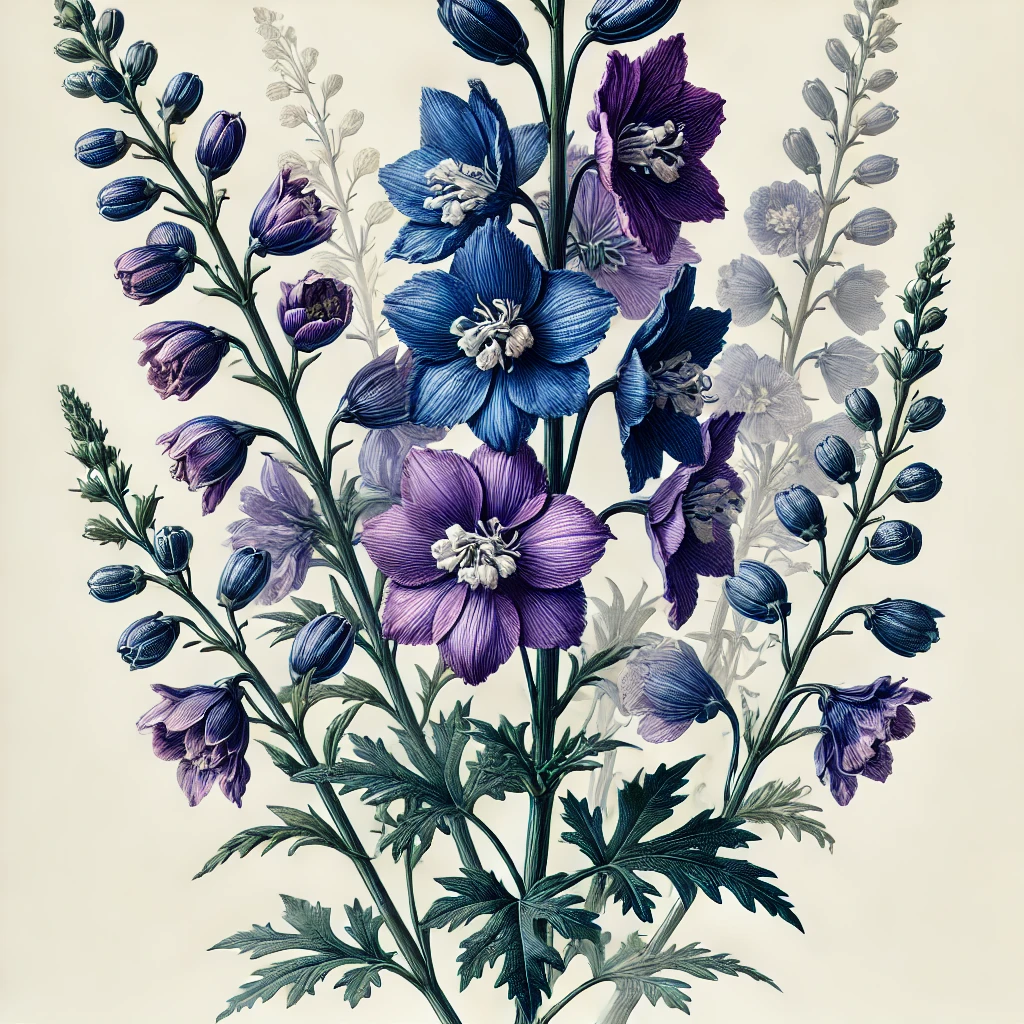
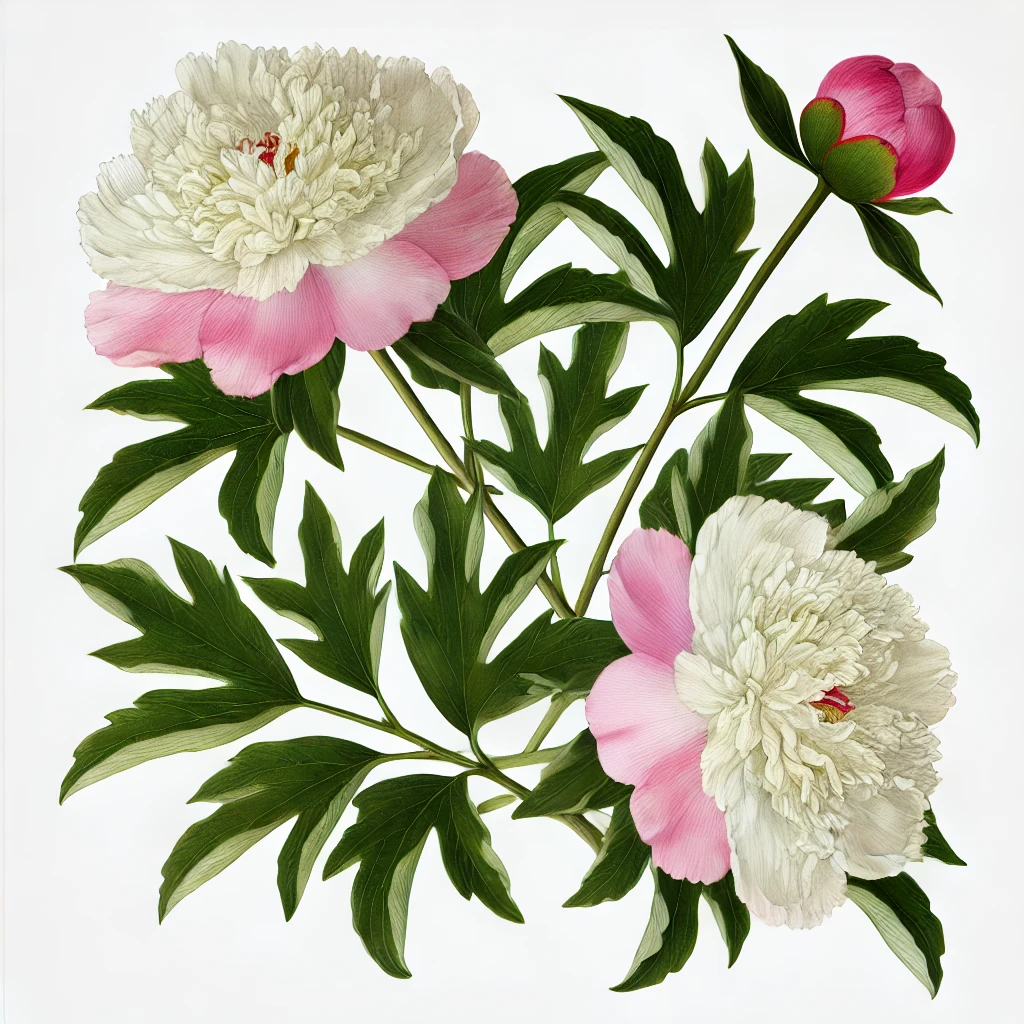
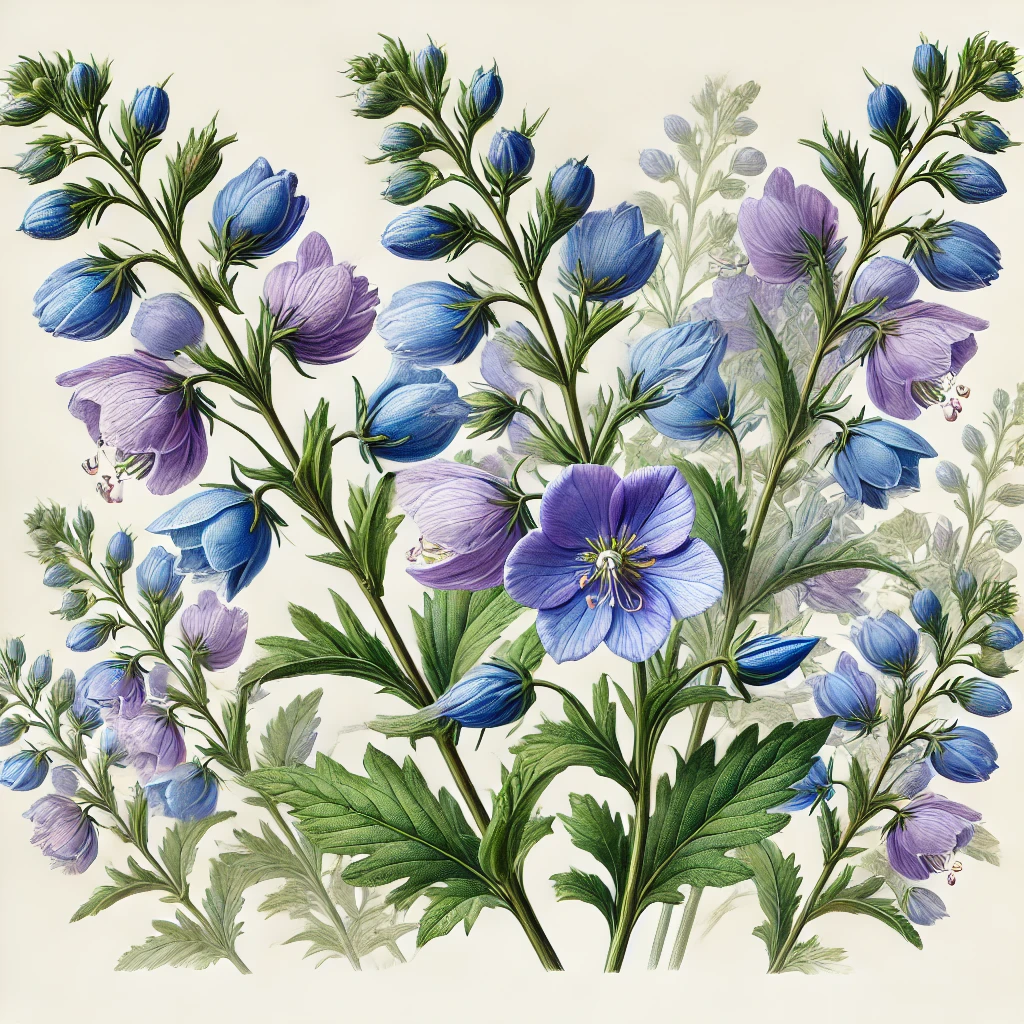
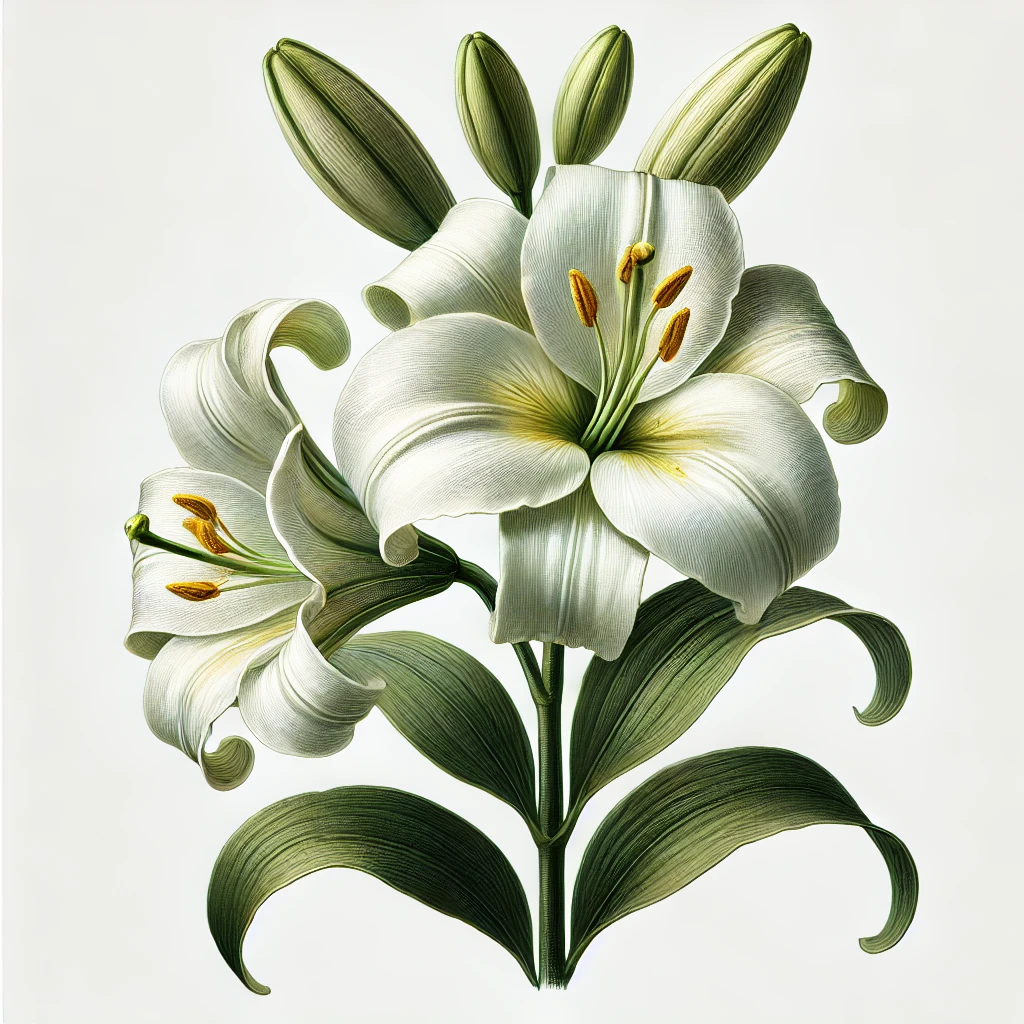
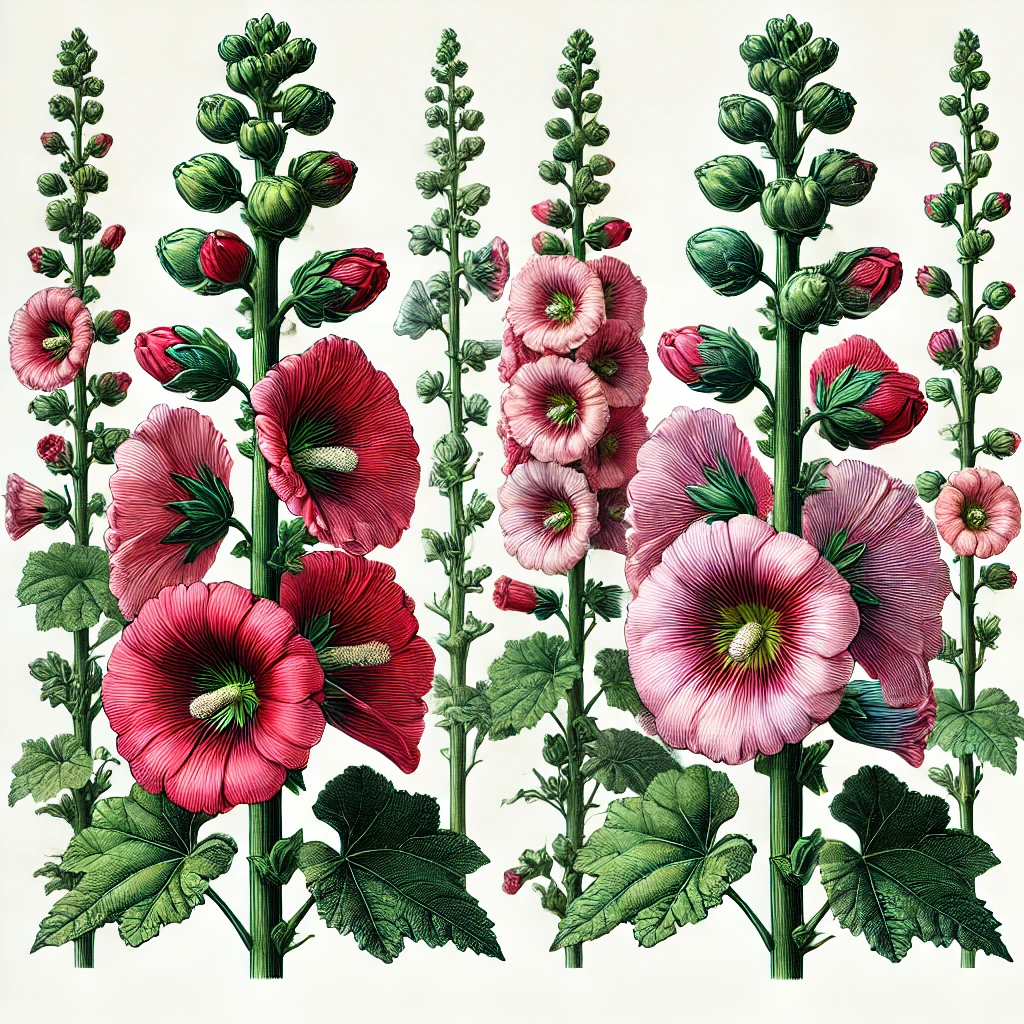
full of old-fashioned flowers--larkspur, peonies, Jacob's ladder, Easter flowers, holly-hocks, lilacs, snowballs, and others. Do you wonder
that we liked to go there! There were many other good people in the community that I would like to speak of, but time and space forbid.
Flower Name
Scientific Name
Image
Larkspur
Delphinium
Peonies
Paeonia
Jacob's Ladder
Polemonium
Easter Lilies
Lilium longiflorum
Hollyhocks
Alcea
Lilacs
Syringa
Snowballs
Viburnum opulus
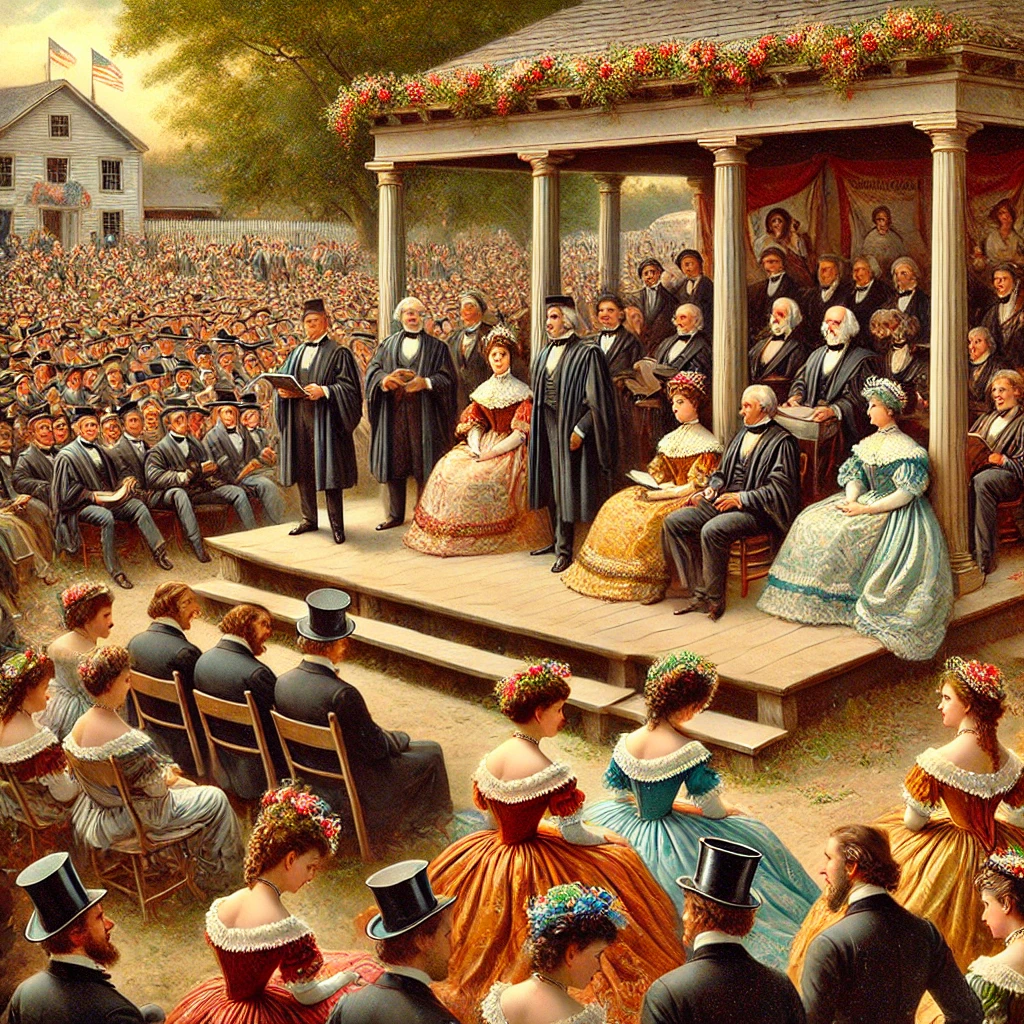
Illustration of the closing exercises at an old academy, created by ChatGPT.
There were a few outstanding days in the village, and one of the most important was that on which the closing exercises of the Academy took place. There were no commencements in those days, no baccalaureate sermons, no alumni banquets, but I am free to confess that, then as now, there was a freshening up of costumes; and the ever old and new question of "What shall I wear?" seemed just as relevant.
It was an exciting time for all involved. The exercises were held in the academy building, with students, teachers, and proud family members filling the hall. Speeches were given, accomplishments were celebrated, and prayers were offered, all culminating in a hopeful view towards the future.
The celebration was as much about tradition as it was about achievement, and everyone, from the youngest student to the most senior teacher, felt a sense of shared pride in the Academy and its mission to educate and uplift the community. It was a day to remember for all who participated, marking a meaningful chapter in the life of the village.
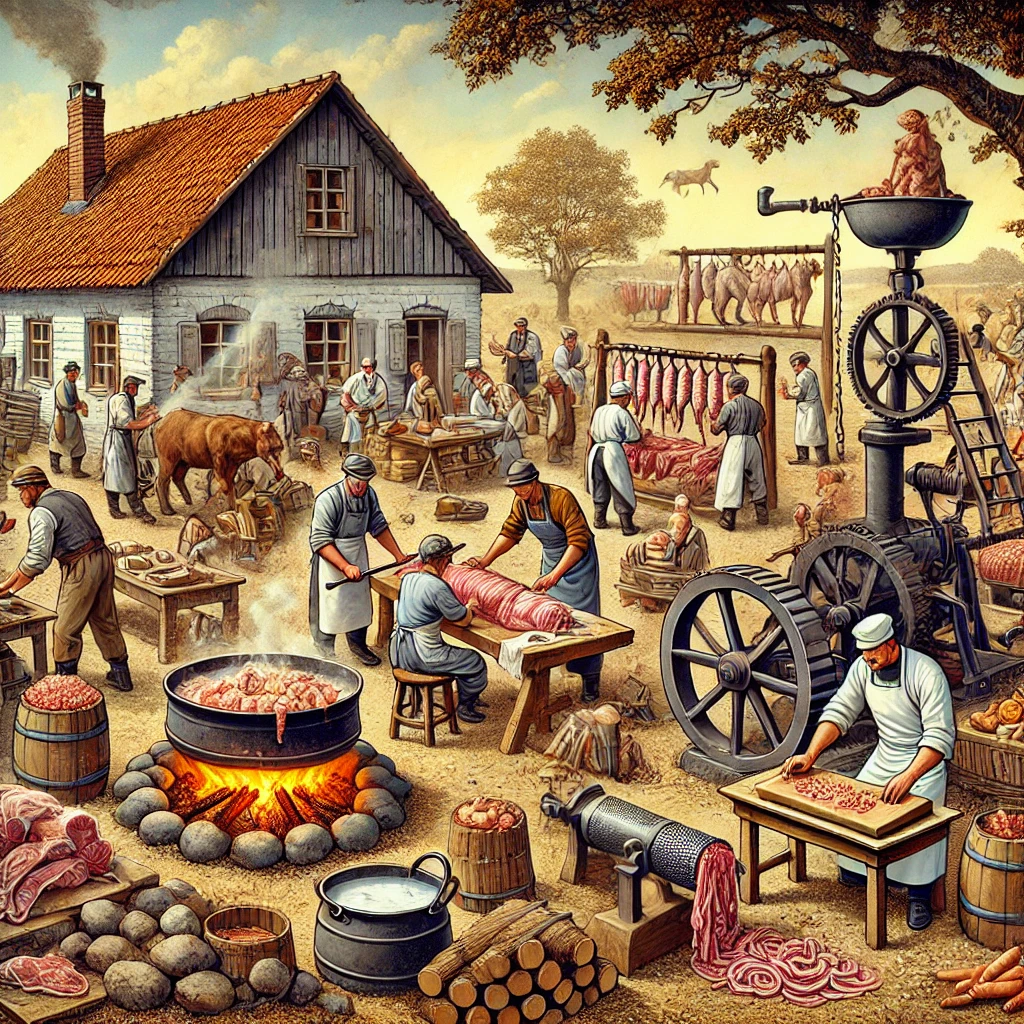
Illustration of a traditional butchering day created by ChatGPT.
Then, too, butchering day was a wonderful time! Very early on this morning, if on no other, all were astir. A huge fire was built, and stones piled in it; a large kettle filled with water was near, and when the stones were thoroughly heated, they were thrown into the kettle to boil the water. After the skillful marksman had used his rifle to bring down the hog, the process of scalding and cleaning began. Family members, neighbors, and friends gathered, each with a role to play in the work, while the children watched in awe and anticipation. The scene was one of efficiency and camaraderie, with the spoils of the day promising sustenance for the cold winter months.
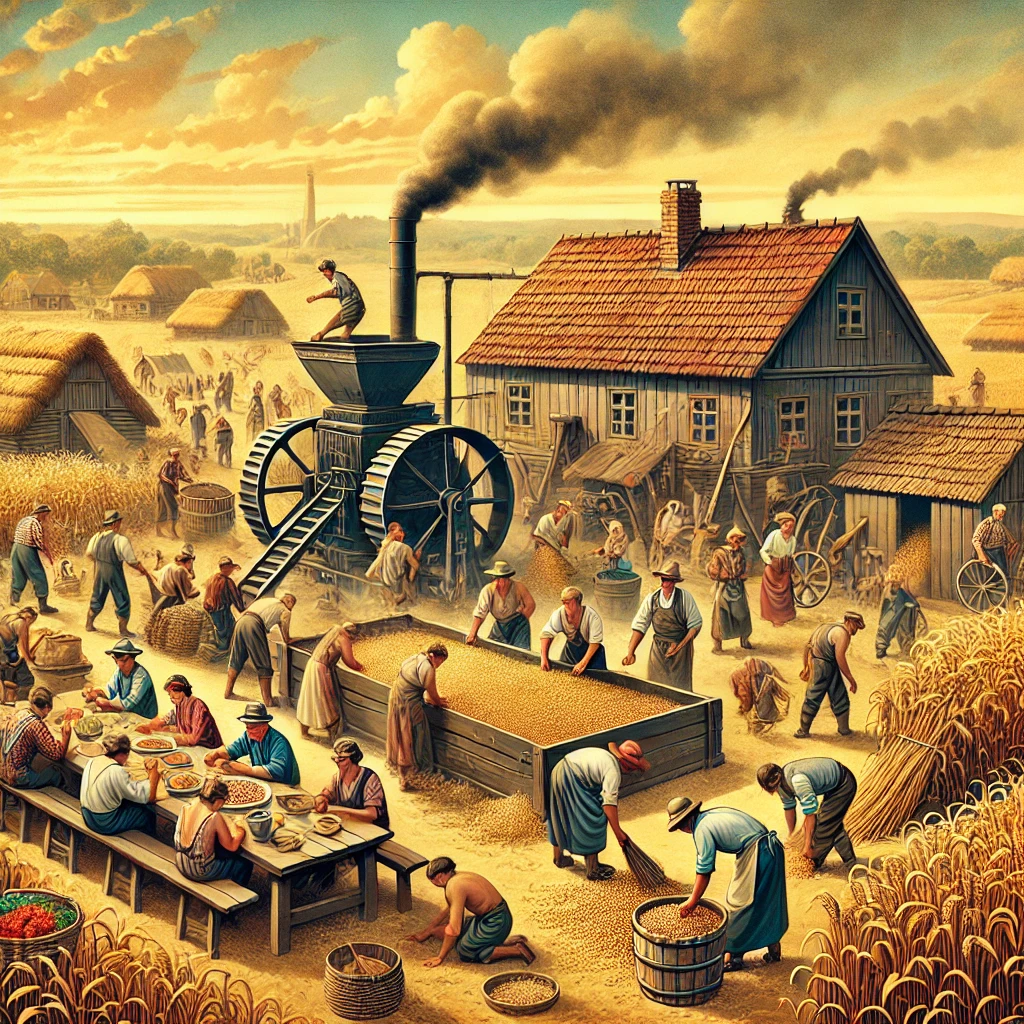
Illustration of a traditional thrashing event created by ChatGPT.
Thrashing was another important event. Although living in a village, the surrounding farms came close to the edge, and many had near friends on the farms who would extend an invitation to watch or help with the thrashing. The huge, lumbering machine would pull up, and the sight of its gears and moving parts provided such a thrill as not even the arrival of a railroad train could match. The entire community came together to assist in separating the grain from the chaff, and the day was punctuated with laughter, hard work, and a shared meal. The fresh smell of the grain, the dusty air, and the camaraderie made it a memorable event for all.
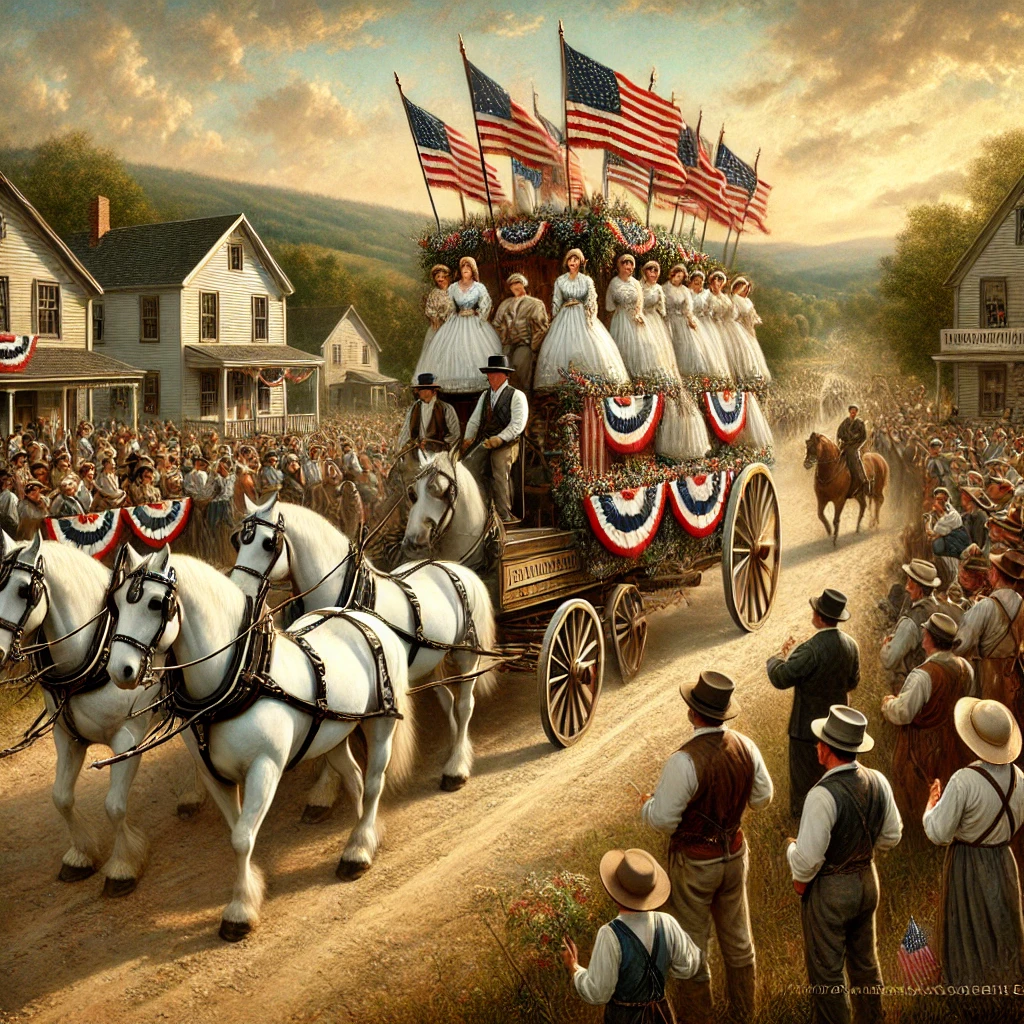
Illustration of a political campaign rally during the Brough-Vallandingham gubernatorial campaign, created by ChatGPT.
Another day stands out distinctly; during the heated campaign for Governor between John Brough and C.L. Vallandingham, when there were so many political meetings held throughout the State. On the occasion to which I refer, one of these was arranged to be held in Carrollton, the county seat. The village was abuzz with talk of politics, and people from surrounding areas flocked to town to listen to the fiery speeches and participate in the excitement. Patriotic songs were sung, flags were waved, and the rhetoric of both parties filled the air, sparking animated discussions among the crowd. It was a rare occasion for many in the village, bringing with it a sense of significance and unity amidst the backdrop of a changing nation.
After reading some things in the foregoing, one might infer that the village was not altogether dry. It was not. It must be remembered that this was a long time before the era of prohibition and in the days of the open saloon. While this village did not have a saloon, one a mile away from it had, and then, as now, those badly wanting strong drink could get it. The majority were strict
teetotalers
teetotaler/ˈtiːˌtoʊtələr/ noun
A person who abstains completely from alcoholic beverages.
, and when the
Women's Crusade
was on, good mothers of the town lent their aid, prayed, sang, and plead with the saloon keepers, and succeeded in having the liquor destroyed.
The little girl, grown to maturity then, has a very vivid recollection of having stood on picket duty one night; and with what fear it
was done. There are many other pleasant personal recollections which would be interesting; but as all can not be given, none will be
undertaken. The self-imposed task of the little girl is done. It has been a labor of love--done, I must confess, from a selfish motive--to
revive old, old associations and friendships, and leave to her children some idea of the days of yore.
Mrs. Margaret E. Price
Footnotes
[1] Margaret E. (Morrison) Price, born September 13, 1850, died April 14, 1938
[2] Alexander J. Morrison, brother of the author, born 1853, died 1932, buried in Leesville Cemetery, Leesville, Orange Township, Carroll County, Ohio
[3] Alexander Morrison, born September 30, 1808, died September 16, 1853, buried in New Hagerstown Cemetery, New Hagerstown, Orange Township, Carroll County, Ohio
[4] Sarah Ann (Johnston) Morrison, born September 9, 1811, died August 8, 1888, buried in New Hagerstown Cemetery
[5] Congruity, Salem Township, Westmoreland County, Pennsylvania
[6] Samuel M. Morrison, oldest brother of the author, born December 21, 1837, died August 30, 1864, buried in New Hagerstown Cemetery
[7] Nancy E. (Morrison) Forbes, born March 18, 1844, died June 22, 1871, buried in New Hagerstown Cemetery
[8] Mary J. Morrison, born February 12, 1846, died October 4, 1872, buried in New Hagerstown Cemetery