Written November 2025
My paternal grandfather John Earl Borland didn't live to see the age of commercial DNA testing, but his paternal half-brother, my great-uncle Jeff Borland did, and I bought him a test while he was still living. It was an autosomal test from Ancestry DNA, the type that provides relationships between cousins on all sides of the family and ranks cousin/relative matches by shared cM. I also tested my own autosomal DNA with Ancestry back in 2013, and I funded the testing of my brother and other close family members in the early days of autosomal DNA testing.
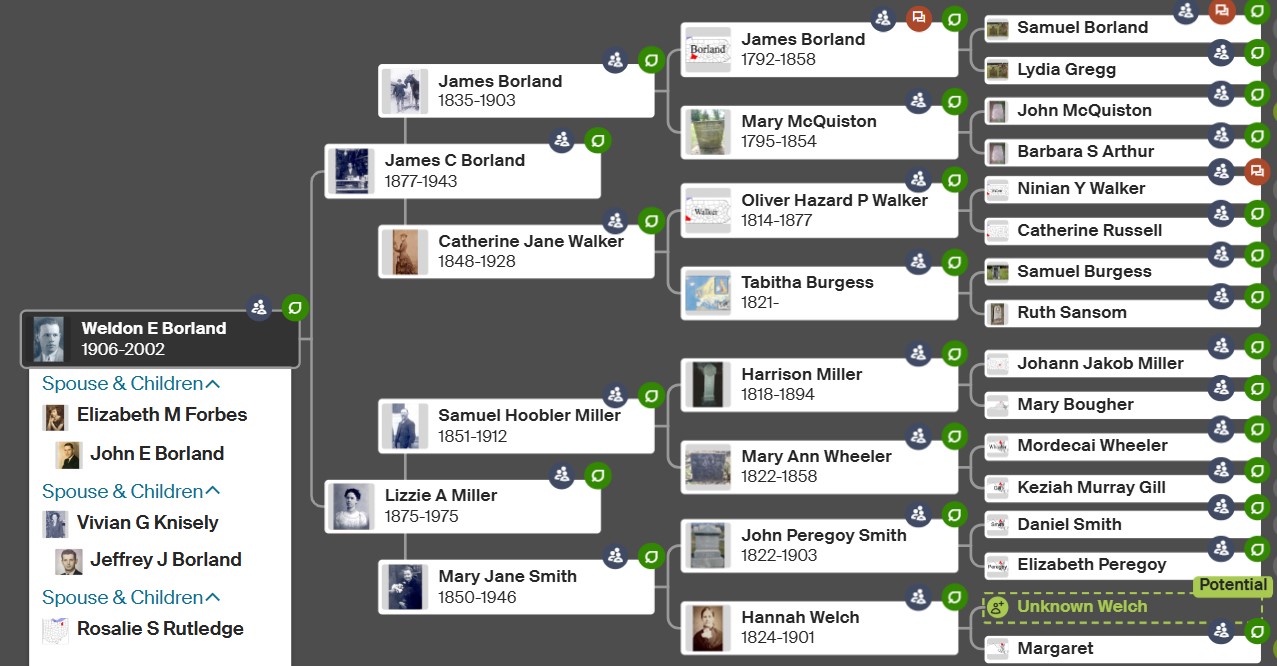
My common ancestor with Jeff Borland is my great-grandfather Weldon Earl Borland, Jeff's father. Weldon was born 1906 in the small town of Bowerston, Ohio, in Harrison County, not too far from Steubenville. Weldon lived to be 95, which was fortunate for me, as I had the opportunity to know him well. I was 27 years old when he died, and during his lifetime, he took us on many fishing trips to Canada, we spent significant time at family events in Ohio, and he even got to meet my wife, who, at the time of his death, I had recently married in 2001.
The time I spent with "Grandpa Weldon" as a teenager was one of the main influences with respect to how I wound up in the genetic genealogy business as an adult. From the high school project where my history teacher suggested we interview an older family member to make a family tree, to later as an adult, driving around the Ohio countryside in my Camaro with Weldon trying to find houses where his grandparents lived when he was a kid, I grew more and more interested in learning about my family history.
However, this article is not intended to be a memoir, but rather a research paper, so let's get into the details. As of 2024, much of Weldon's family history in Ohio has been researched and is well documented. However, even a cursory inspection of his ancestors in my Ancestry.com tree reveals that his "brick wall" ancestor is Hannah Welch. Very little is known of her parentage.
Recently, I published an article on the Borland Genetics website titled Beyond Hannah Welch, explaining how I used "traditional" genealogy methods to determine that Hannah's mother's name was Margaret. It is also known that both Hannah and Margaret were born in Harford County, Maryland, but Hannah grew up in Franklin Township, Harrison County, Ohio, and that she married John Peregoy Smith and they settled in neighboring Stock Township, also Harrison County. From census data and other sources, Margaret was born around 1793, and Hannah in 1824. Let's take it a step farther and apply some genetic genealogy to see if we can get some more clues as to Hannah's parents' identities.
The methodology for this paper is based on the Leeds Method, which is a method devised by Dana Leeds whereby one can "cluster" shared DNA matches with the intention of sorting those methods by the ancestors through which the matches relate to the subject donor. By "shared matches," I mean that if Uncle Jeff matches a relative A (perhaps me), and BOTH Jeff and I match relatives B, C, D and E, then those matches are our shared matches. Leeds clustering, however, takes shared matches to the next dimension (a matrix), whereby we analyze subsets (or "clusters") of the shared matches. For example, we might notice that matches B and D also match each other, but neither B nor D match C or E. But, we might find that C also matches E. In this simple example, we have two match clusters {B,D} and {C,E}. Perhaps Jeff and I share matches with {B,D} and they match each other because they are both descendants of Weldon's father James, whereas {C,E} form a match cluster because Jeff and I both inherited our shared DNA segments with members of this cluster from Weldon's mother Lizzie. Of course, real life examples are not so simple, and perhaps we have another shared match F, which matches only B but not C, D, or E. Do we include it in a cluster {B, D, F} even though it doesn't match D? What if match G matches both B and C? Must we collapse everything to a single cluster {A, B, C, D, E, F, G}? For problems involving close relative matches, where the goal is simply to sort by grandparent, say for the purposes of determining the parentage of an adoptee, much of the confusion is sorted out simply by setting thresholds. That is, limiting the study to matches within a range of cM likely to produce only meaningful clusters relative to the problem at hand. In deeper analyses, such as the one we aim to persue, i.e. using the relationships between Jeff's matches to isolate the relatives through Hannah Welch, requires more preparation than simply setting cM thresholds in clustering software.
The setup for the current task took place over several years, as I manually went through hundreds of Uncle Jeff's DNA match's family trees in a preliminary attempt to discern through which of Jeff's great-great-grandparent(s) and even great-great-great-grandparent(s) each match was related. I used Ancestry's color-coding system to keep track of my work. I was only able to find the connection in trees in a fraction of the DNA matches, which is common, even if you have a solid tree in all directions as Jeff does. Sometimes the common ancestor is just too far back, and often this process requires building out a tree for a match who only has documented say his or her parents or grandparents. After this process has been undertaken for a while, when you inspect a new match and look at the "shared matches" tab on Ancestry, you will begin to see patterns. That is, a match who doesn't have a tree at all may mostly or only have shared matches with Jeff on Jeff's grandfather James Borland's side. We would therefore assign color-coding accordingly to indicate that this match is likely through James. Ancestry's color coding system involves "groups" which allow you to apply up to 24 different colored circles representing up to 24 different tags. I ordinarly find it most useful to have my tags represent ancestors. In applying these colored tags and repeating this iterative learning process and "clustering" the matches to a kit by their shared matches, we are essentially manually performing a variation on the Leeds clustering method.
In recent years, Ancestry has introduced a tool called "Side-View" which assists in AUTOMATICALLY sorting one's matches into paternal vs. maternal. This was immensely helpful in my sorting process, as I only had to concern myself in Jeff's paternal matches, thereby reducing my workload in half. After much time spent dutifully clustering as many of Jeff's matches as possible, I achieved the following clusters at the great-great-grandparent level (the level of Hannah's relation to Jeff). By paternal great-grandparent:
| Great-grandparent name | Descendants identified among Jeff's matches | Total number of Jeff's matches that cluster with those descendants |
|---|---|---|
| James Borland (1792) | 16 | 41 |
| Mary McQuiston | 16 | 71 |
| O.H.P. Walker | 8 | 17 |
| Tabitha Burgess | 8 | 55 |
| Harrison Miller | 14 | 263 |
| Mary Ann Wheeler | 14 | 194 |
| John Peregoy Smith | 12 | 580 |
| Hannah Welch | 12 | 42 |
In addition, there were 81 paternal matches that I discovered clustered among themselves but did not cluster with any of the known paternal cousins to Jeff. I call this the "Tara Cluster" because the closest match to Jeff in the cluster (at 33 cM) is a donor whose first name is Tara. This will come up later in our analysis.
First, let's make some observations regarding the comparitive sizes of our known decendants and clusters at this level. Notice that the tested descendant count matches between great-great-grandparent pairs for each pair of great-great-grandparents. This is because I only derived these tallies by filtering my Ancestry matches by group. In doing so, I made the assumption that say a descendant of Hannah Welch is a match to which I had previously applied both the John Peregoy Smith and Hannah Welch tags to. Hannah only married once, so this will be an accurate reflection. (Harrison Miller married twice and I admittedly may have missed one or two descendants of Harrison if they came from his second wife; however this study is on Hannah, so I wasn't worried about that). There is some variation in the first column across grandparent pairs with the values ranging from 8 to 16, with Hannah's known tested descendant count exactly in the middle at 12. Certainly, more than 12 of Hannah's descendants have tested their DNA and can be found in Ancestry's database, but due to the randomness of DNA inheritance, only a fraction of those individuals will match Jeff. Also, there are probably quite a few of her descendants that match Jeff but are buried deep into Jeff's match list, and I probably will not discover them during my lifetime since doing so often requires spending hours per match building out their trees.
In the next column, the cluster size, the variation is much wider, and is clearly NOT dependent on the value in the first column alone. Other issues are at play. John Peregoy Smith and Mary Ann Wheeler were distant cousins. This alone would not skew the clustering very much if at all. However, both of Mary Ann's parents (Mordecai and Keziah) were cousins to one another, and also each of them were cousins to John Peregoy Smith. Mordecai, Keziah, and John's mother Elizabeth, were from "alligned" families who traveled from Baltimore to rural Ohio in the pioneer days and consistently married within their group for generations, resulting in pedigree collapse. A similar process may occur called endogamy, whereby descendants of a "bottlenecked" population only select as mates from within their geographically or socio-econmicly confined group for a much longer period of time, even if never marrying close cousins. It suffices to know that both pedigree collapse and endogamy can cause problems when analyzing DNA match clusters. The reason is that A and B might not both match C because {A, B, B} share a common grandparent, but rather, because all 3 have say a grandfather from the same endogomus population, and while A and B are known cousins, C only matches A and B because C 's family came from a bottle-necked valley in the Carpathian Mountains, and both A and B have grandparents from that valley, and 50% of people from that valley match one another somewhere on their genomes due to matching pieces of the limited available tapestry of DNA segments that could be passed down from the members of the founding population.
The high values for Mary Ann Wheeler and John Peregoy Smith probably reflect the pedigree collapse common to the alligned families who settled this part of Ohio from Baltimore in the early 19th century (who were also aligned for several generations back into Maryland). The high value for Harrison Miller probably indicates that he is from an endogamous population. His parents were Germans from Pennsylvania and the Shenandoah Valley. I have yet to do sufficient research to determine the nature of any specific endogamous population to which any of his ancestors belonged. Further research is required before making sense of Harrison's clustering results, but fortunately, Harrison is not the focus of this particular study. Our Hannah has a relatively managable number of 42 matches in her cluster.
Is it odd that the individual donors in such a large cluster of inter-related matches (the Tara Group of 81) shares no matches with known descendants of any of Jeff's known ancestors? I would say that it is somewhat odd, but not enough to turn any heads. One can only have 8 great-great-grandparents on one's paternal side. The issue here is not one of misattributed parenthood, but it almost seems as if Weldon had an extra great-grandparent to whom this cluster corresponds. I assert that this cluster probably is a relic of endogamy, epresenting one or more segments from not a common recent ancestor, but that reflect decent from a common endogamous population WITHOUT sharing any common ancestors in recent history. Imagine, for example, Weldon had a 5th great-grandparent that was a founder of a Quaker population that only married other Quakers. I might not have that Quaker ancestor in my tree yet, but Weldon may have inherited say 3 segments from that ancestors, and due to endogamy, each of those segments is going to match 100 Quakers, even if we'll never find the common ancestor in our tree. There are other tools for examining such clusters, but that is beyond the scope of this paper, and we will only discuss the Tara Cluster to the extent it affects the interpretations when examining Hannah's "supercluster."
Strictly speaking, most of the clusters on our chart are superclusters rather than simple cluysters. That is, they exhibit some structure within the grouped matches. That is to say, maybe, some of the matches in our Hannah supercluster are related via Hannah's father, whereas others are related via Hannah's mother. Part of the challenge (and fun) of interpreting the cluster is looking for evidence that it has such useful structure. In the absence of knowing practically anything that might distinguish Hannah's parents from one another, we'll have to rely on any statistical patterns that we might observe when analyzing the results.
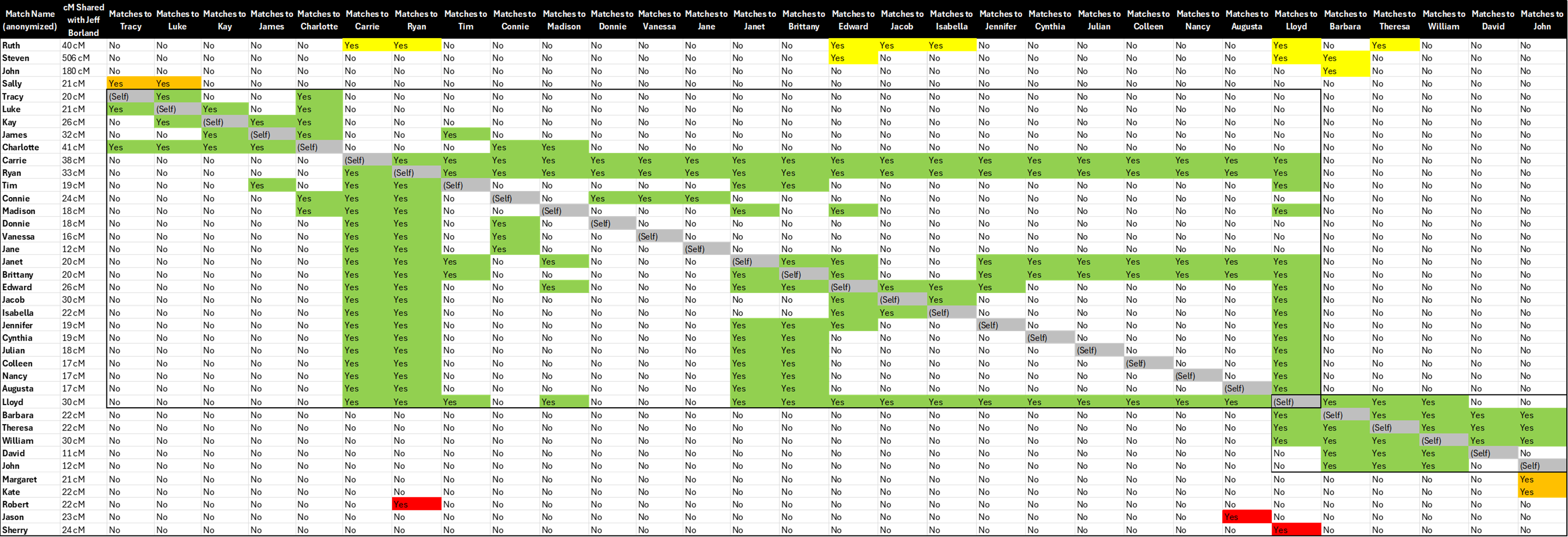
I arranged the rows and columns manually to show that this supercluster consists of two sub-clusters, joined via the presence of a single donor who belongs to both sub-clusters. I indicated the boundaries of the cluster on my diagram using thick black borders. Before we discuss the properties of the clusters themselves, let's first examine the information above and below the boxes. At the very top, the first three rows indicate the shared matches within the cluster with the known descendants of Hannah that form the basis for the diagram. Those descendants are Ruth, Steven and John. Steven is my brother, and Ruth and John's last names are witheld for privacy. Note that I do not match the members of this cluster, as I did not inherit from my father the specific segments upon which the matching donors match my brother. Since I am using Ancestry data, which imposes a threshold of 20 cM between two matches to be considered a "shared match," in fact, there would probably be more yellow "yes" cells in the diagram if not for the threshold. That is, for example, my brother, who we see matches at least one of the donors in each sub-cluster (indicated by the three yellow "yes" cells above the chart), probably matches more of the other donors in each cluster, but the matches are being obscured by the 20 cM threshold. I would have to go into my brother's account to confirm that, as the match data generated here pertains to matches and shared matches to Jeff Borland. However, doing so would shed no additional light on this particular analysis I don't think.
The other two descendant matches to the cluster (Ruth and John) are descendants of both Hannah and her husband, as all of Hannah's children were by John Peregoy Smith, her husband. So without knowing the parentage of Hannah, and without knowing whether each particular shared segments were inherited from Hannah vs. John (since Ancestry does not provide segment data), How do I know I am not looking at a cluster that belongs instead to her husband? The simple answer is process of elimination. As we already discussed, we already observe the clusters pertaining to each of John Peregoy Smith. In fact, we observe two distinct clusters, one pertaining to Daniel Smith, his father, and one pertaining to Elizabeth Peregoy, John's mother. The matches in this cluster do not cluster with any of the tested descendants of Daniel Smith and/or Elizabeth Peregoy, other than to those tested descendants who also descend through Hannah.
| Great-great-grandparent name | Descendants identified among Jeff's matches | Total number of Jeff's matches that cluster with those descendants |
|---|---|---|
| Daniel Smith | 117 | 386 |
| Elizabeth Peregoy | 117 | 306 |
Note that other branches of this Smith family were prolific, and that 117 documented descendants of Daniel and Elizabeth could be found among Jeff Borland's DNA matches in the database! The fact that the instant cluster being inspected does not collapse into the Smith and Peregoy clusters is telling. However, we will ultimately inspect the trees of as many donors in our suspected Hannah supercluster as possible, seeking confirmation of our assumption.
Next, let's turn to the two orange "yes" cells above the clusters, pertaining to a donor we are calling Sally. Sally is not a descendant of Hannah Welch. However, she matches two individuals in our larger sub-cluster, but is a member of another of Jeff's paternal clusters already. Sally has a public tree, so we will explore this later, to the extent possible. Similarly, at the bottom below the smaller cluster, that there are two orange cells as well. The two testers in question here (Margaret and Kate) are a mother-daughter pair. They are also members of the previously mentioned mysterious "Tara Cluster" and since they both have public trees on Ancestry, we can also investigate this later.
Our last observation before moving on to analyzing the actual sub-clusters themselves, is that we have three red "yes" cells at the very bottom. This is because Ryan, Augusta and Lloyd, in addition to also sharing matches within the cluster in question, also coincidentally match one of Jeff's maternally clustered cousins (Robert, Jason and Sherry respectively). We are not excluding Ryan, Augusta or Lloyd from this study, but just making a note of the issue for sake of completeness. There is no need, however, to examine their trees to make certain that the identified maternal clusters don't collapse into this to form a larger super-cluster, because Ancestry via Side View, has already determined that the relevant outside clusters are maternal and therefore the unions are coincidental. This is why I chose the red, yellow and orange colors for the various cells. Green cells are within the cluster. Orange cells require further investigation to determine whether collapsing with a potentially related paternal cell is warranted. Red cells don't require that kind of investigation because Ancestry has already determined that the matches are paternal, but that they also coincidentally match some relatives who match Jeff on the maternal copy of his chromosomes, for a completely different reason than having a shared ancestor in common with Jeff. To summarize, if an outside, potentially connecting cluster has overlap with the super-cluster identified, we will attempt to rule out the overlap as coincidence after we examine the two core sub-clusters with the green "yes" cells.
We have a sub-cluster with just 6 matches, and another sub-cluster with 25 matches. Let's take on the smaller one first. The next step is to examine their trees. We are in luck, because five of the six donors in this cluster (all but Barbara) have public trees on Ancestry. After examining the trees, it is obvious that four of the matches are related, being from the same Fisher family. Specifically, Theresa and William descend from a Loberta Fisher (born 1890), daughter of Thomas Fisher and Rachel Bennington, whereby David and John both descend from Loberta's brother William John Fisher (1886-1970). The parents of Loberta and William were Thoams Fisher (1843-1915) and Rachel (Bennington) Fisher (1852-1893). Recall that Hannah was born 1824 in Harford County, Maryland. Thomas Fisher was born in Darlingotn, Harford County, Maryland. Rachel, his wife was from Havre de Grace, also in Harford County. This is important validation of our assignment of this cluster to Hannah. Jeff's other paternal ancestors in this generation were not from Harford County, Maryland. The connection is not coincidental. Taking this family back an additional generation, the grandparents of Loberta and William Fisher were Madison Fisher (b. 1814) and wife Eliza (Boyd) Fisher (b. 1815), who both resided in Dublin, Harford County, and on the maternal side, Thomas Bennington (b. 1808) and Sarah (Barrett) Bennington (b. 1818), both born in Pennsylvania. Our next observation at this point is that neither of the four grandparents have the surname Welch. Also, they are all younger than Hannah's mother Margaret (b. 1793). Since the surname Welch is not found, I think we can safely assume that none of the four individuals have any reasonable likelihood of being Hannah's paternal aunts or uncles (younger siblings of Hannah's father). The next closest potential relationship I think we can rule out is that grandparents Thomas and Sarah (Barrett) Bennington are related to Hannah's mother Margaret. Margaret was born in Harford County at an earlier date than either of these individuals came to that county from Pennsylvania. However, since both Madison and Eliza (Boyd) Fisher were born in Maryland, it is very well possible that either of these individuals might be a younger sibling of Hannah's mother Margaret. Given the timeframe, this initial hypothesis will require extensive research to prove or disprove. First, let's see if we can get any more clues from this sub-cluster.
We must next ask ourselves why Lloyd (the other member with a public tree) does not descend from this family. Let's take a look at who he does descend from and see if we can make any connection. I built a tree for Lloyd that dates back to the timeframe in question. I will not share all the names in it for his privacy, but I will share some statistical information. Going back 4 generations from Lloyd, of his 16 great-great grandparents, four were from the Shenandoah Valley region of Virginia, one was from Ireland, three were from parts of Pennsylvania near Philadelphia, four were from the state of Delaware, four were from Caroline County, Maryland. While we are roughly in the correct part of the world, the connection to the Welch family or the Fisher/Bennington family is not obvious. Further extensive tree-building will be required to find such connections using paper research alone.
While we are discussing the smaller sub-cluster, let's briefly have the discussion on the relationship with the outsider cluster whereby John happens to match a mother/daughter pair who belong to the Tara cluster. The first possibility is that the connection between John and the mother/daughter pair in question might be purely coincidental and have nothing to with Jeff's connection to Margaret and Kate. That is, maybe the cell deserves a red color given only one match and her daughter are in overlap with the non-ancestor-designated cluster, on the theory that they only overlap one of the four Fisher/Bennington descendants. To be thoroughough, we should check for the possibility that the clusters are related and our Hannah cluster actually embodies a third sub-cluster, i.e. the Tara Cluster. While expanding all of the trees in the Tara cluster is not a reasonably short-term undertaking, let's just look at the tree of the mother/daughter pair for now instead. The tree of Margaret and Kate is not very comlete, but with some work, I did make a discovery worth pointing out. They are descendants of an Elizabeth M. (Welch) Busby, born 1802, a resident of Ohio, allegedly the daugher of a Jacob Welch of unknown origin. While Welch is a relatively common name, the possibility that these clusters are linked via Hannah's father is indeed something that needs to be researched further in the future. They hypothesis would be that perhaps the Tara cluster is a sub-cluster representing Hannah's paternal grandfather, whereas maybe the small established cluster represents Hannah's father's mother. Given the distinct possibility that Elizabeth (Welch) Busby could very well be Hannah's paternal aunt, we can not rule out the merger of the clusters. A thorough investigation of the other Tara cluster trees is warranted in the near future.
As a sidenote, one might ask, well, if all of these matches are to Hannah's father's side, where is the cluster for Hannah's mother? One possibility is that the large sub-cluster represents Margaret's family, but since Lloyd belongs to both sub-clusters, this seems impossible. Absent an error in Lloyd's tree, Lloyd does not descend from a sibling of Hannah. However, let's consider for a moment how Hannah got to Harrison County, Ohio from Maryland. One possibility is that neither Hannah's father nor mother had any relatives in the area and just picked the location because they bought some land after they got married. At one point, I tried to prove or disprove this by hiring a local historian to search land records, and she did not find any evidence of this. The next possibility is that Hannah's father had family in the area. While there were some families with the surname Welch in the area, I have done extensive research into these Welch famlies, and it is my opinion that none of them are related to Hannah (none being from Harford County). I explored this possibility in my previous article, referenced in the introduction to this article. The final possibility is that Hannah's father died in Harford County, and that afterward Margaret migrated to Harrison County with family. After Margaret arrived in Ohio, she quickly remarried to a man by the name of Solomon Delong, of which I know quite little. When she was twice widowed, she married later in her life Nicholas Wheeler, who happens to be my cousin via Weldon's ancestor Mary Ann Wheeler, and also my cousin via Weldon's ancestor Elizabeth Peregoy's paternal grandmother Elizabeth (Wheeler) Peregoy. The Wheeler, Price, Smith and Busby families can said to be "aligned" families that knew each other back in Baltimore, prior to pioneering in Harrison County, and they married amongst each other frequently in Ohio. In fact, my great-grandmother, the first wife of Weldon even descends from some of these families. Also, note that the Welch in the Margaret/Kate tree was married to a Busby. Hannah's father may have lived very close to the Busbys in Maryland. The theory would be that perhaps Margaret, for her later-in-life husband took on a husband from a family aligned with her from the pioneer period, and that there is no separate cluster for Margaret among Jeff's matches because Margaret shares her ancestry with say Mary Ann (Wheeler) Miller, an ancestor of Weldon, and a close relative of Nicholas Wheeler. Pedigree collapse may have collapsed their clusters, contributing to the fact that what I have assumed is the Mary Ann Wheeler cluster contains 194 matches. That cluster has very little structure if any, because Mary Ann Wheeler's parents were closely related, both members of these aligned Baltimore families. While I have no paper evidence of the same and I'm just tossing it into the wind, what if Margaret were a daughter of John Busby and Edity Price? This is only one of many possibilities and I admit it's somewhat of a long-shot, so I'm going to focus the rest of this paper on the other larger sub-cluster.
Let's forcus on the larger sub-cluster, which includes 24 more clustered donors, 10 of which have public trees. (Recall that we already examined Lloyd's tree, and he is the single donor that spans both sub-clusters). While I wish I had good news to report, I reviewed the public trees and found no evidence of close relationships within this sub-cluster. The common ancestor might just be too far back, even if we know it's through Hannah. Our best hope is probably through future further research on Lloyd's tree unless some new donors shed some light on this sub-cluster. One final note, for sake of completeness is the Potential overlap of 2 individuals from this cluster to my enormous (263 donors) Harrison Miller cluster. As I mentioned earlier, I think this cluster might be inflated due to some amount of endogamy among the families of early German-speaking settlers of Pennsylvania. That doesn't rule out Sallie also belong to the Hannah Welch cluster, but it appears the segment or segments under the hood of this sub-claster are too old. I also don't recognize any similarities between Sallie's tree and any of the other trees in our cluster. I do note that she is 17% German though, and her German ancestors were from the midwest United States, which may explain why she appears in the Miller cluster.
After quite a bit of work, we have made some progress. It appears that the small sub-cluster has enough recent match that we can see ties to a specific family in Harford County, Maryland, that is obviously related to Hannah (the Fishers). Due to the overlap with the Tara cluster, and the tree we found there, we found a potentially related Welch family to explore, i.e. the family of Jacob Welch who settled elsewhere in Ohio. We have also come up with a theory on how Margaret came to be a single mother in the pioneer days of Ohio, with no trace of her husband to be found there. In the previous article, we looked at paper records including census records and local histories which lead us to the consistent conclusion that Hannah and her mother were from Harford County, Maryland. Finally, we have identified more work that can be done that might lead us to more clues on both Hannah's father and mother's side. I have also begun reconstructing Hannah's genome using the tools I developed at Borland Genetics, and I am currently working on expanding that project. I will report on that in a future article, should that yield any useful results.