James Borland Civil War Records
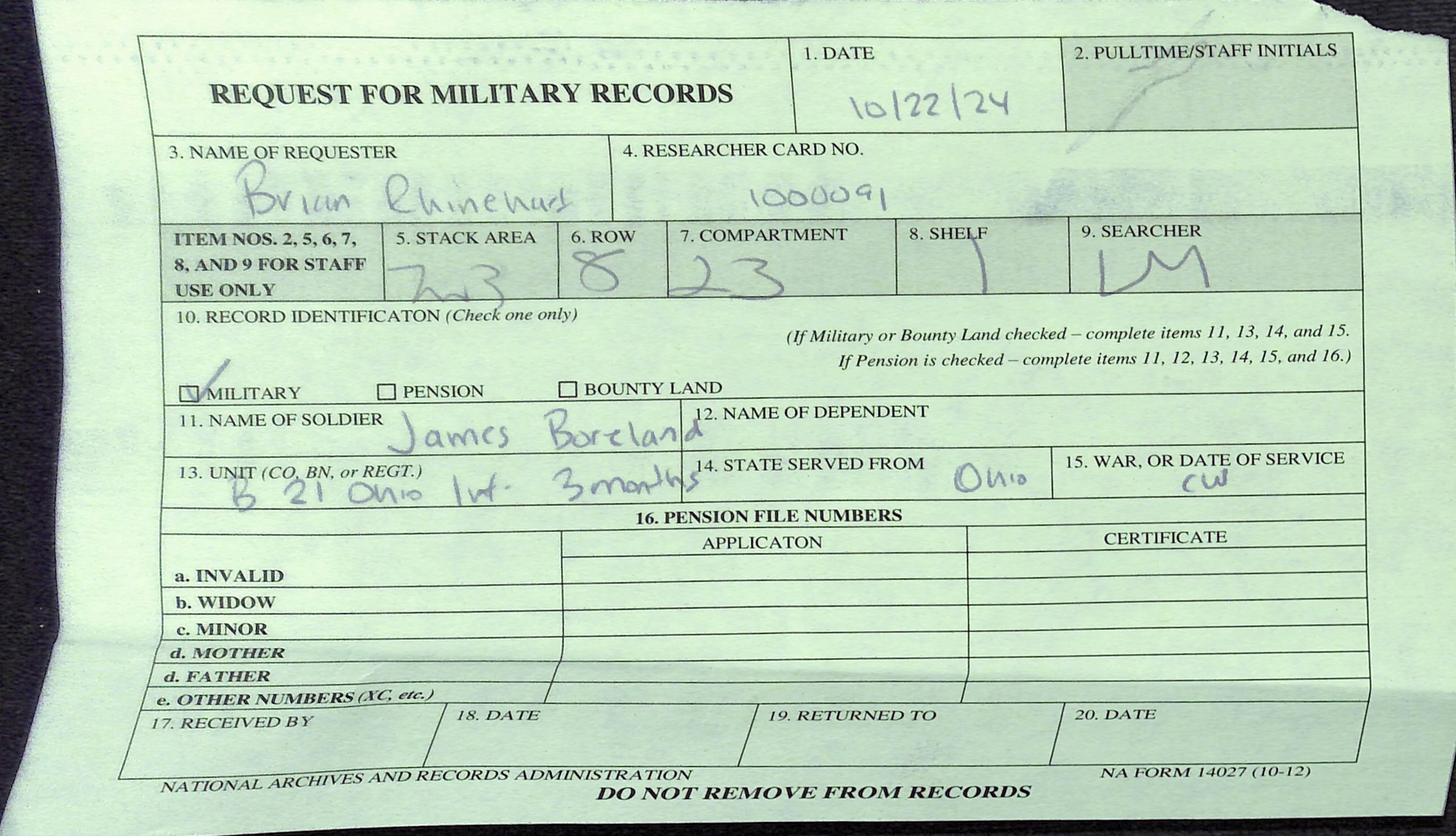
Records Retrieved by Brian Rhinehart
Narrative by Kevin Borland
Service Records
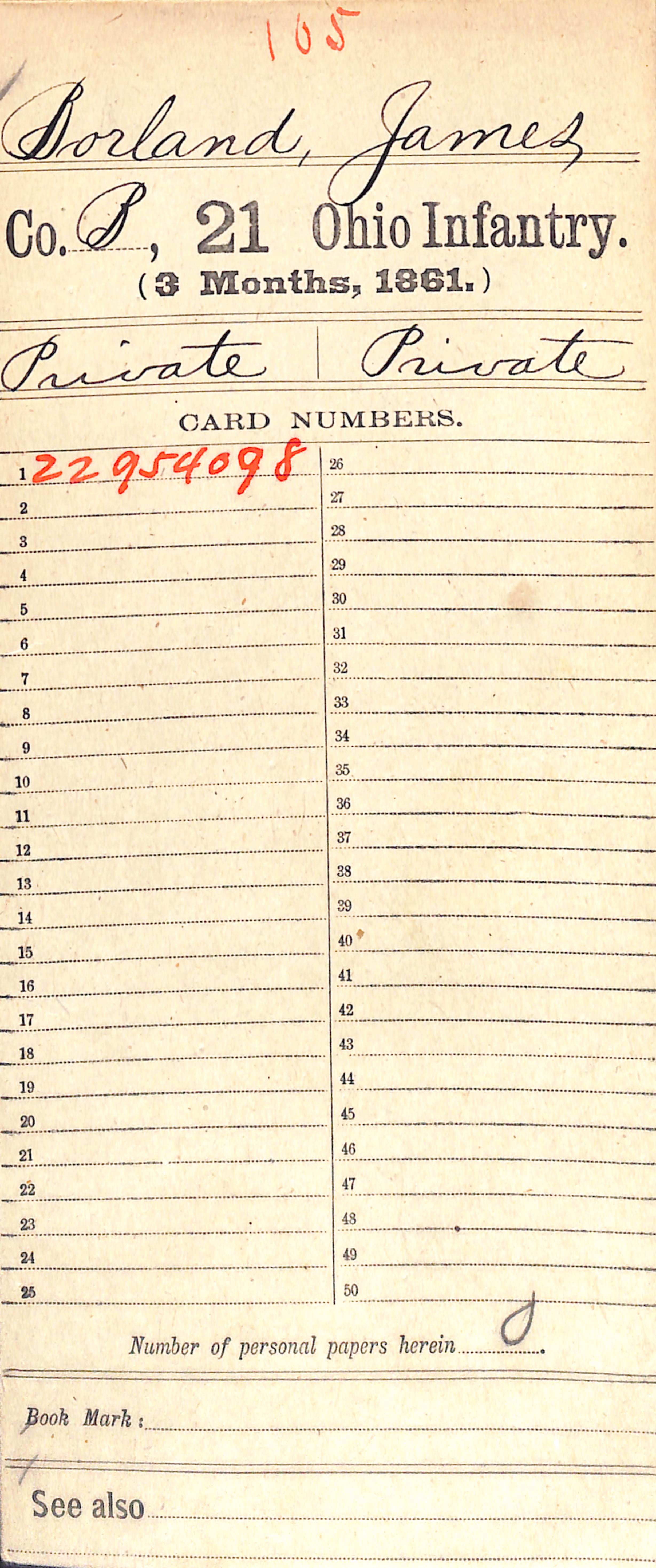
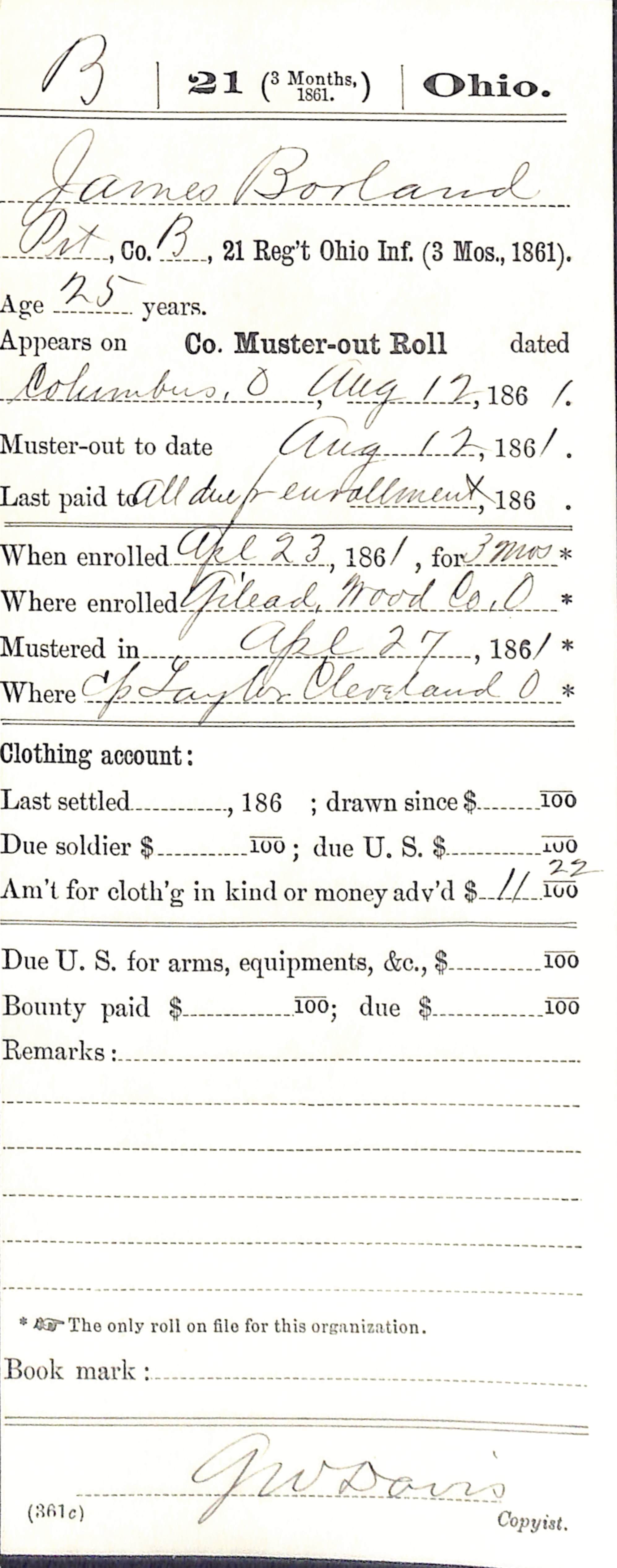
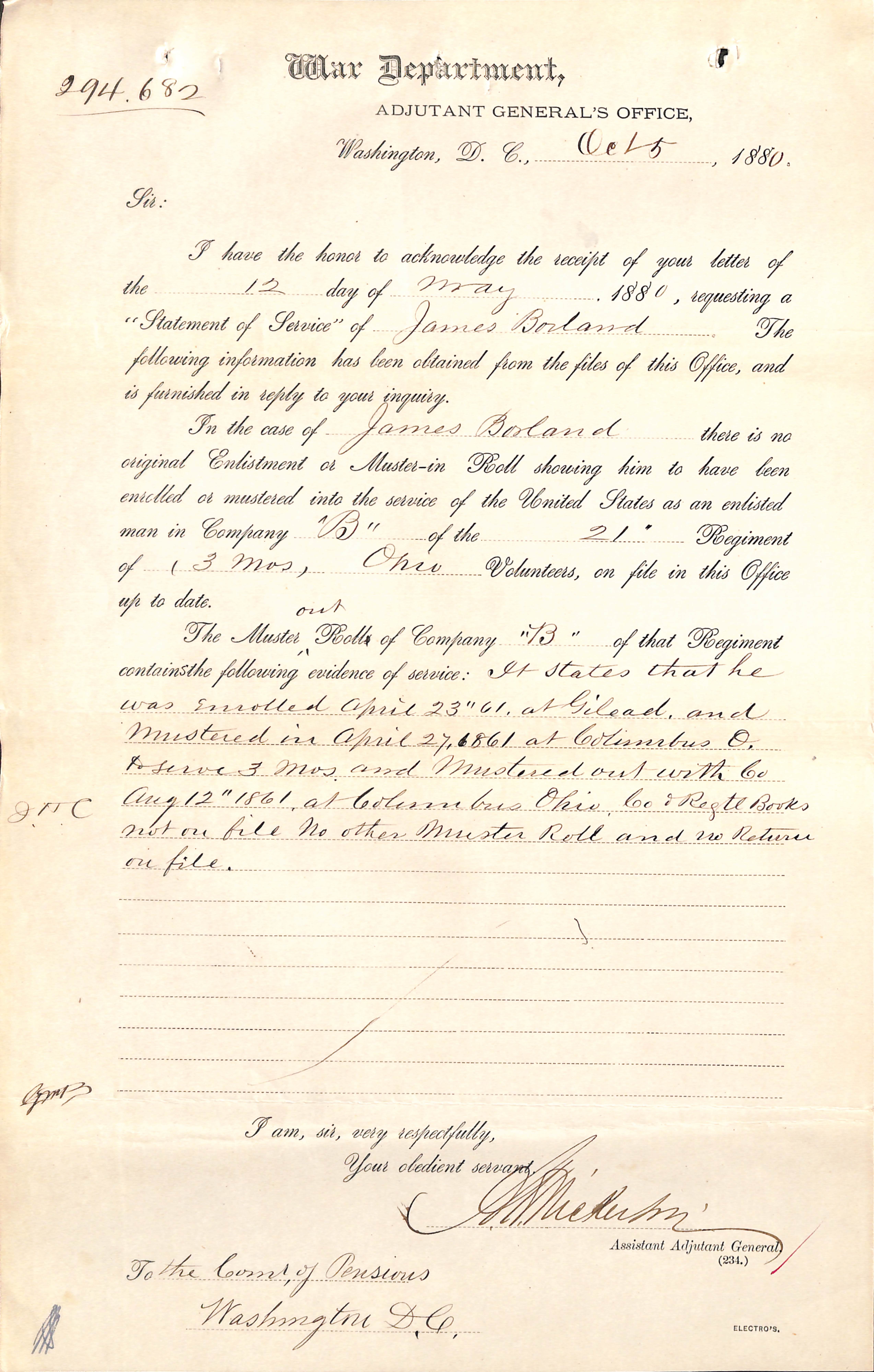
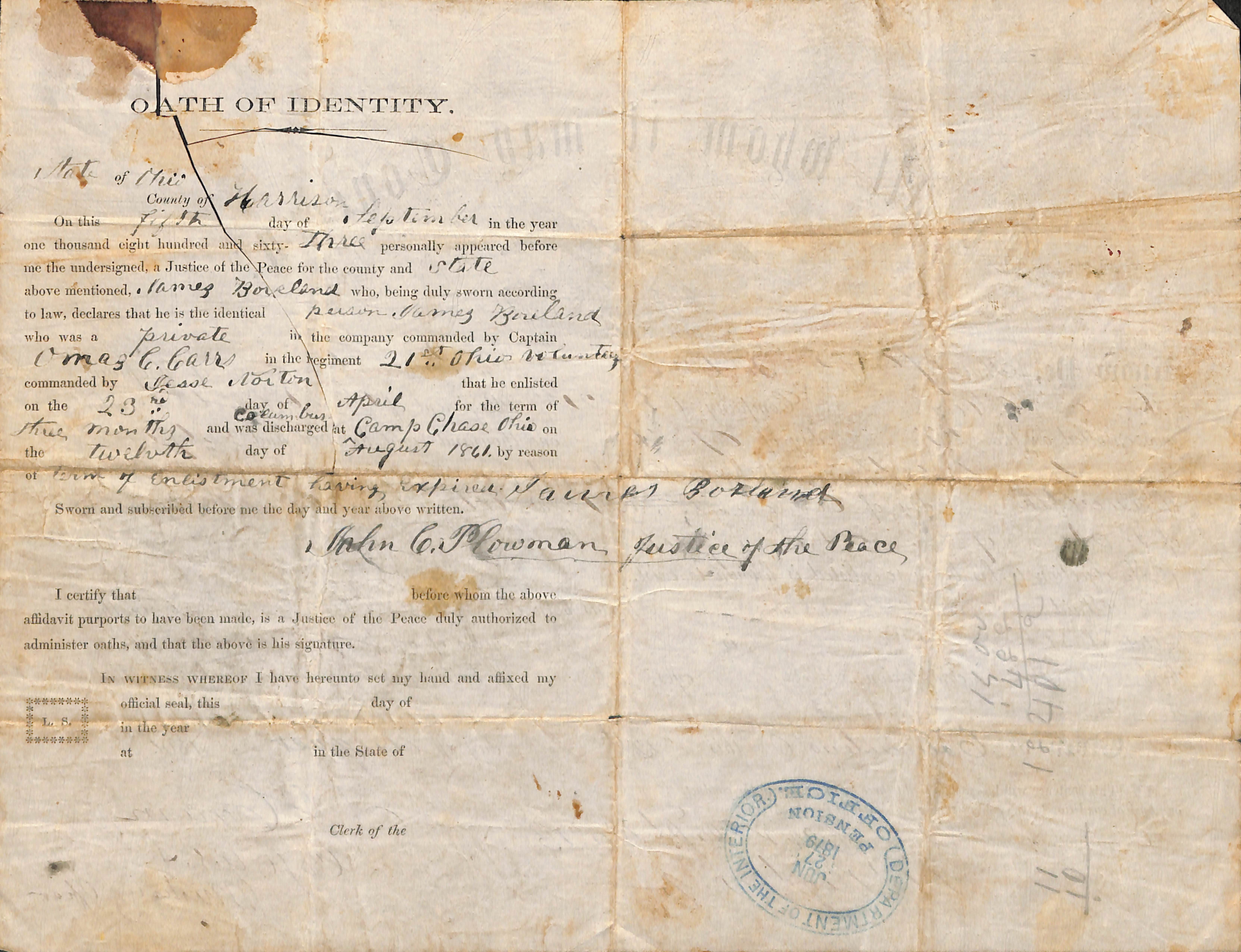
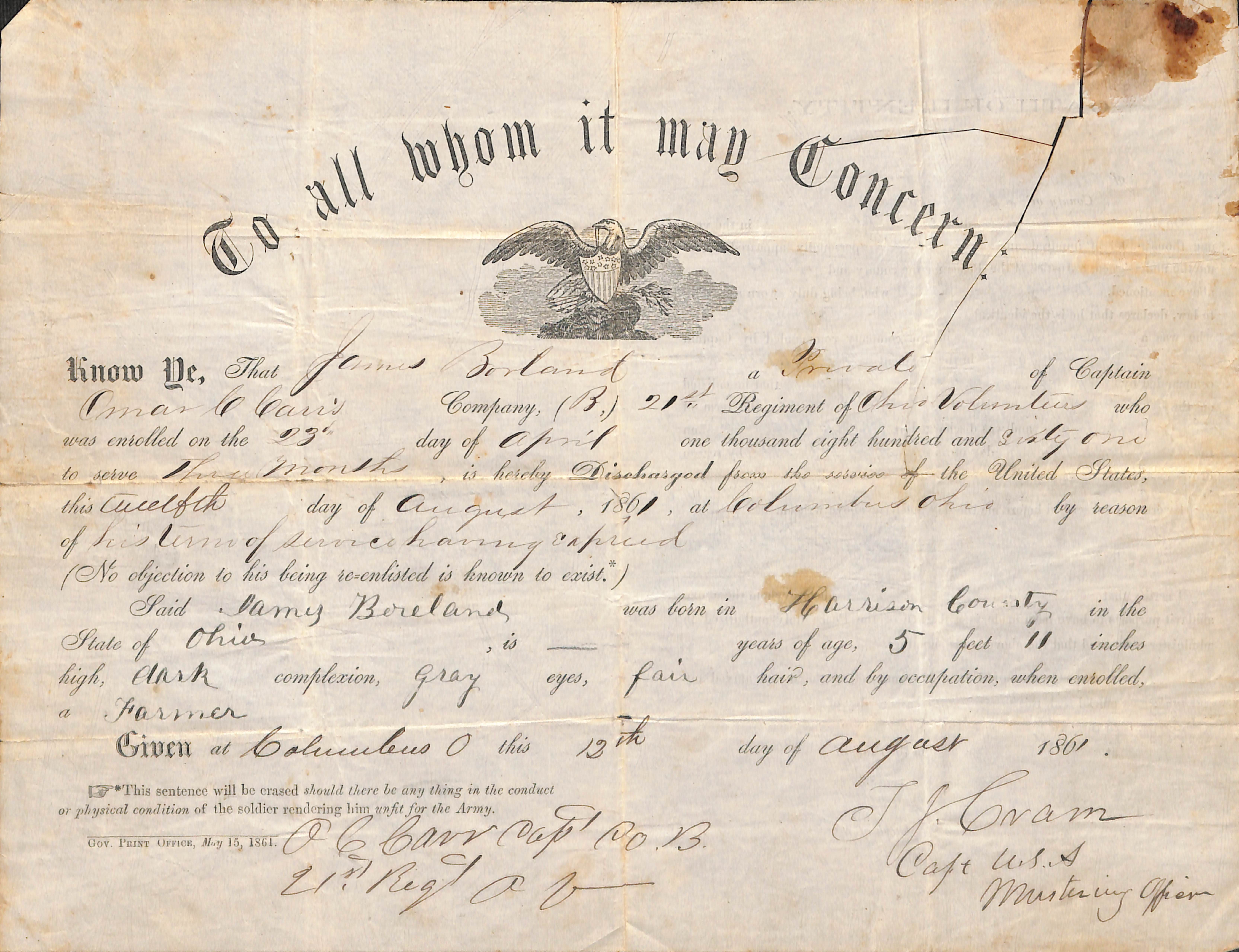
James Borland served as a Private in Company B of the 21st Regiment, Ohio Infantry, during the Civil War. His service was for a three-month period in 1861, with an enlistment date of April 23, 1861, at Gilead, Wood County, Ohio, and a muster-in date recorded as April 27, 1861, at Camp Taylor in Cleveland, Ohio. He was mustered out on August 12, 1861, in Columbus, Ohio. The records indicate that he was paid all dues up to his enrollment date, with minimal advances noted for clothing expenses, amounting to $11.22. At the time of enlistment, James Borland was 25 years old1.
Camp Taylor, located in Cleveland, Ohio, was a temporary training ground established in April 1861 for Civil War enlistees responding to President Lincoln’s initial call for volunteers2. The camp, directed by Governor William Dennison and managed by General J. W. Fitch, was strategically located near Woodland Avenue, possibly at East 30th Street or Forest Street, which no longer exists today3. Initially using Cleveland's old fairgrounds, the camp housed up to 5,000 soldiers from northern Ohio regions at its peak2. It provided barracks, dining halls with large stoves, and a full complement of kitchen staff to manage meals2. Soldiers engaged in rigorous drills, daily routines, and observed strict military decorum. The main focus was on training three-month volunteer regiments like the 21st Ohio Infantry, of which James Borland was a member. Most of the regiments moved to other locations, such as Camp Dennison, by the end of May 1861, and Camp Taylor closed down in October 1861 as federal camps took over training duties2.
After training at Camp Taylor, the regiment was sent to Western Virginia (modern-day West Virginia), arriving in the region in early June. The primary duty here was to safeguard transportation lines and strategic points, which were critical due to the ongoing threat of Confederate forces in the region. The regiment was positioned to help secure railroads and ensure the flow of supplies and communications for Union operations3.
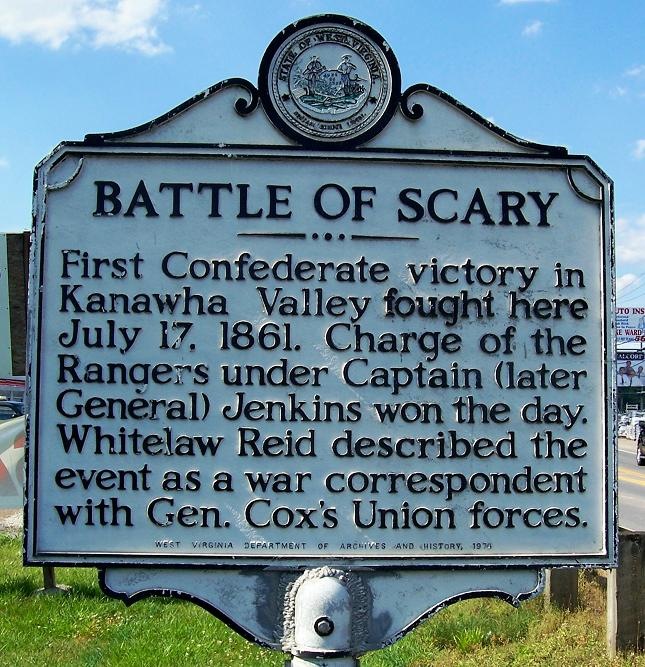
The 21st Ohio Infantry took part in their first major engagement at the Battle of Scary Creek in July 1861. This battle occurred near the Kanawha River in Putnam County, Virginia (now West Virginia), under the leadership of General Jacob D. Cox. Although this engagement was relatively small, it was a key early action for Union troops in the region. Union forces, including the 21st Ohio, faced off against Confederate troops in an attempt to secure strategic routes. The battle did not result in a decisive victory for either side, as Confederate forces were able to repel Union troops, leading to a withdrawal to safer positions. For soldiers like James Borland, who enlisted for the initial three-month period, this was their only notable engagement before being mustered out in August 1861, as their short-term enlistment concluded. Following their departure, the 21st Ohio was reorganized later that year with new recruits for longer-term service and participated in significant battles over the following years, but Borland did not reenlist.
Following their service in Virginia, the regiment eventually returned to Ohio in August 1861, where they were mustered out in Columbus. By then, their brief but formative three-month service term had concluded3.
Invalid Pension Claims
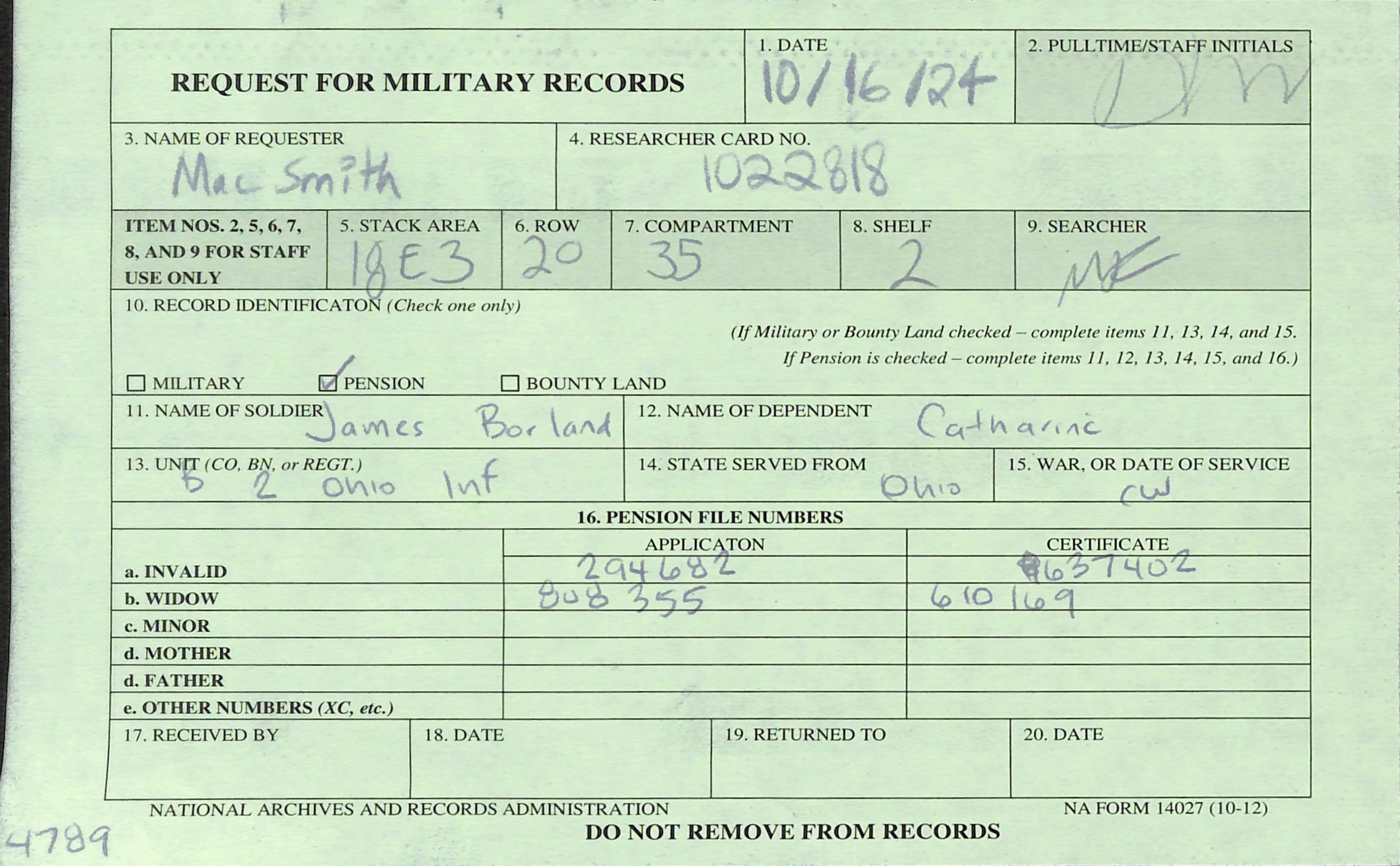
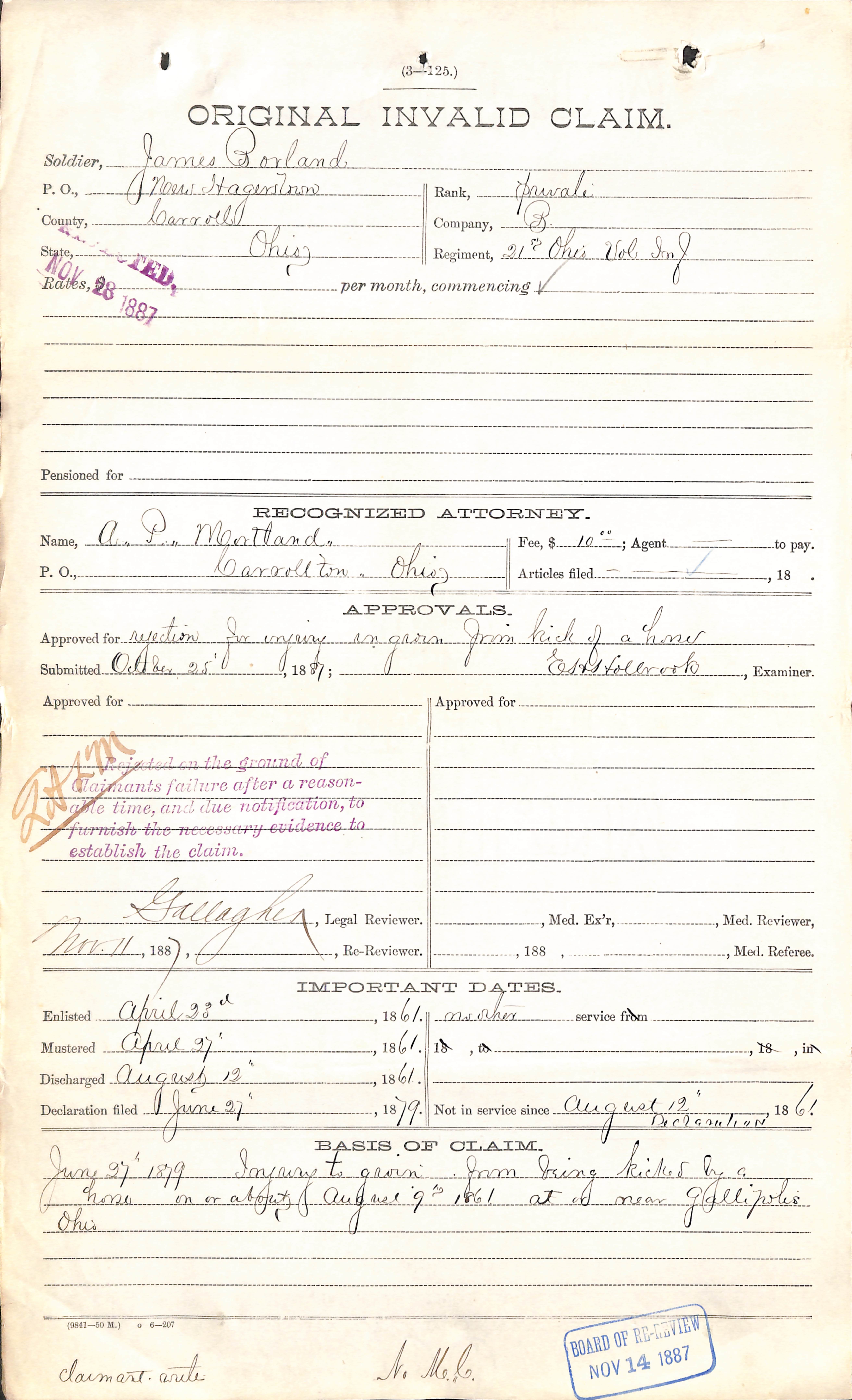
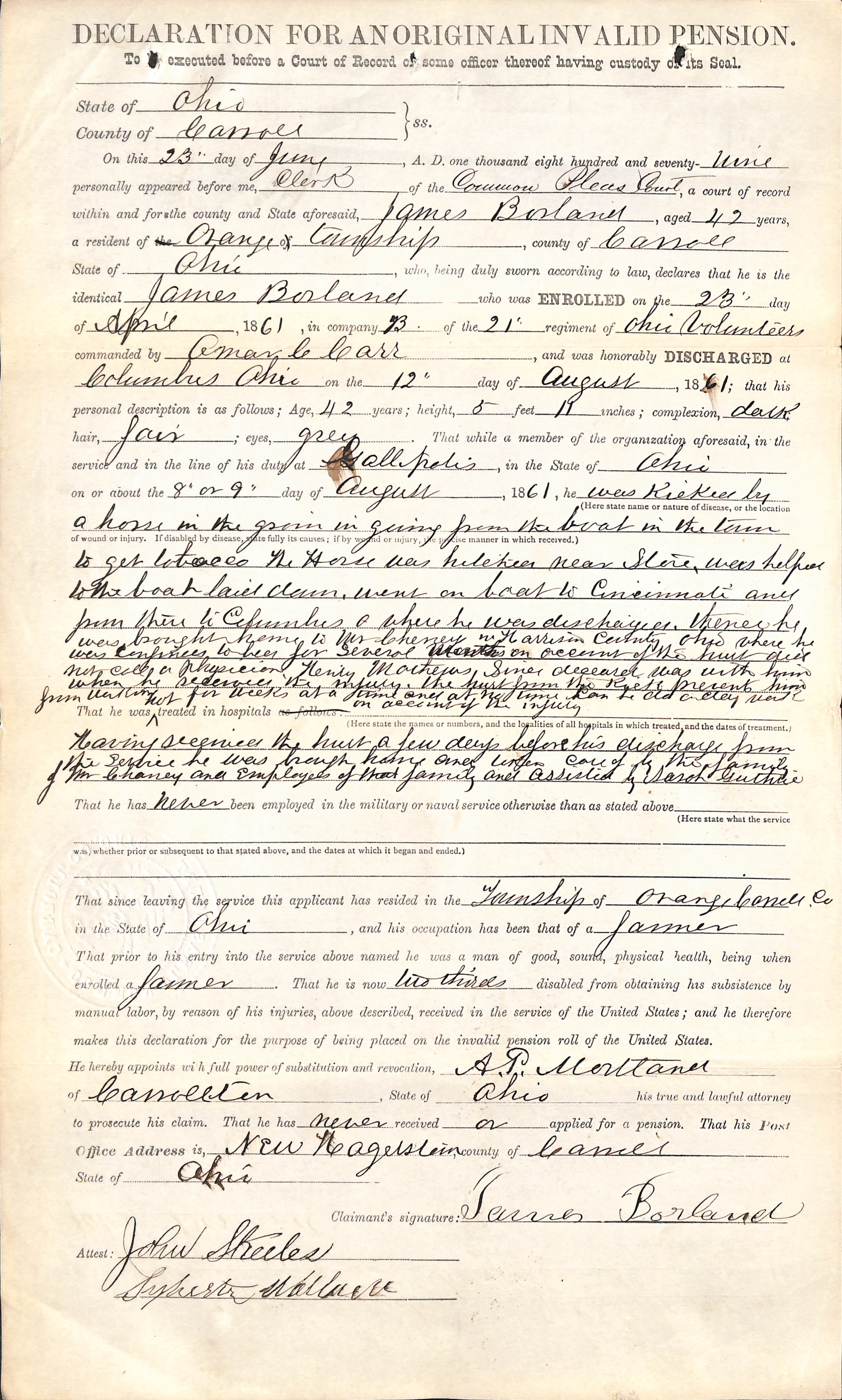
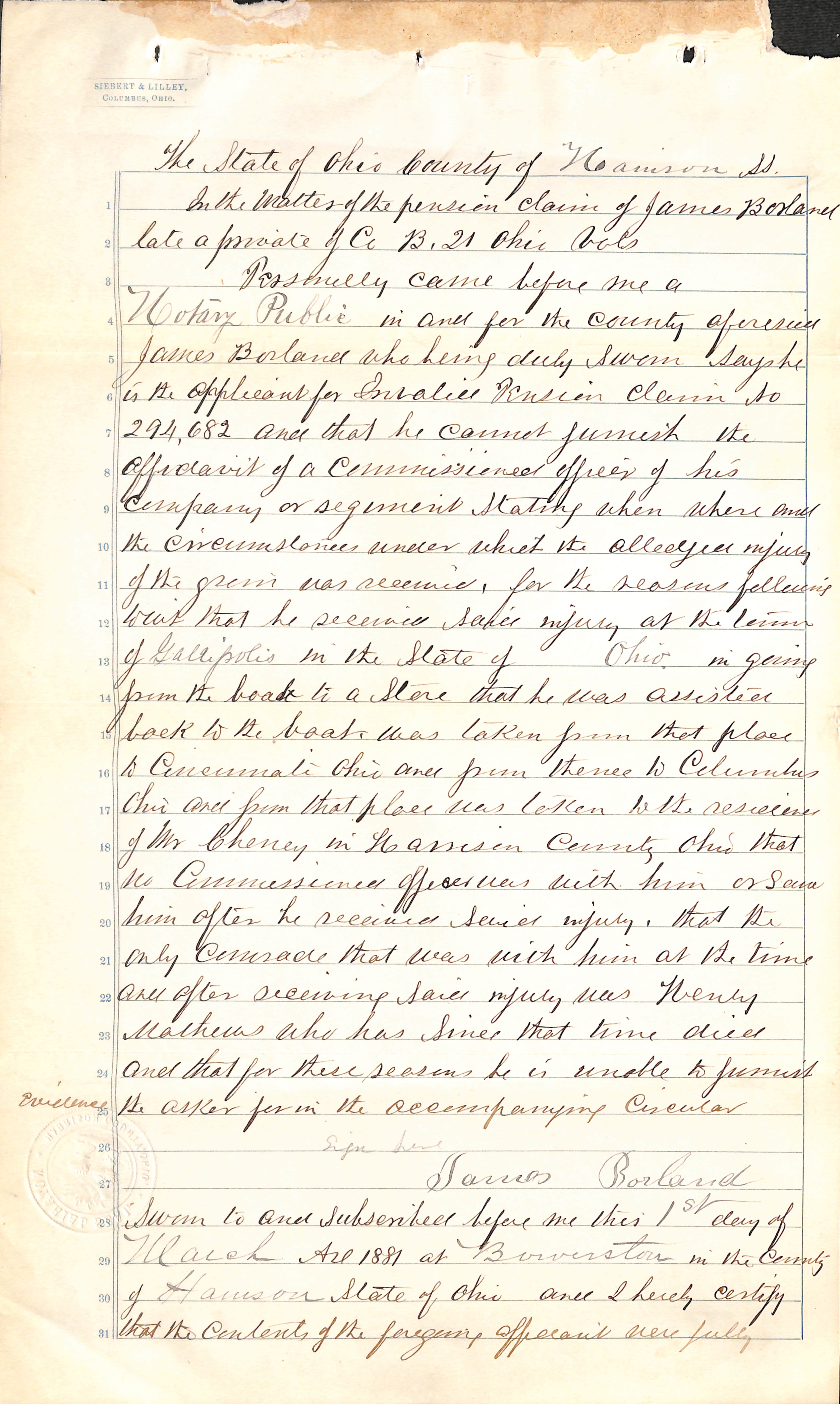
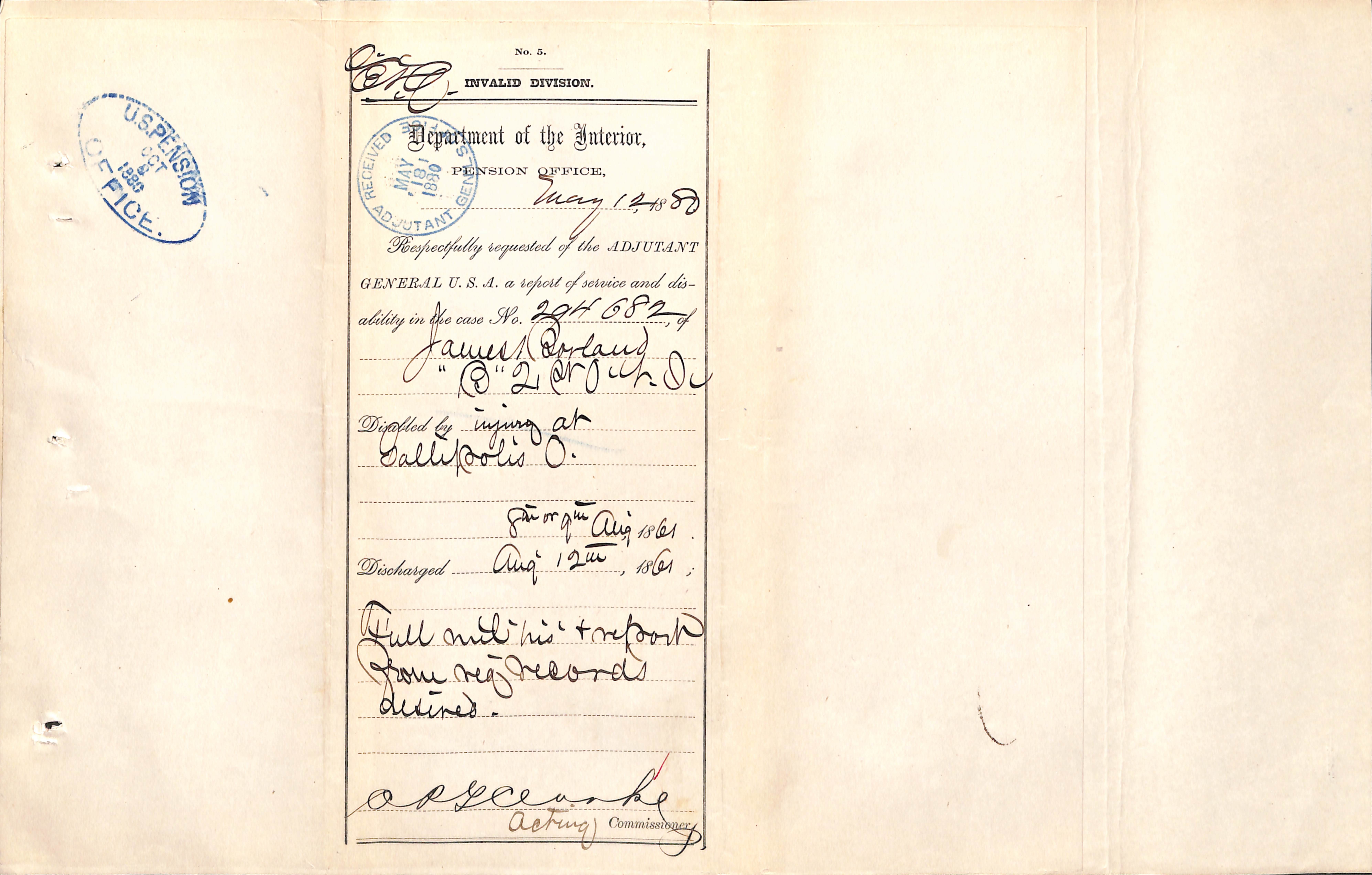
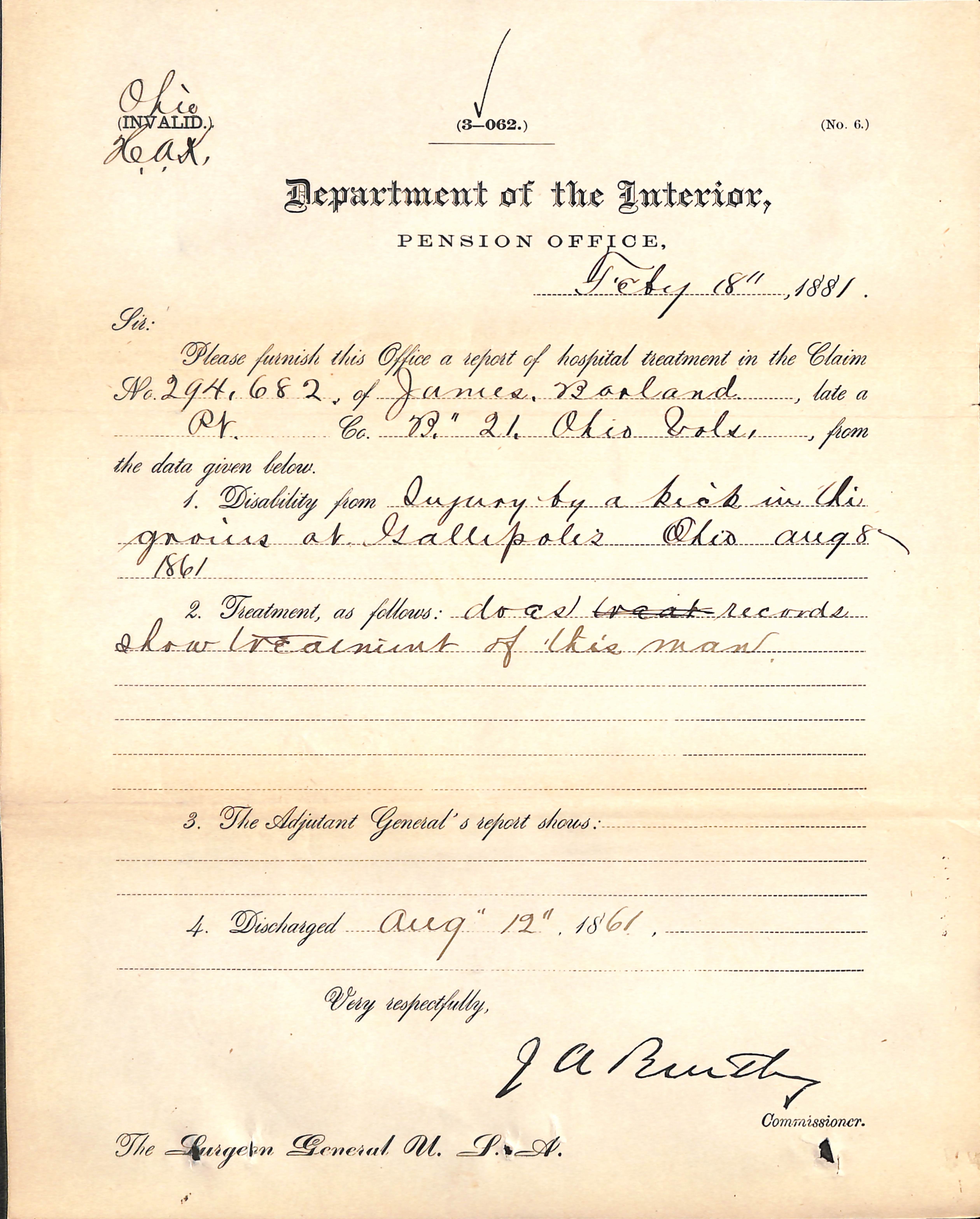
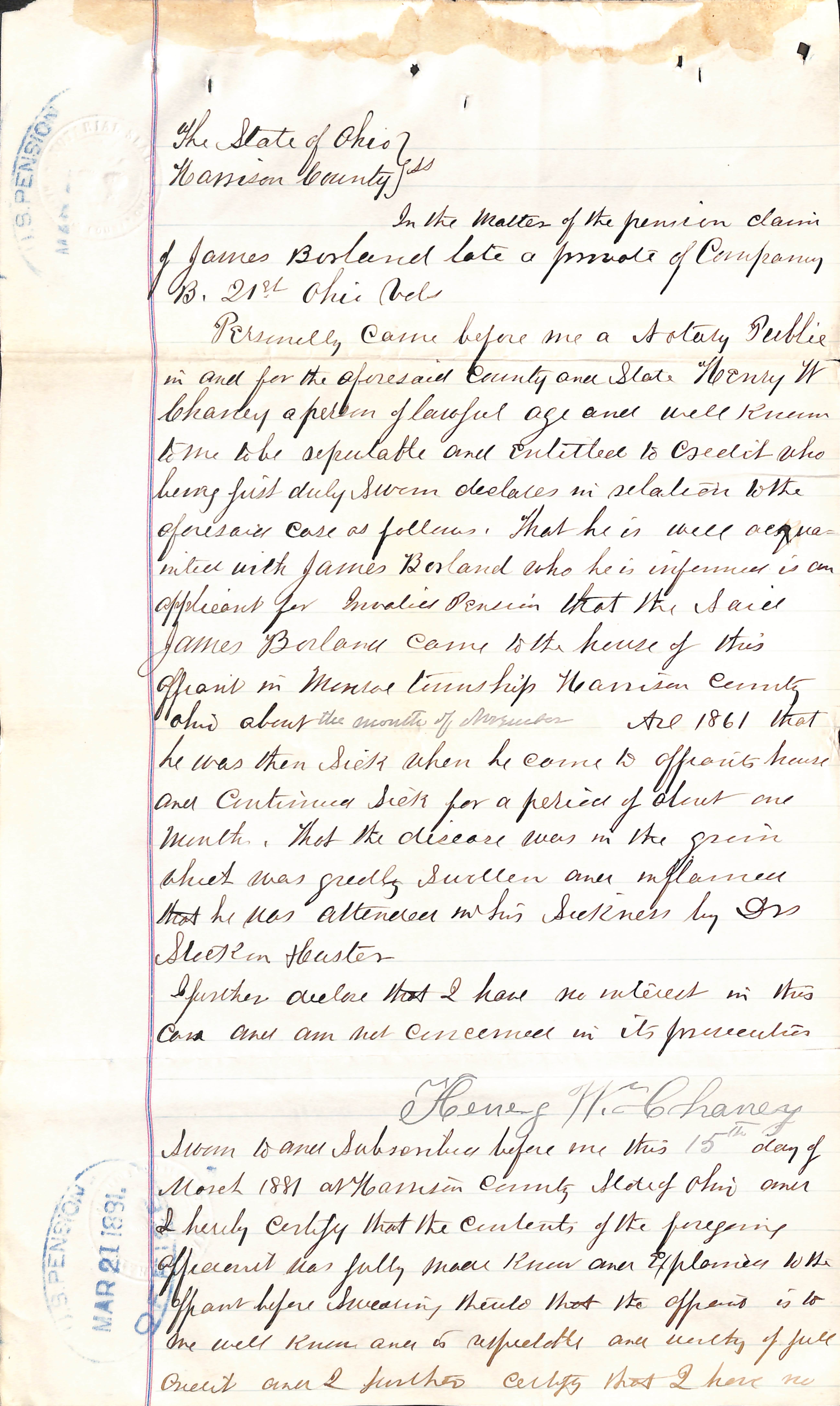
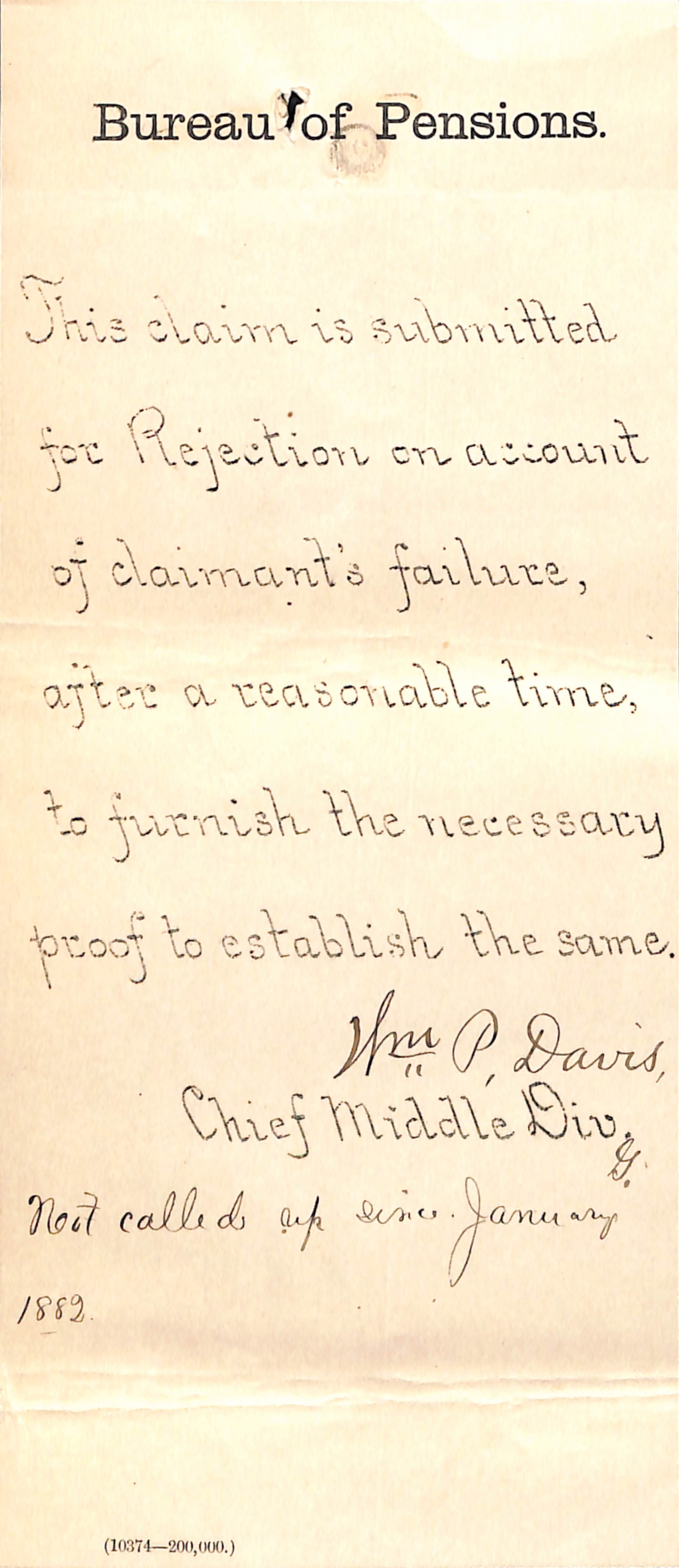
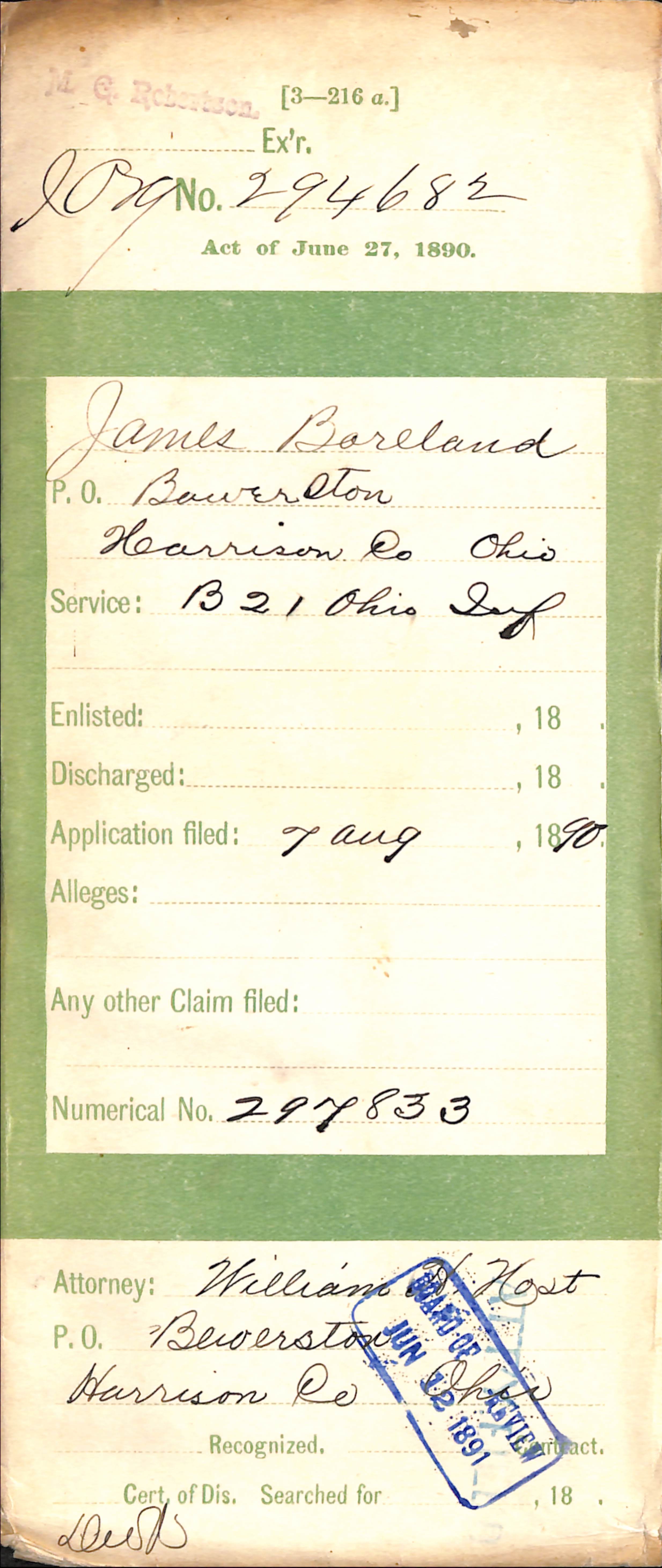
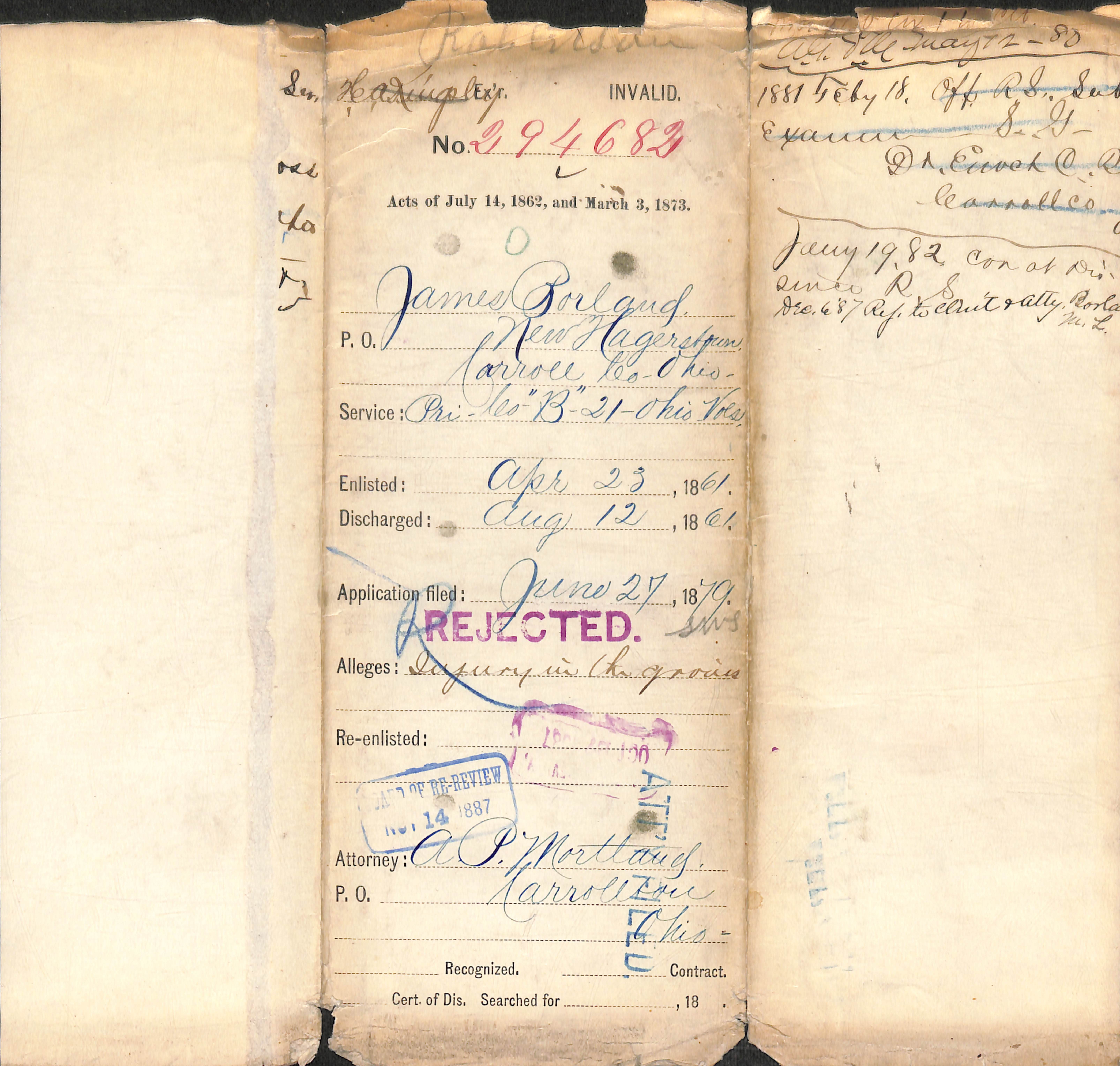
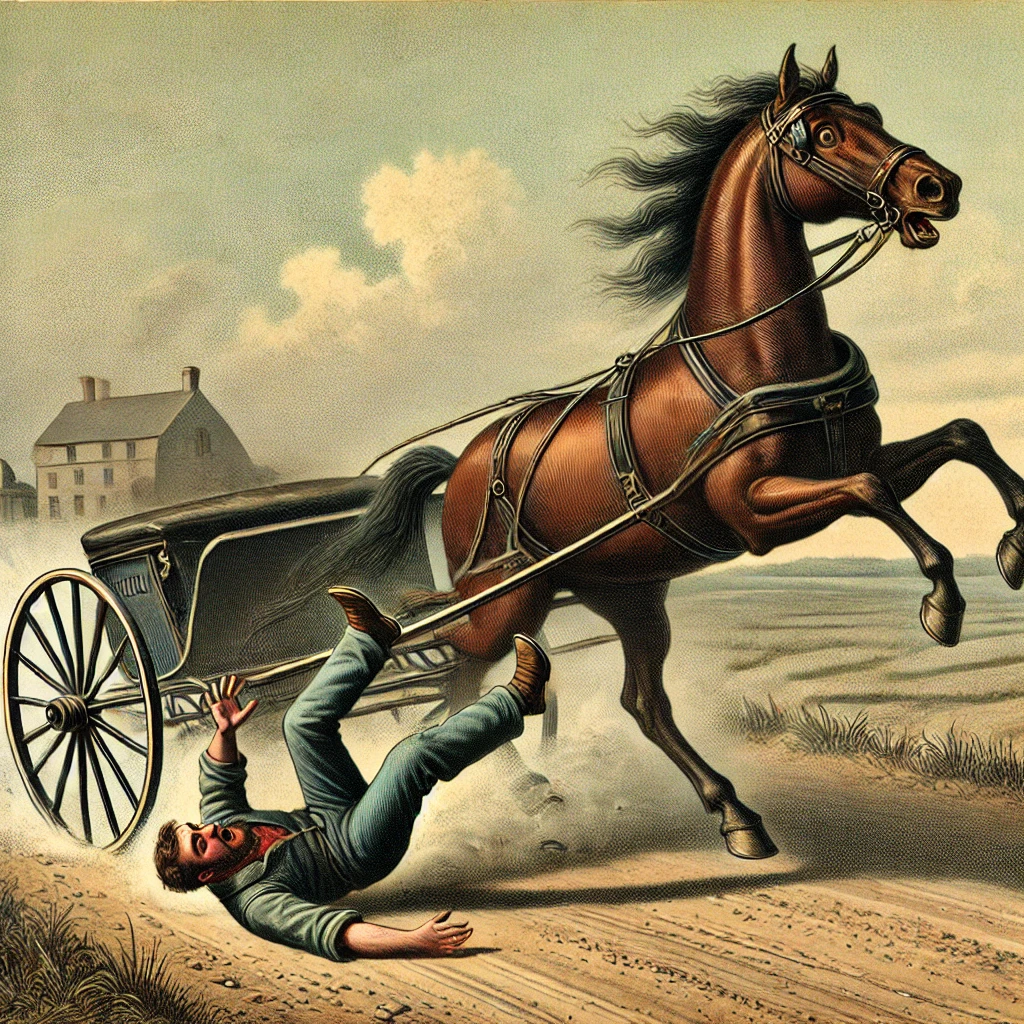
James Borland made an initial claim for a disability under the Pension Act of March 3, 1873, based on an injury to his groin from being kicked by a horse, which he suffered on August 8th or 9th, 1861, near Gallipolis, Ohio, just a few days before the conclusion of his voluntary service. His claim, claim # 294,682, submitted June 27th, 1879 by attorney A.J. Mortland of Carrollton, Ohio, who charged a legal fee of $10, was ultimately rejected eight years later, November 11, 1887 (re-reviewed November 14, 1887), on grounds of "failure after a reasonable time, and due notification, to furnish the necessary evidence to establish the claim."6
State of Ohio, County of Carroll, ss.
On this 23rd day of June, A.D. one thousand eight hundred and seventy-nine, personally appeared before me, Clerk of the Common Pleas Court, a court of record within and for the county and State aforesaid, James Borland, aged 42 years, a resident of Orange Township, county of Carroll, State of Ohio, who, being duly sworn according to law, declares:
That he is the identical James Borland who was ENROLLED on the 23rd day of April, 1861, in company B of the 21st regiment of Ohio Volunteers commanded by Amon C. Carr, and was honorably DISCHARGED at Columbus, Ohio, on the 12th day of August, 1861.
That his personal description is as follows: Age 42 years; height 5 feet 11 inches; complexion, dark; hair, fair; eyes, grey.
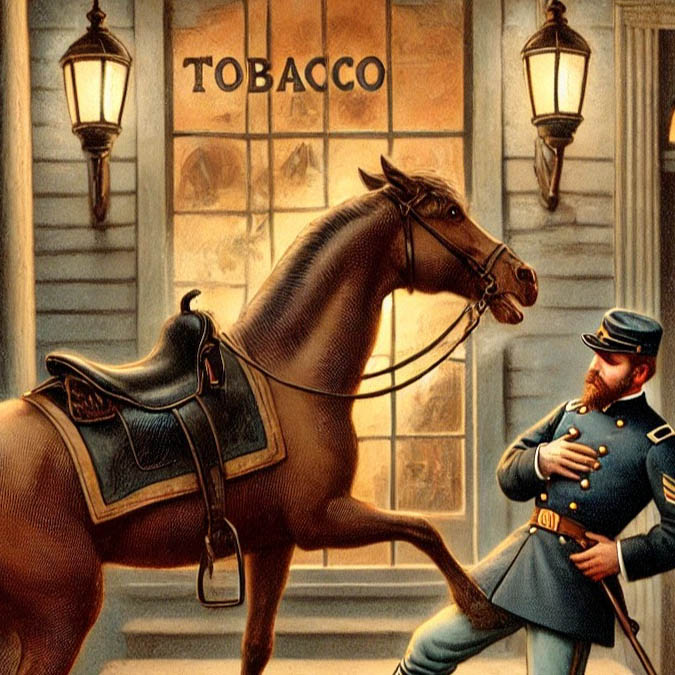
That while a member of the organization aforesaid, in the service and in the line of his duty at Gallipolis, in the state of Ohio, on or about the 8th or 9th day of August, 1861, he was kicked by a horse in the groin in going from the boat in the town to get tobacco. The horse was hitched near store, was helped to the boat, laid down, went on back to Cincinnati and from there to Columbus & where he was discharged. Thence he was brought home to Mr. Cheney in Harrison County, Ohio, where he was confined to bed for several months on account of the hurt, did not call a physician. Henry Mathews, since declared, was with him when he received the injury. The hurt from the [injury] prevents him from working for weeks at a time and at no time can he do manual work on account of the injury.
That he was not treated in hospitals. Having received the hurt a few days before his discharge from the service, he was brought home over [illegible] care of by the family of Mr. Chaney and employees of that family and assisted by Sarah Guthrie.
That he has never been employed in the military or naval service otherwise than as stated above.
That since leaving the service this applicant has resided in the Township of Orange, Carroll Co., in the state of Ohio, and his occupation has been that of a farmer.
That prior to his entry into the service above named he was a man of good, sound, physical health, being when enrolled a farmer.
That he is now two-thirds disabled from obtaining his sustenance by manual labor, by reason of his injuries, above described, received in the service of the United States; and he therefore makes this declaration for the purpose of being placed on the invalid pension roll of the United States. He hereby appoints with full power of substitution and revocation, A.P. Mortland of Carrollton, State of Ohio, his true and lawful attorney to prosecute his claim.
That he has never received or applied for a pension.
That his Post Office Address is, New Hagerstown, county of Carroll, State of Ohio.
Claimant's signature: James Borland
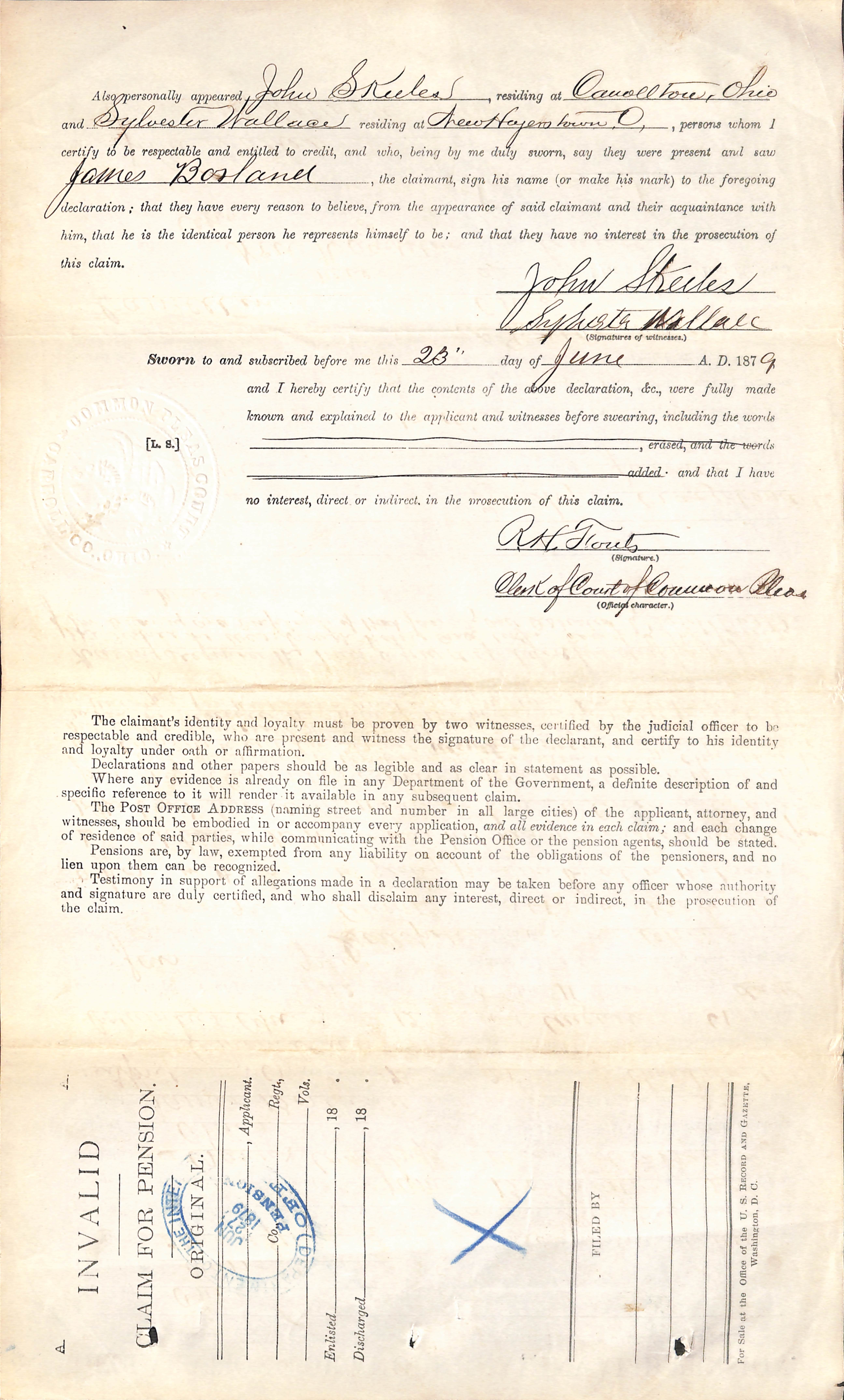
Attest: John Sheeles, Sylvester Wallace9.
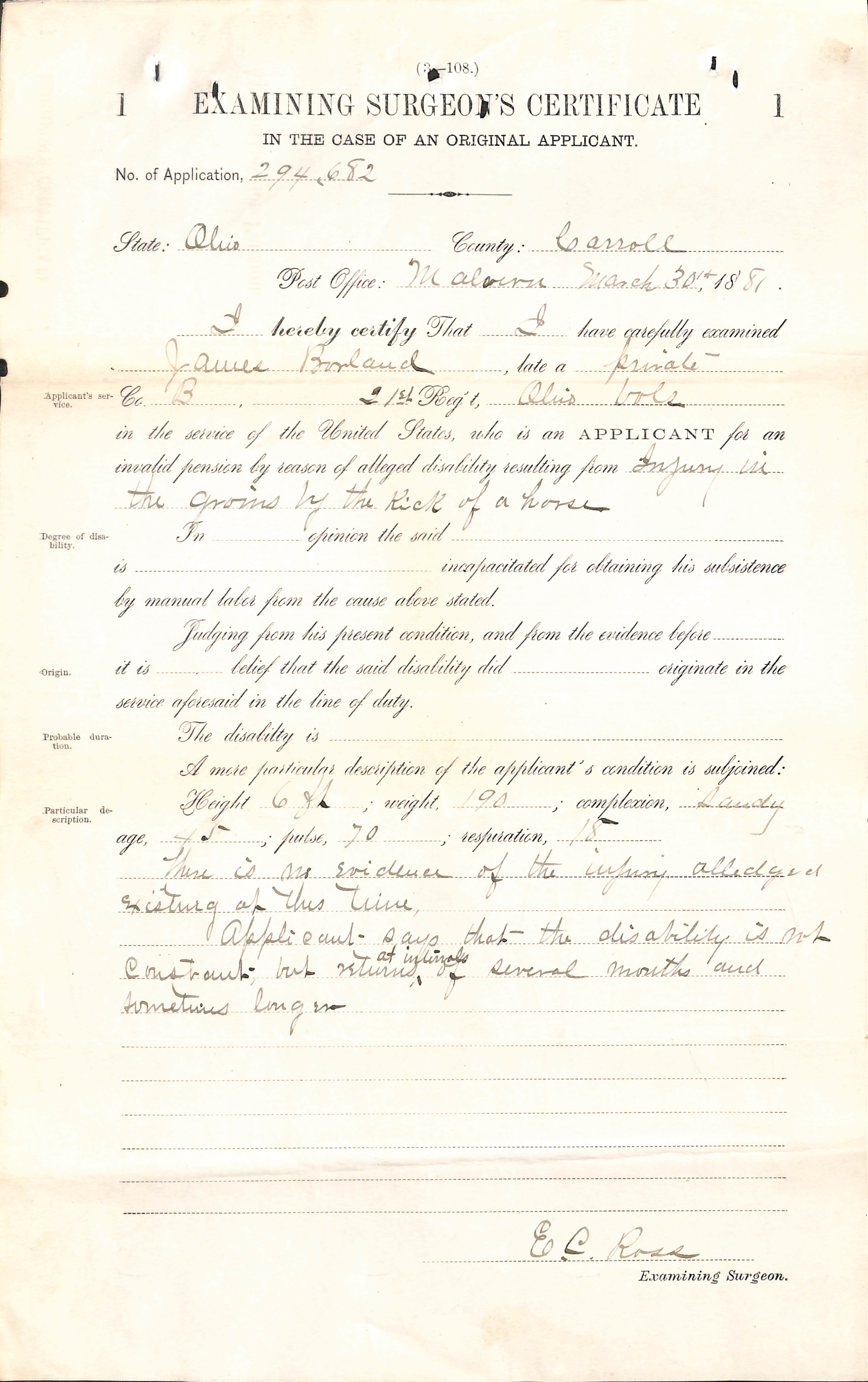
The death knell in this initial disability claim appears to be an Examining Surgeon's Certificate entered by E.C. Ross of Malvern, Ohio, dated March 30, 1881, which states, "There is no evidence of the injury alleged existing at this time. Applicant says that the disability is not constant but returns of several months and sometimes longer."8
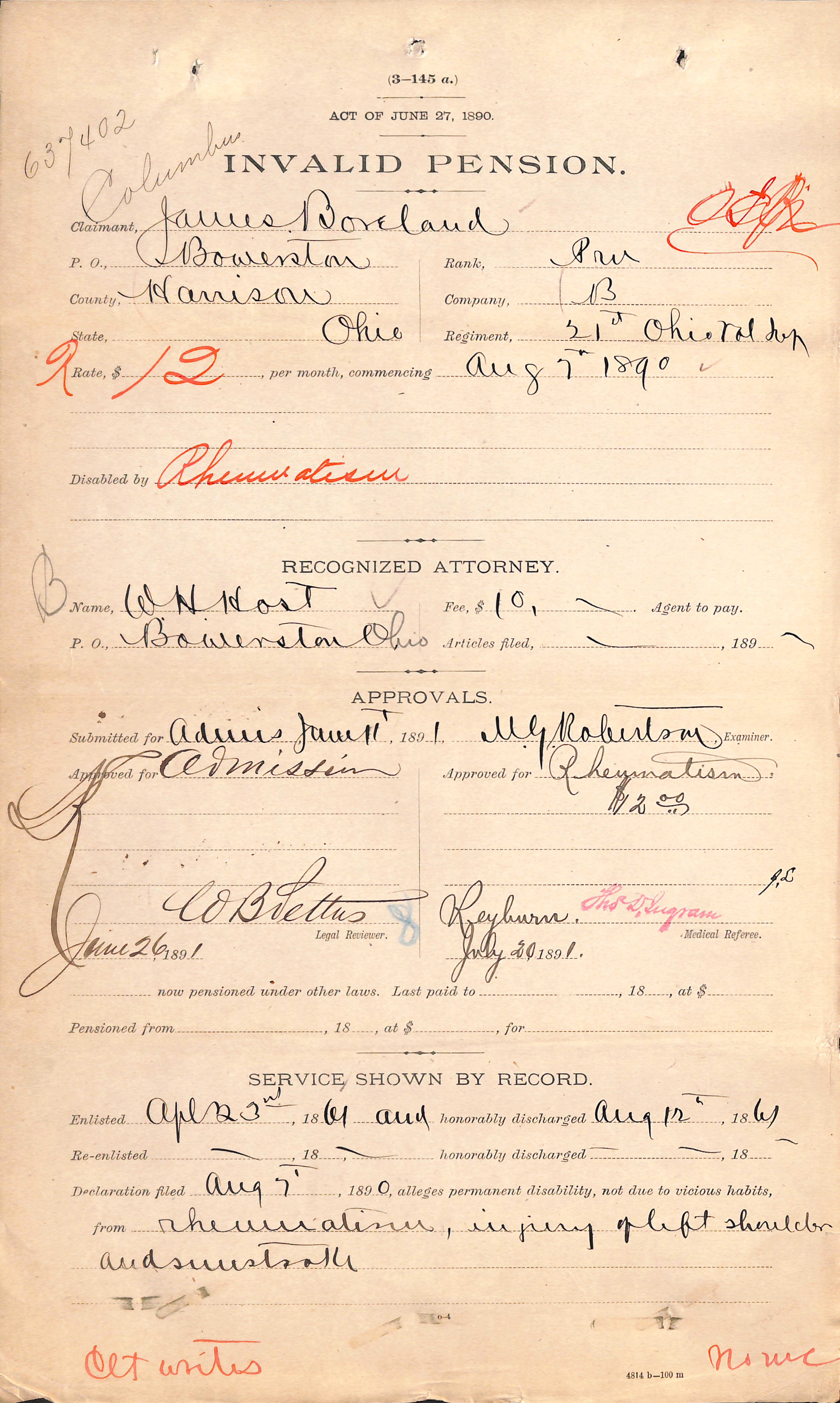
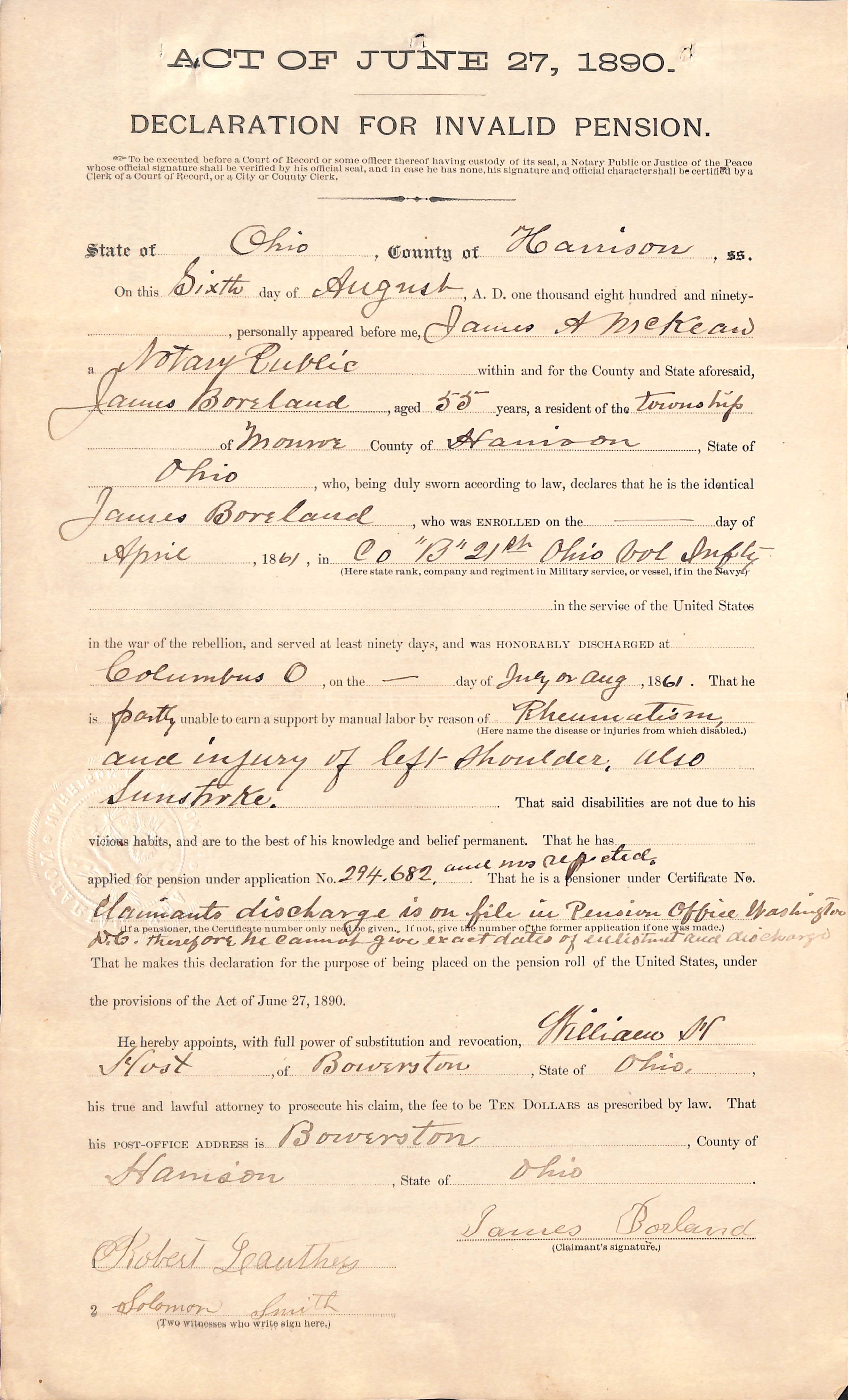
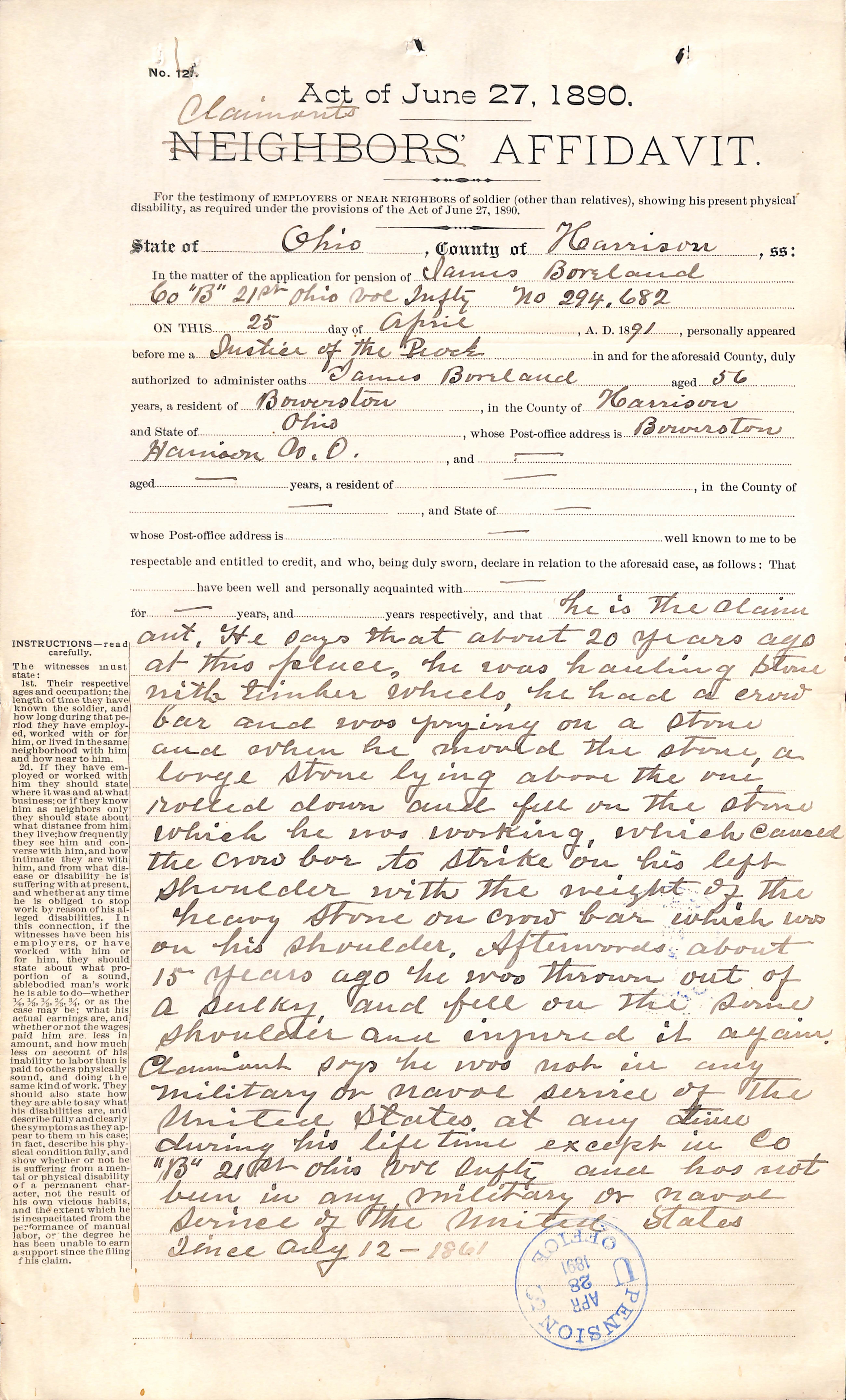
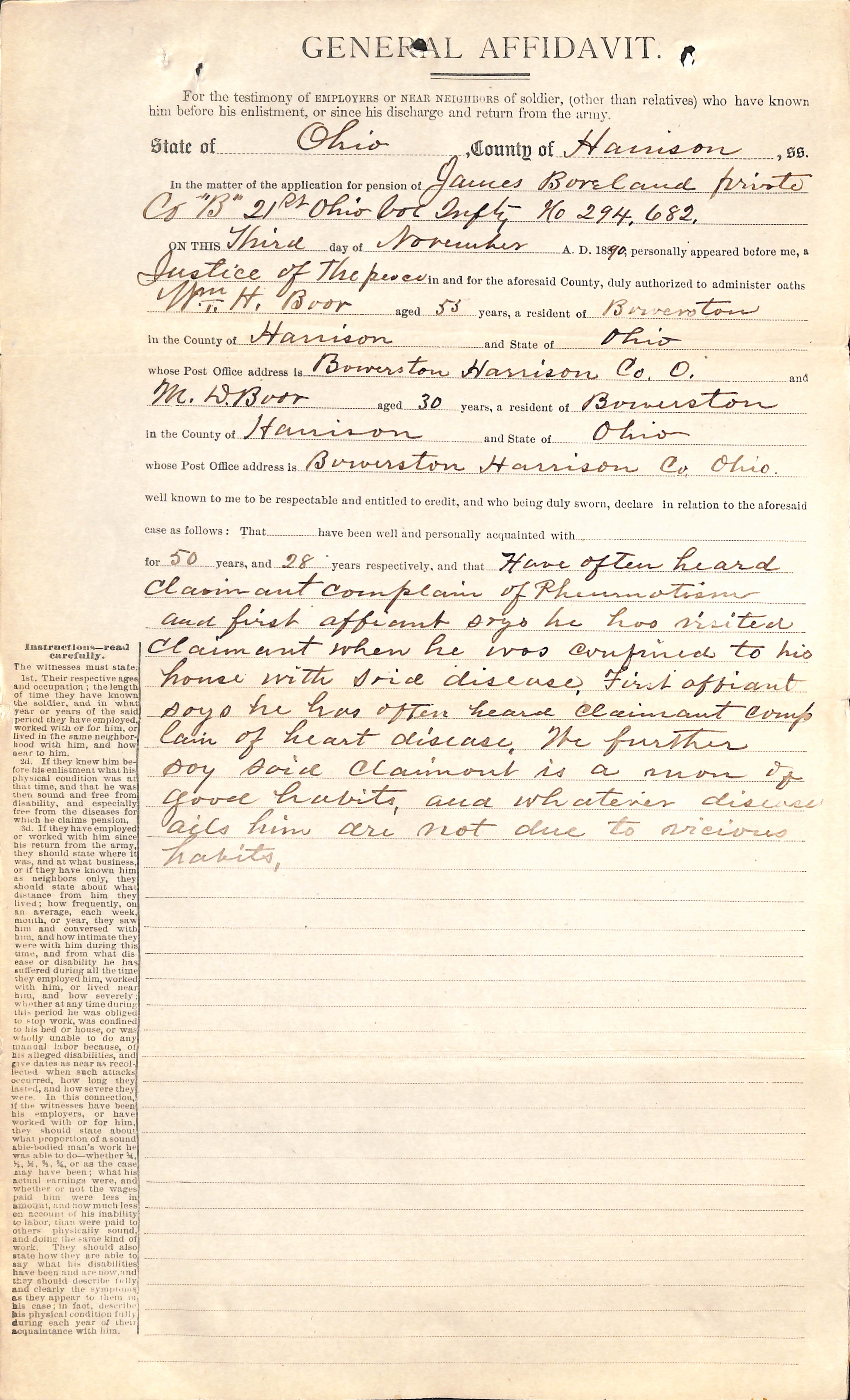
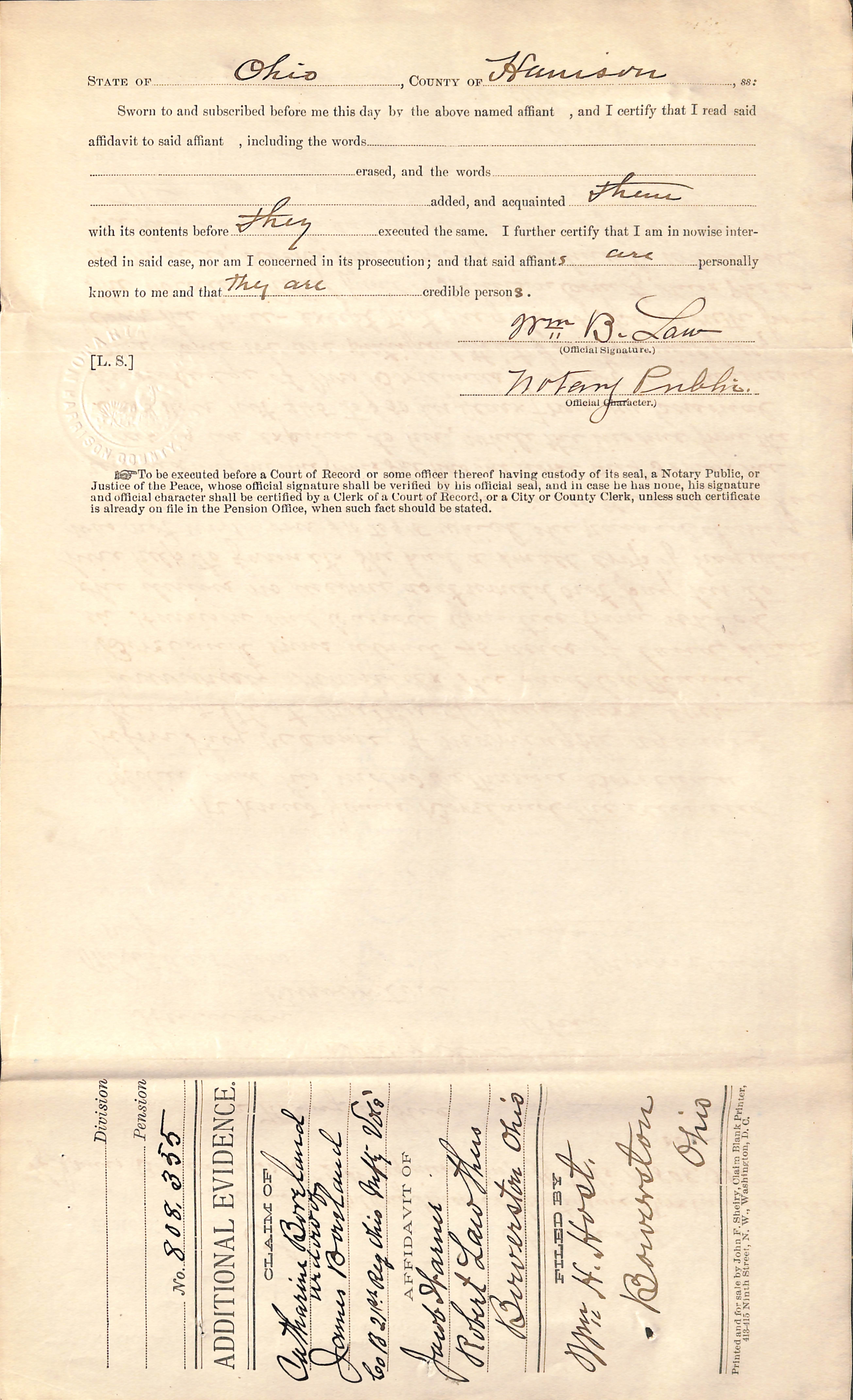
In August, 1890, immediately after passage of the Disability Act of June 27, 1890, James Borland, with a new attorney William H. Host of Bowerston, reasserted his claim under the new law11, which expanded eligibility to include disabilities not directly related to wartime experience7. This time, to perfect his claim, Borland needed to prove that he suffered from a permanent mental or physical disability that incapacitated him from performing manual labor. The key requirements included demonstrating that the disability was not due to his own "vicious habits" and proving that the disability affected his ability to earn a living11.
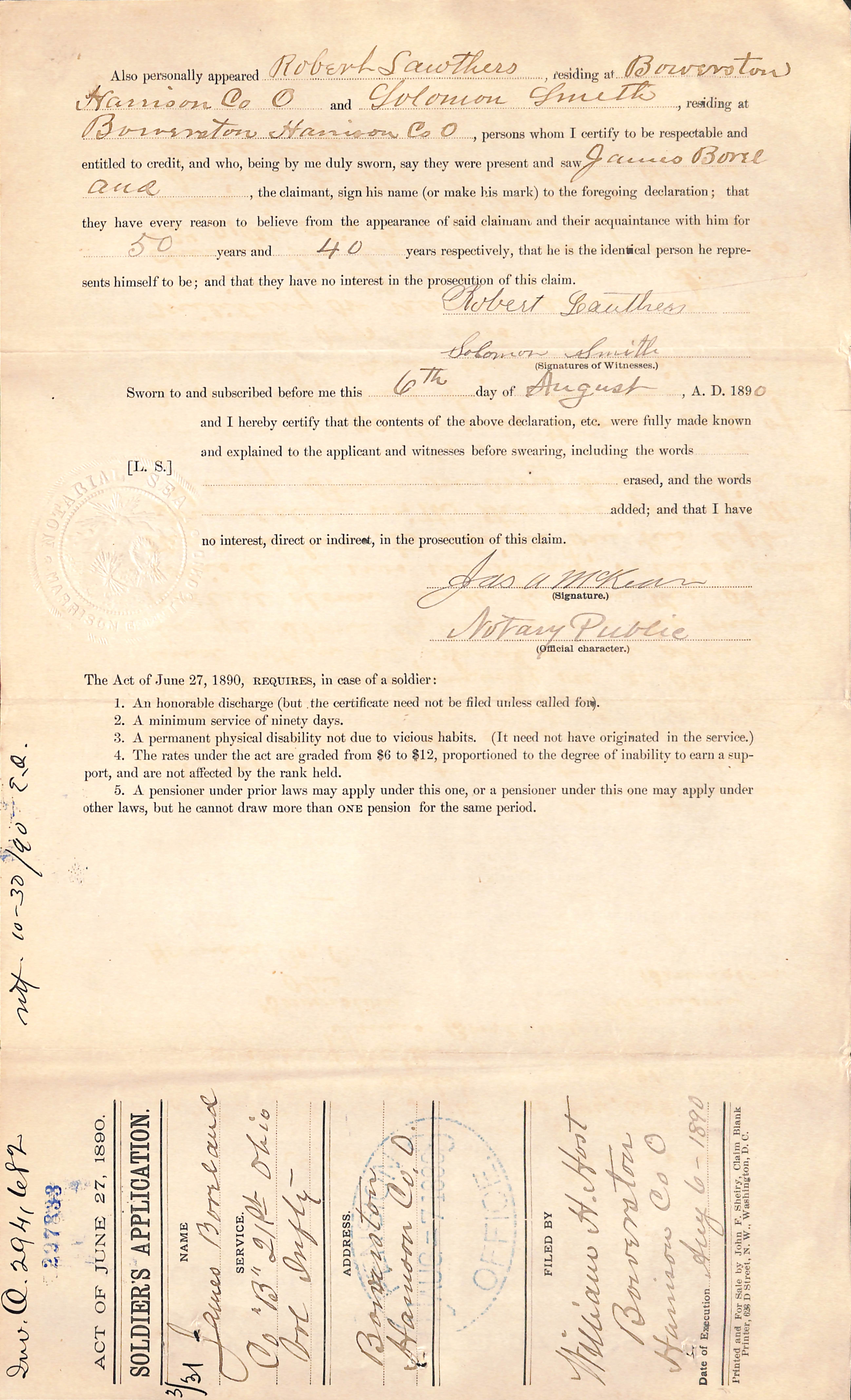
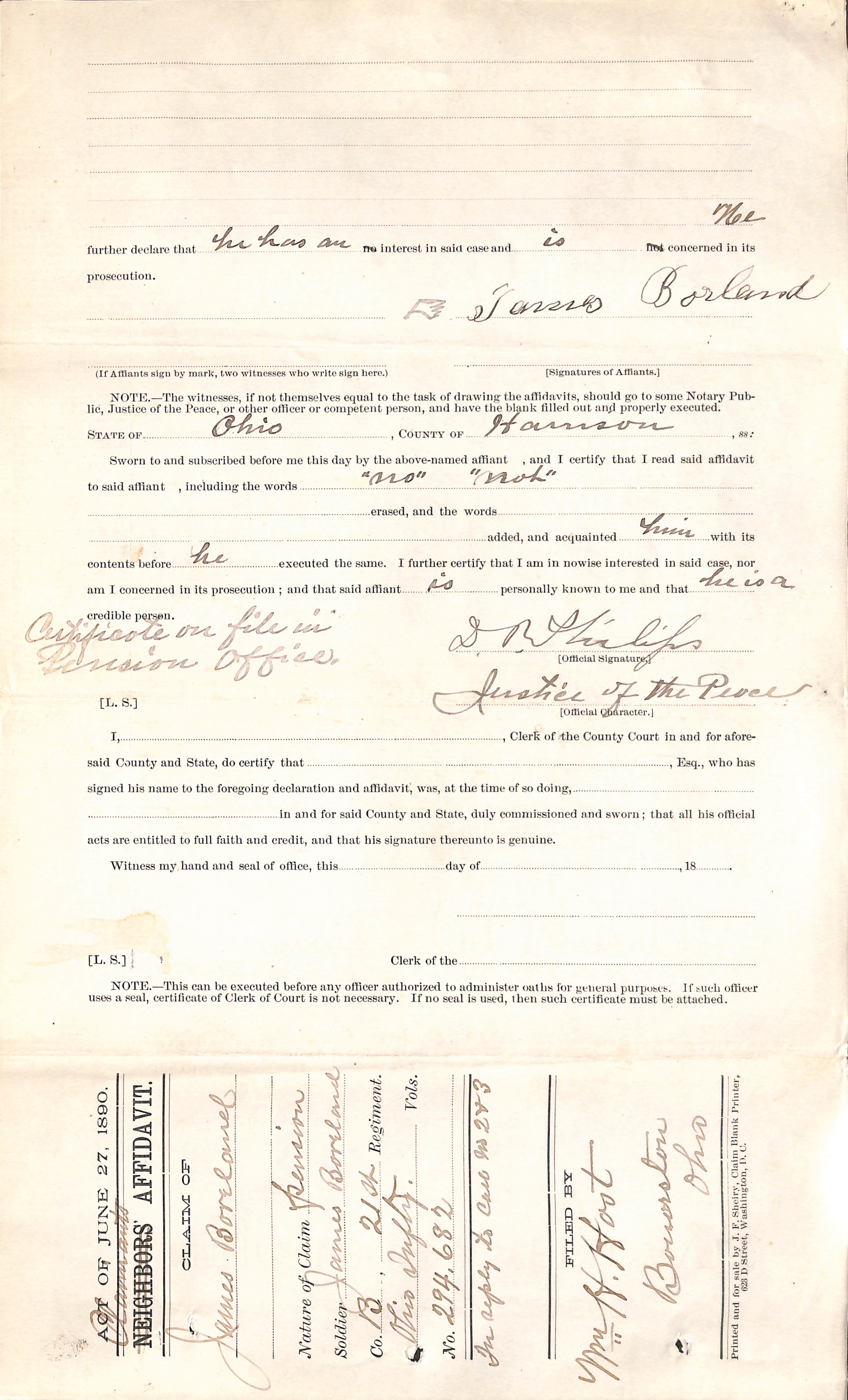
Borland's renewed claim indicated that he suffered from rheumatism in his right hip and left shoulder, in addition to the prior claimed groin injury11. It was witnessed by Robert Lawthers and Solomon Smith, the former who stated that he knew Borland for 50 years, and the latter for 4011. James Borland signed another affidavit regarding his shoulder injury, stating the following (in relevant part)12:
He says that about 20 years ago, at this place, he was hauling stone with timber wheels, he had a crow bar and was prying on a stone, and when he moved the stone, a large stone lying above the one which he was working, which caused the crow bar to strike on his left shoulder with the weight of the heavy stone on crow bar which was on his shoulder. Afterwards, about 15 years ago, he was thrown out of a sulky, and fell on the same shoulder and injured it again.
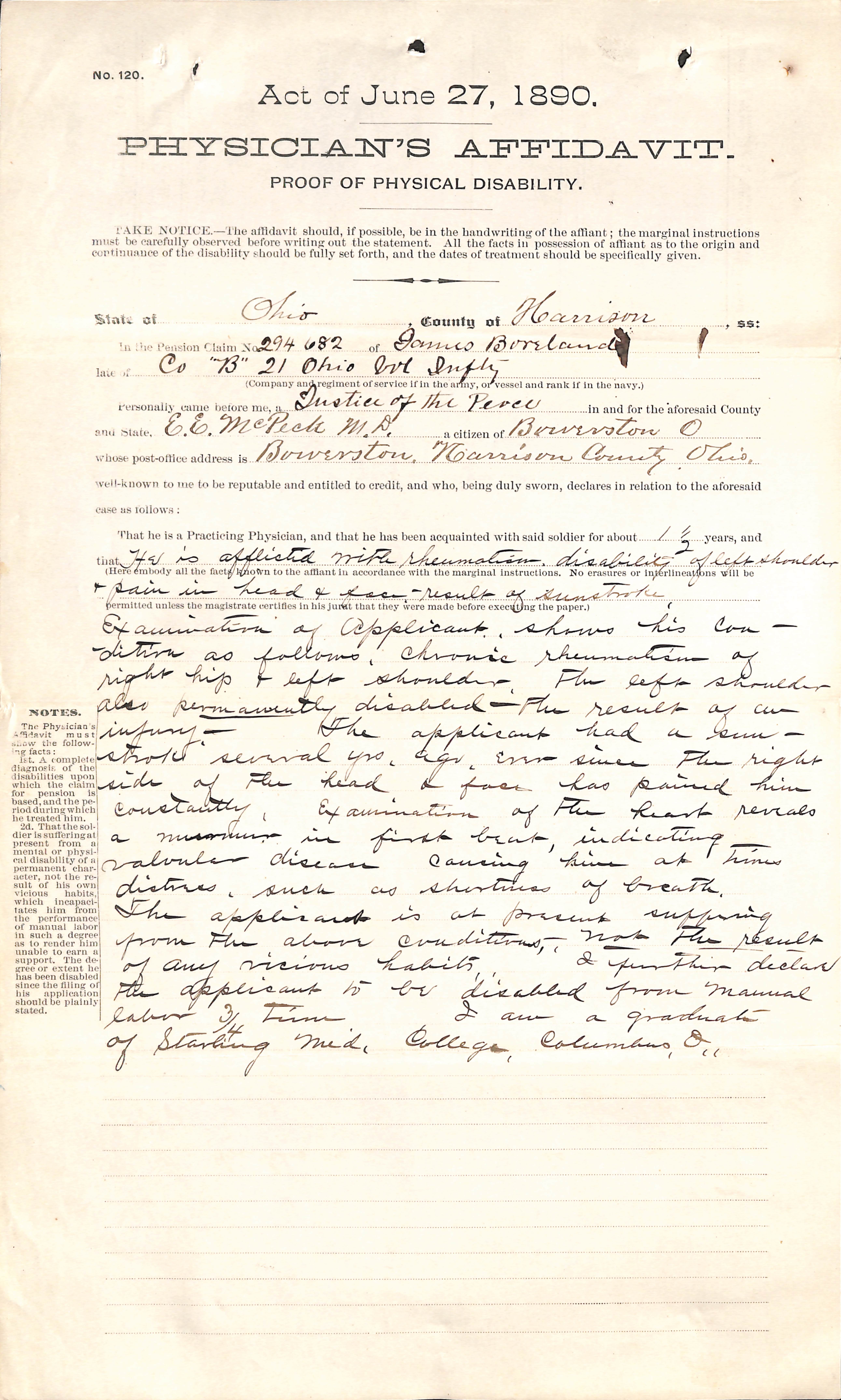
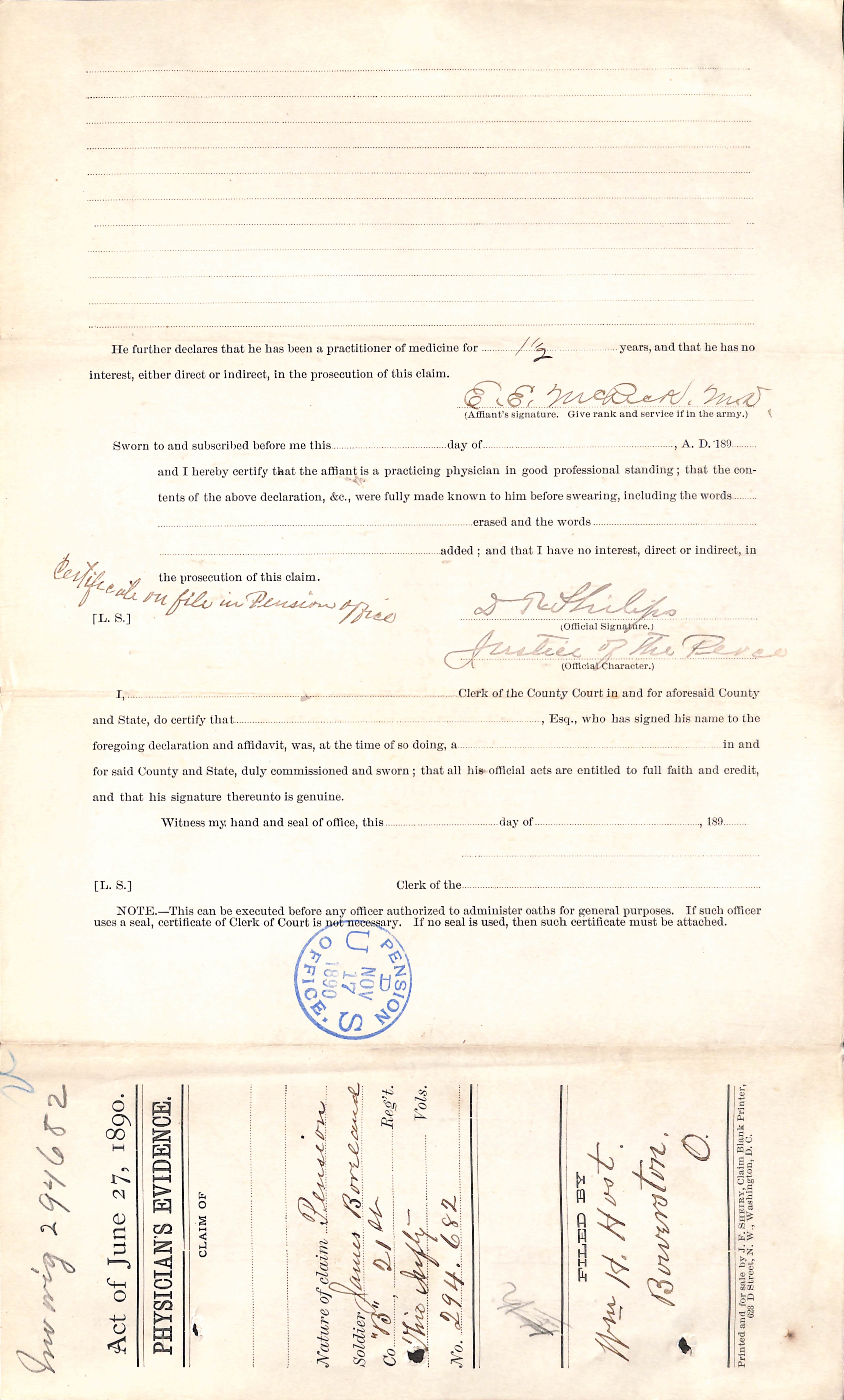
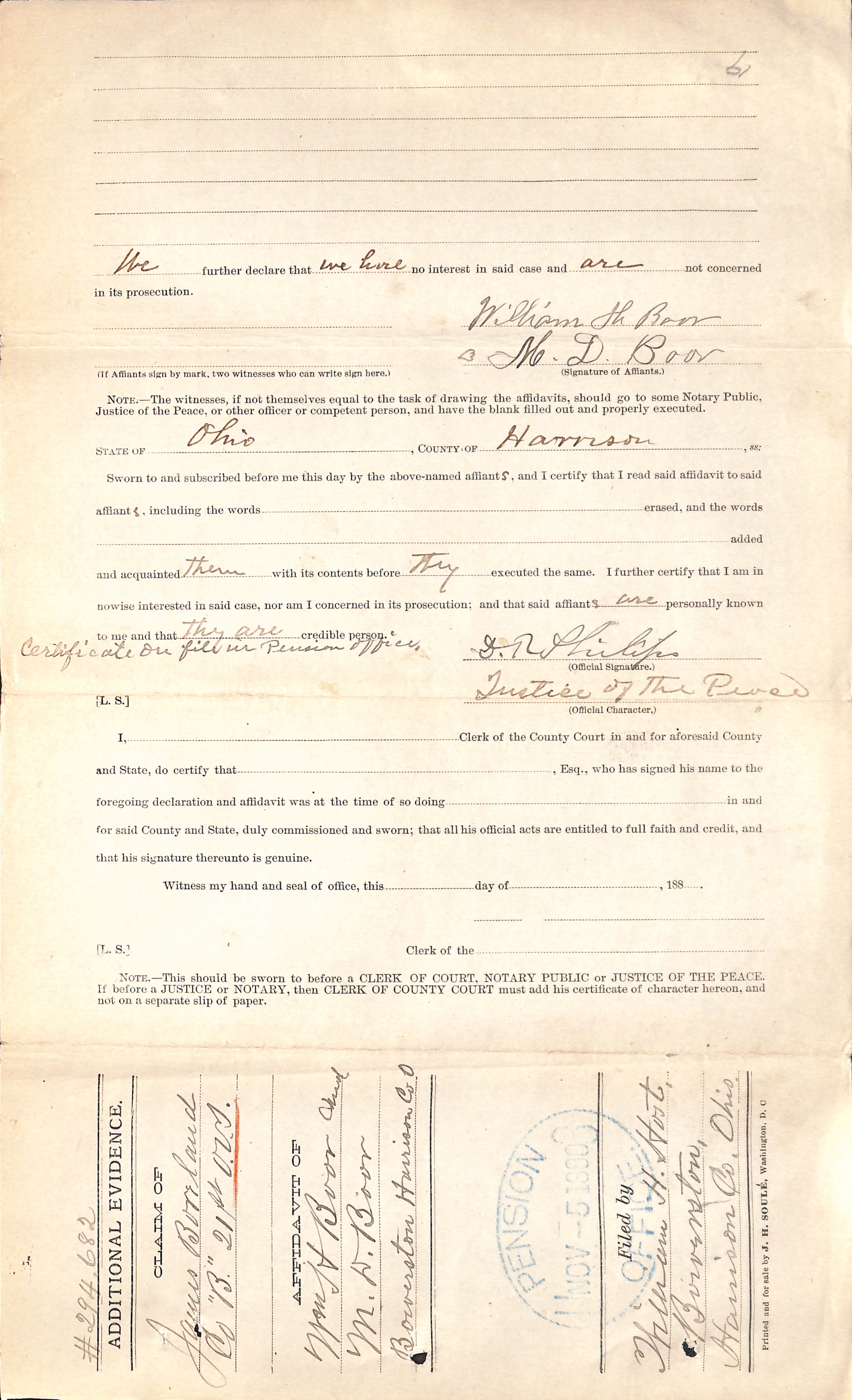
James Borland's injuries were supported by an affidavit of E.E. McPeck, M.D. of Bowerston, who further noted that Borland was suffering from chronic pain on the right side of his head and face that were a result of sun stroke several years back. Dr. McPeck also determined that Borland suffered from vascular disease which caused him some distress and shortness of breath, and further concluded that Borland was "disabled from manual labor 3/4 time."13 William H. Boor and M.D. Boor also provided testimony stating that they had often heard Borland complaining about the rheumatism, and described Borland as a "man of good habits."14
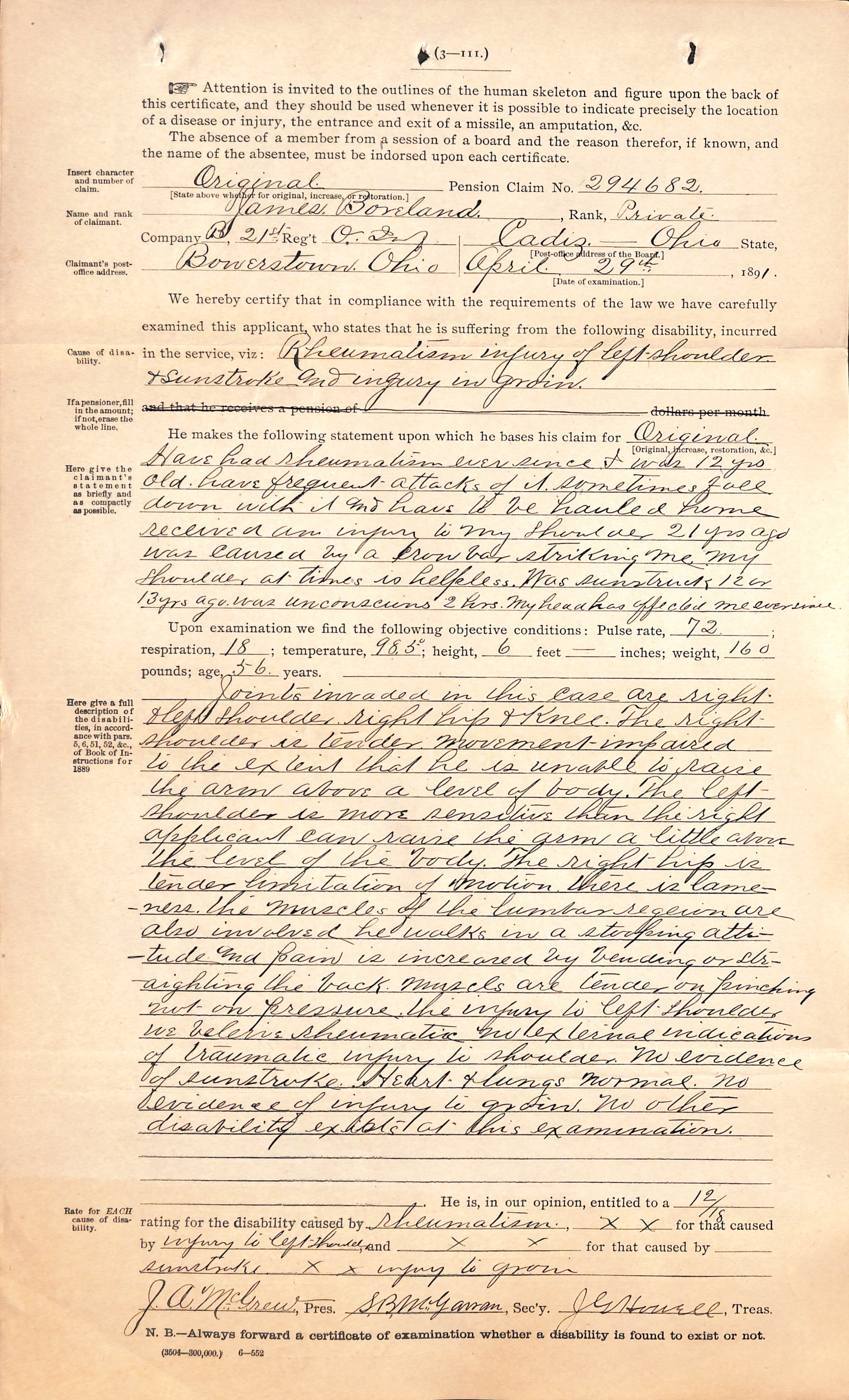
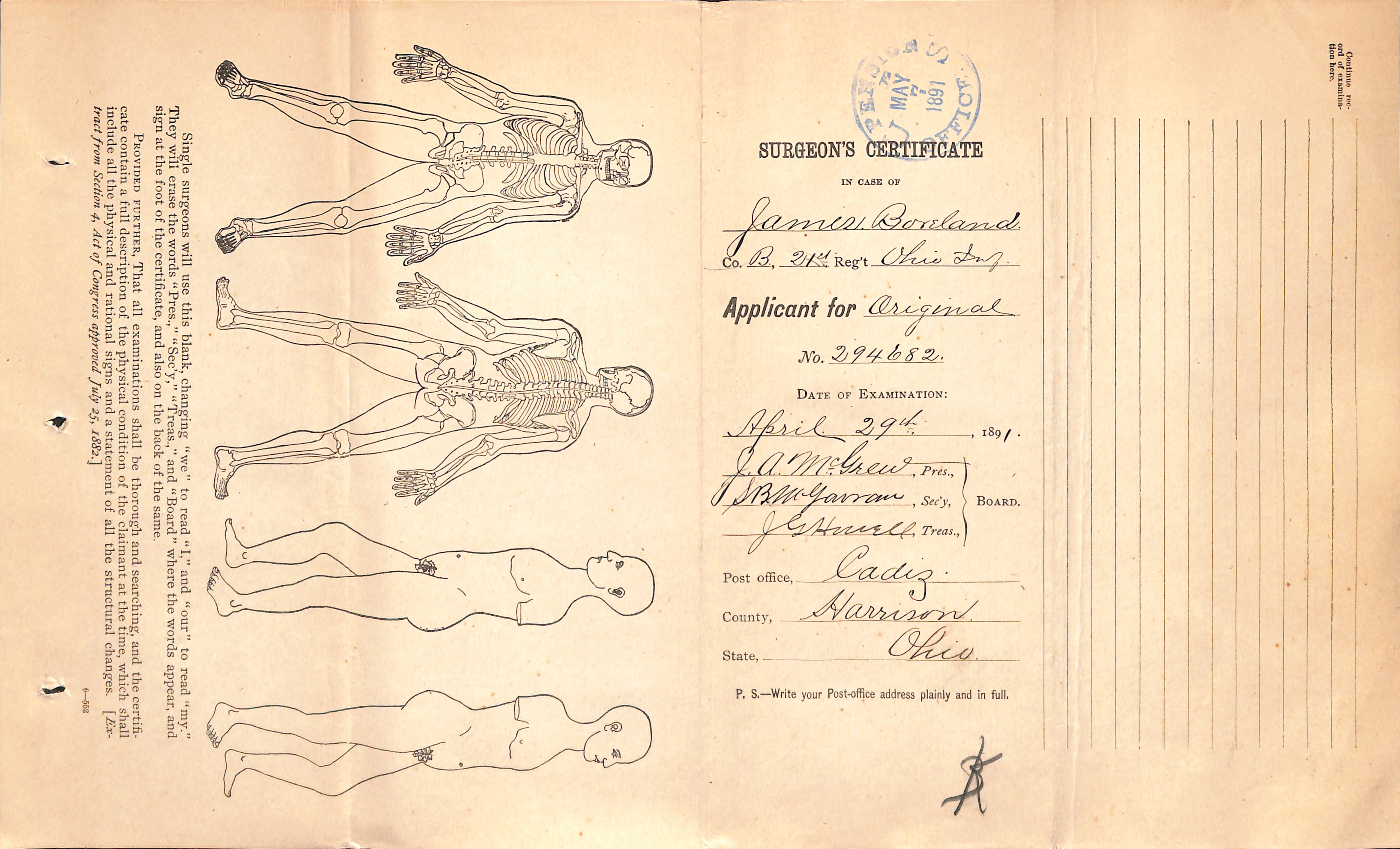
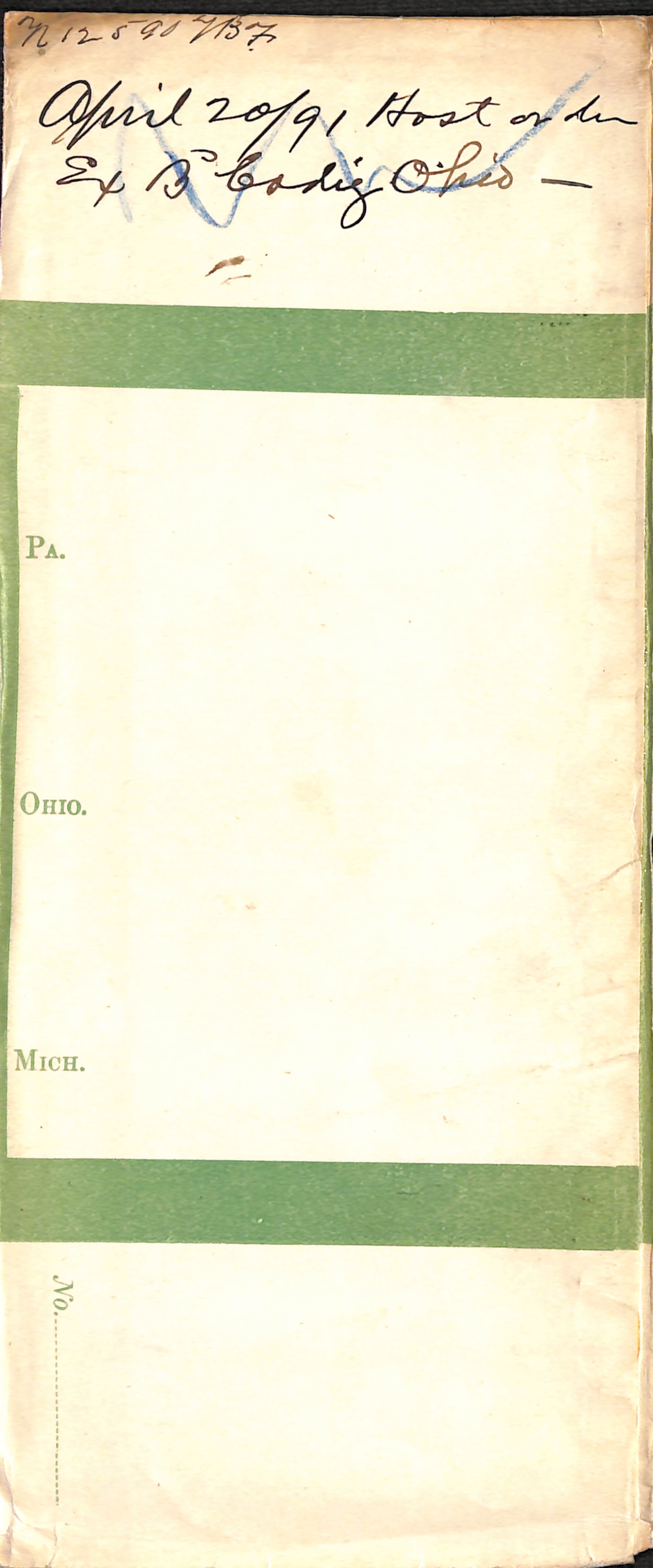
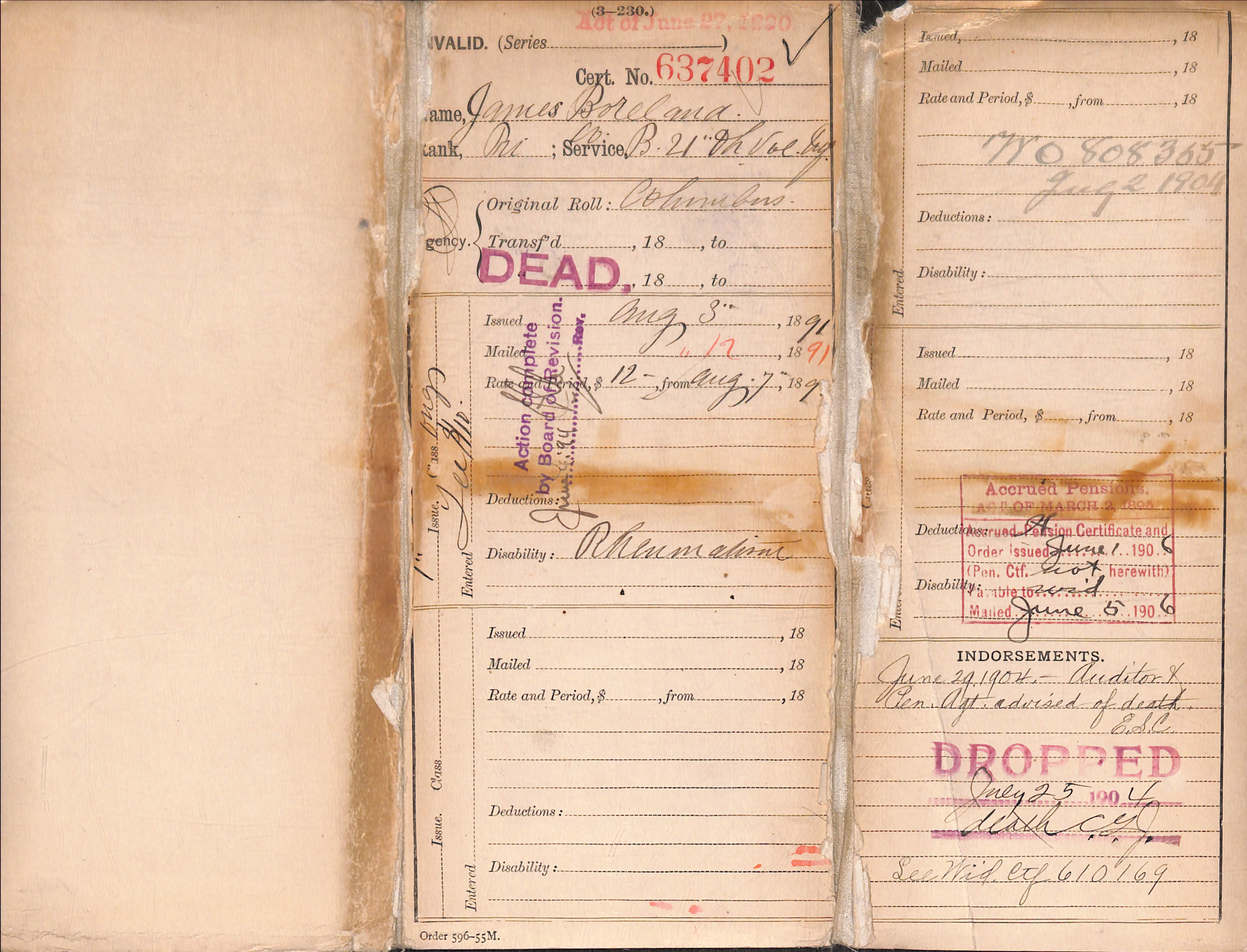
A physical examination was conducted on April 29, 1891, in Cadiz, Ohio, and a surgeon's certificate was issued. The report states that James Borland was 56 years old, was 6 foot tall and weighed 160 pounds. While the board did not award Borland a disability rating for the shoulder, groin or sun stroke injuries, they did find that he was entitled to a "12/18 rating for the disability caused by rheumatism."15 James Borland was approved to receive $2 per month commencing August 7, 1890, and his attorney was awarded a $10 legal fee16.
Widow's Pension Claim
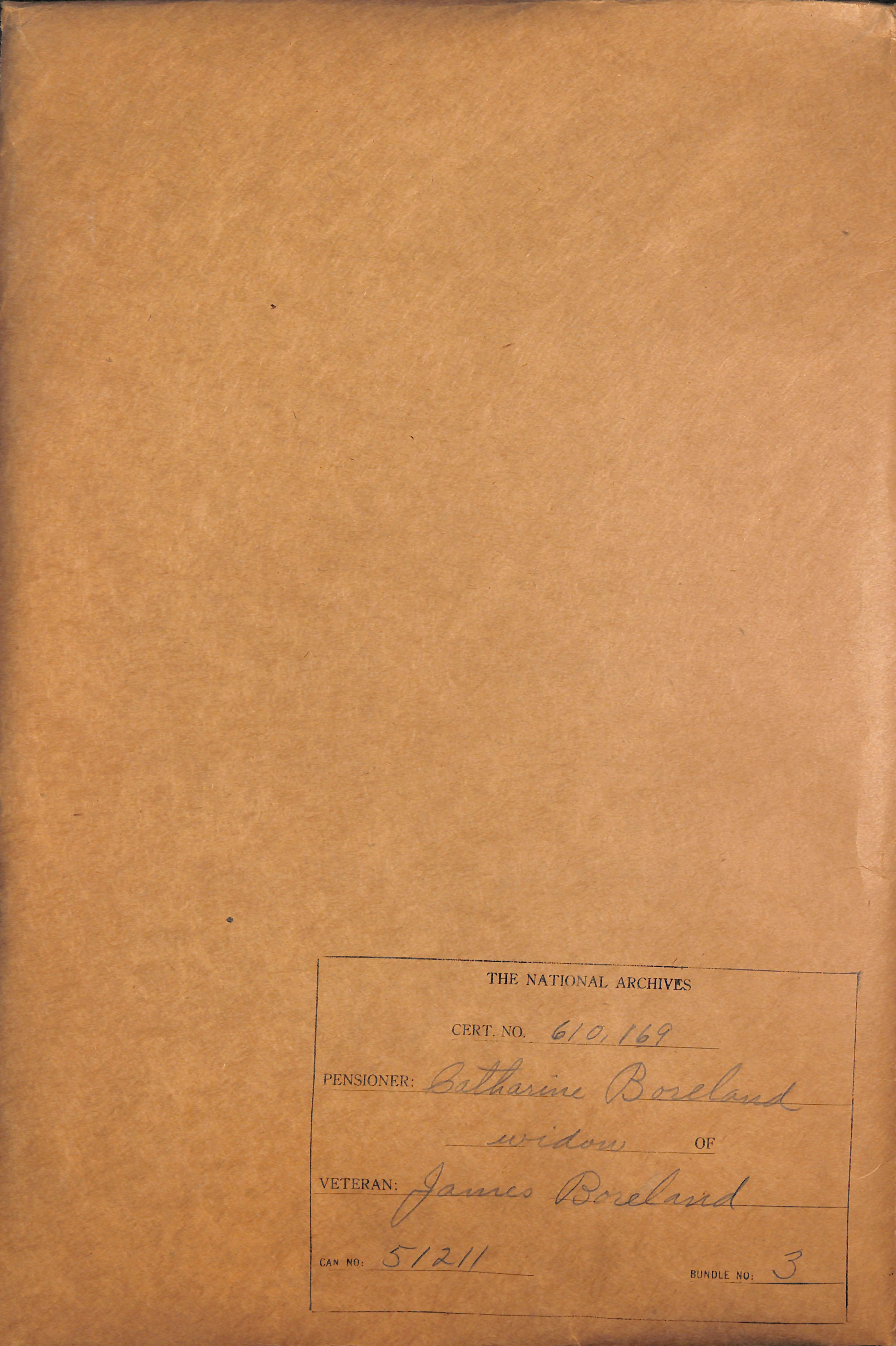
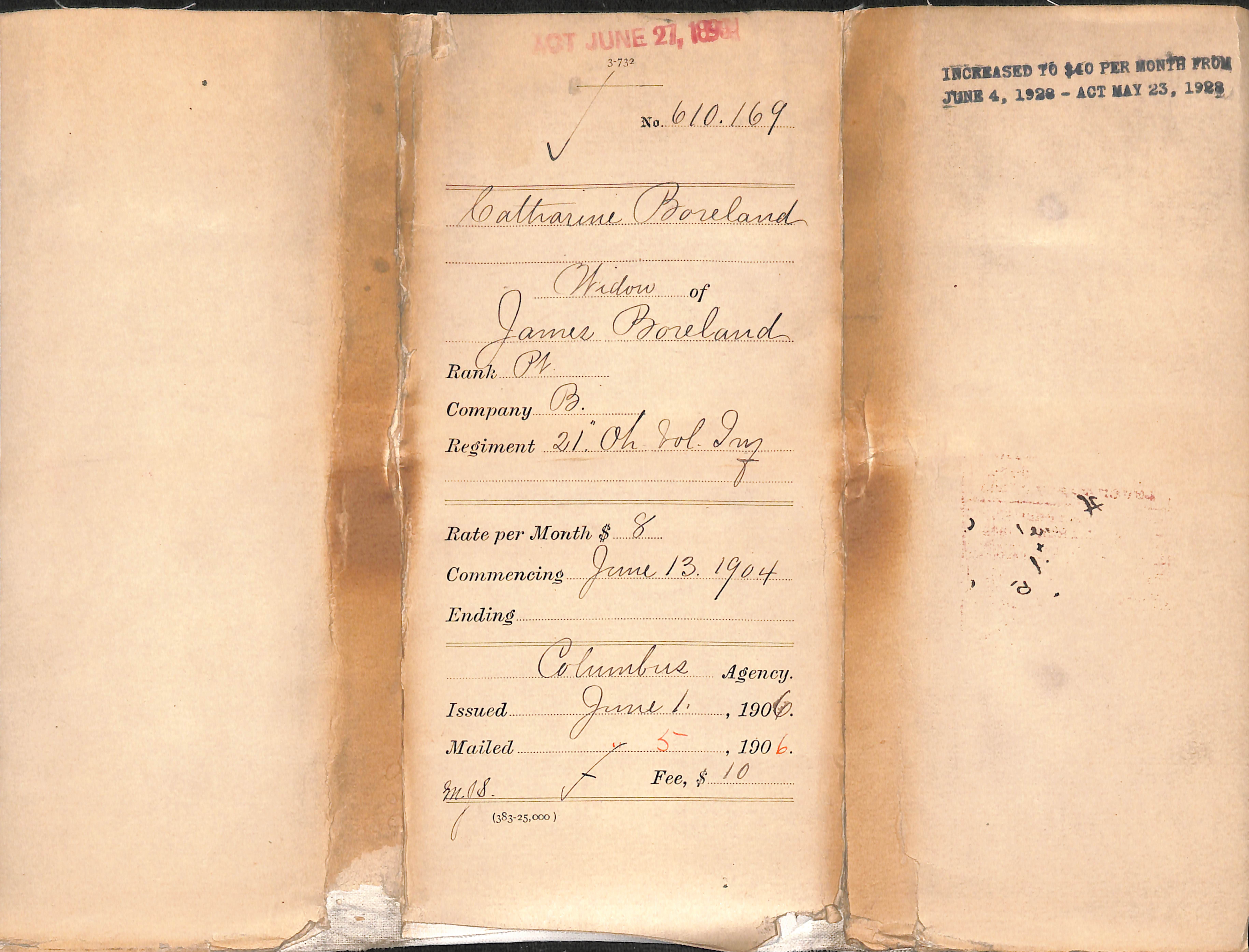
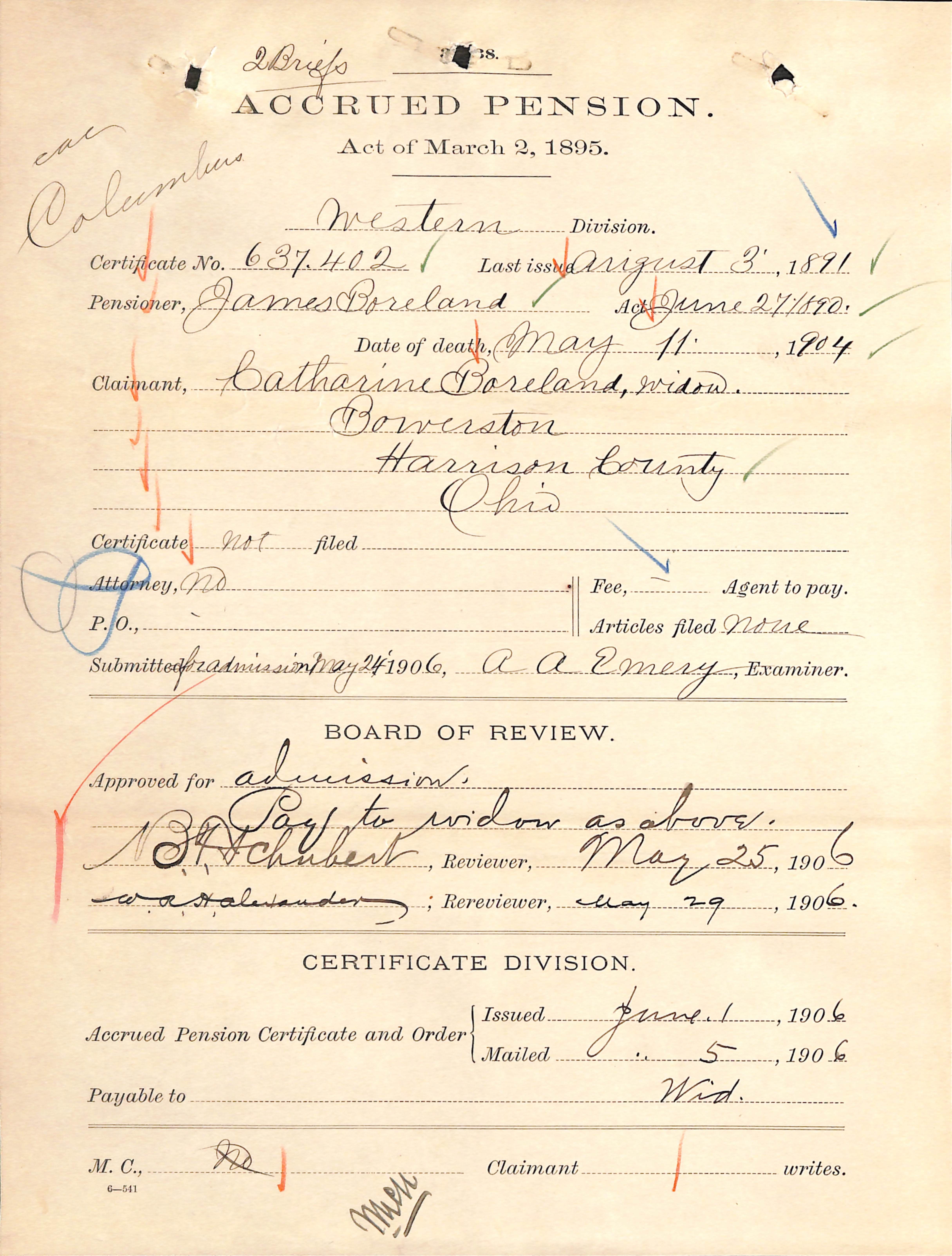
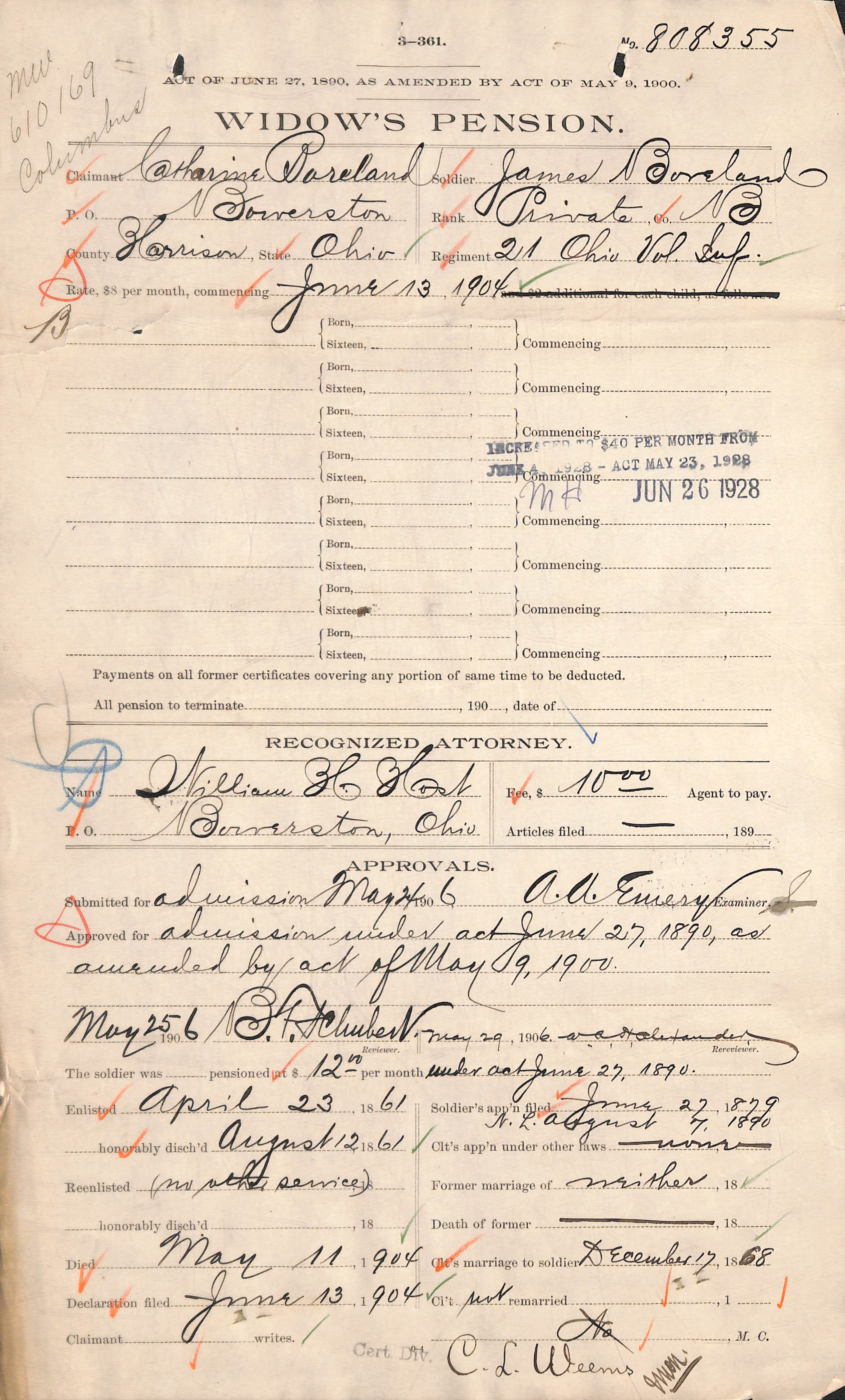
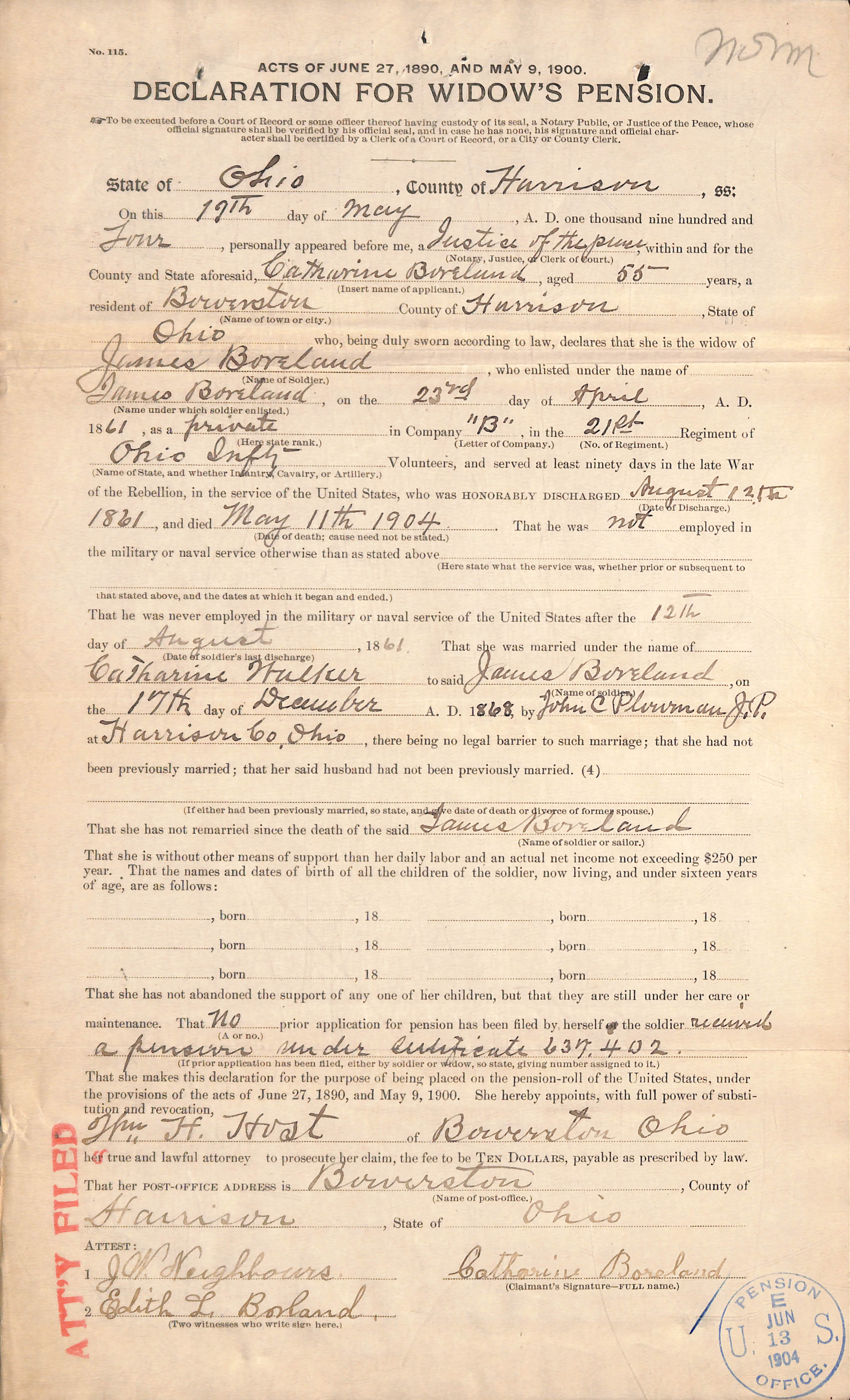
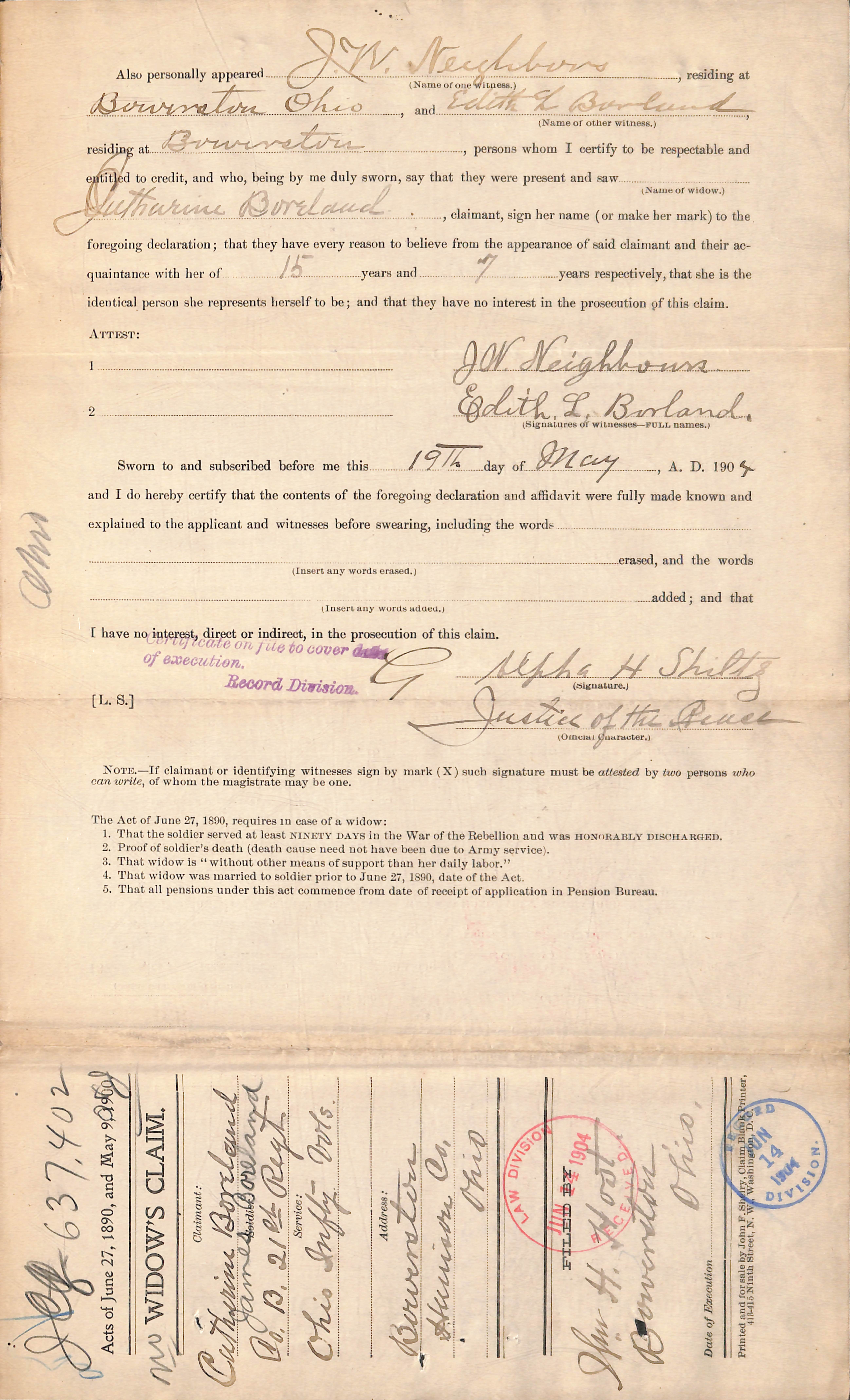
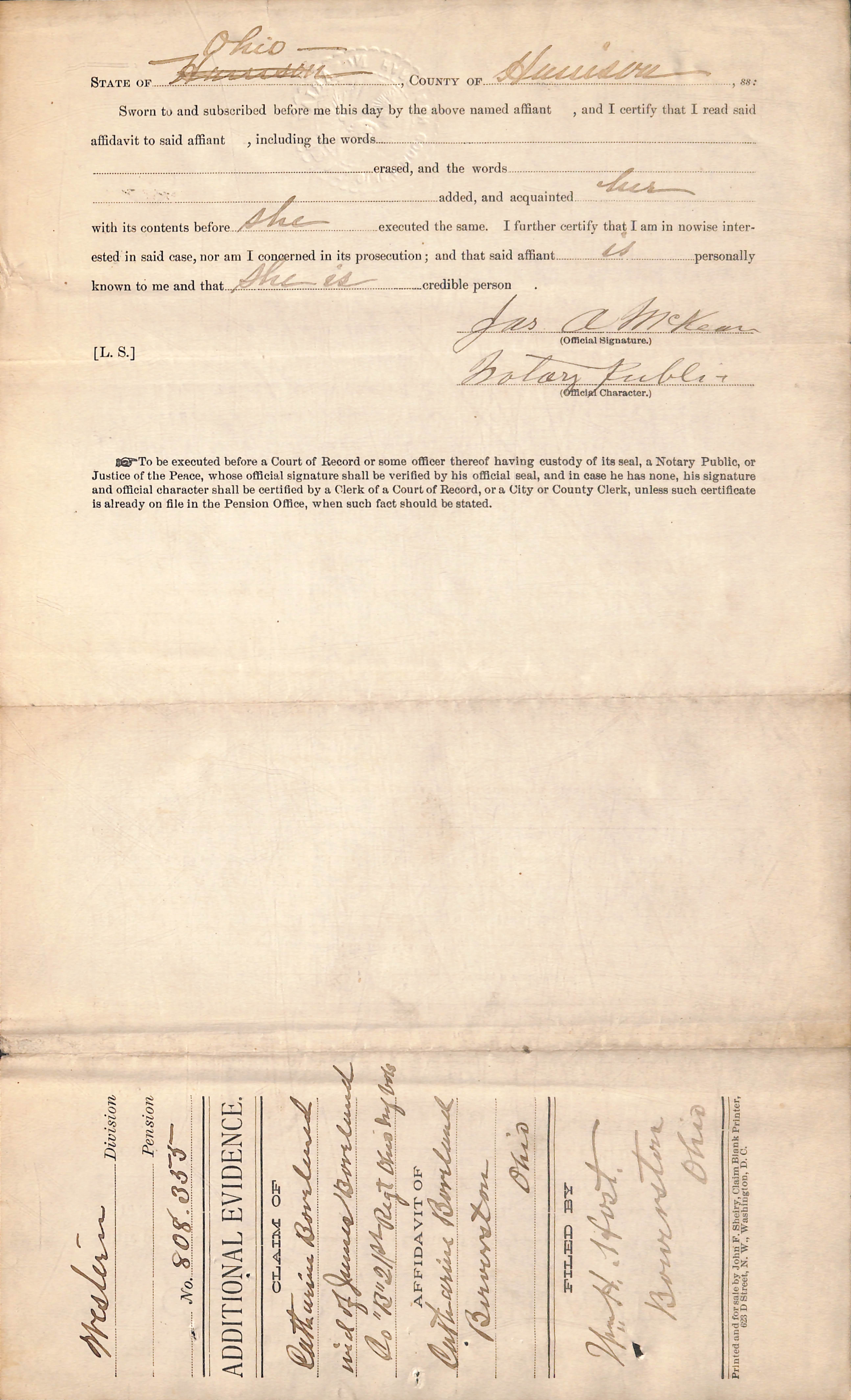
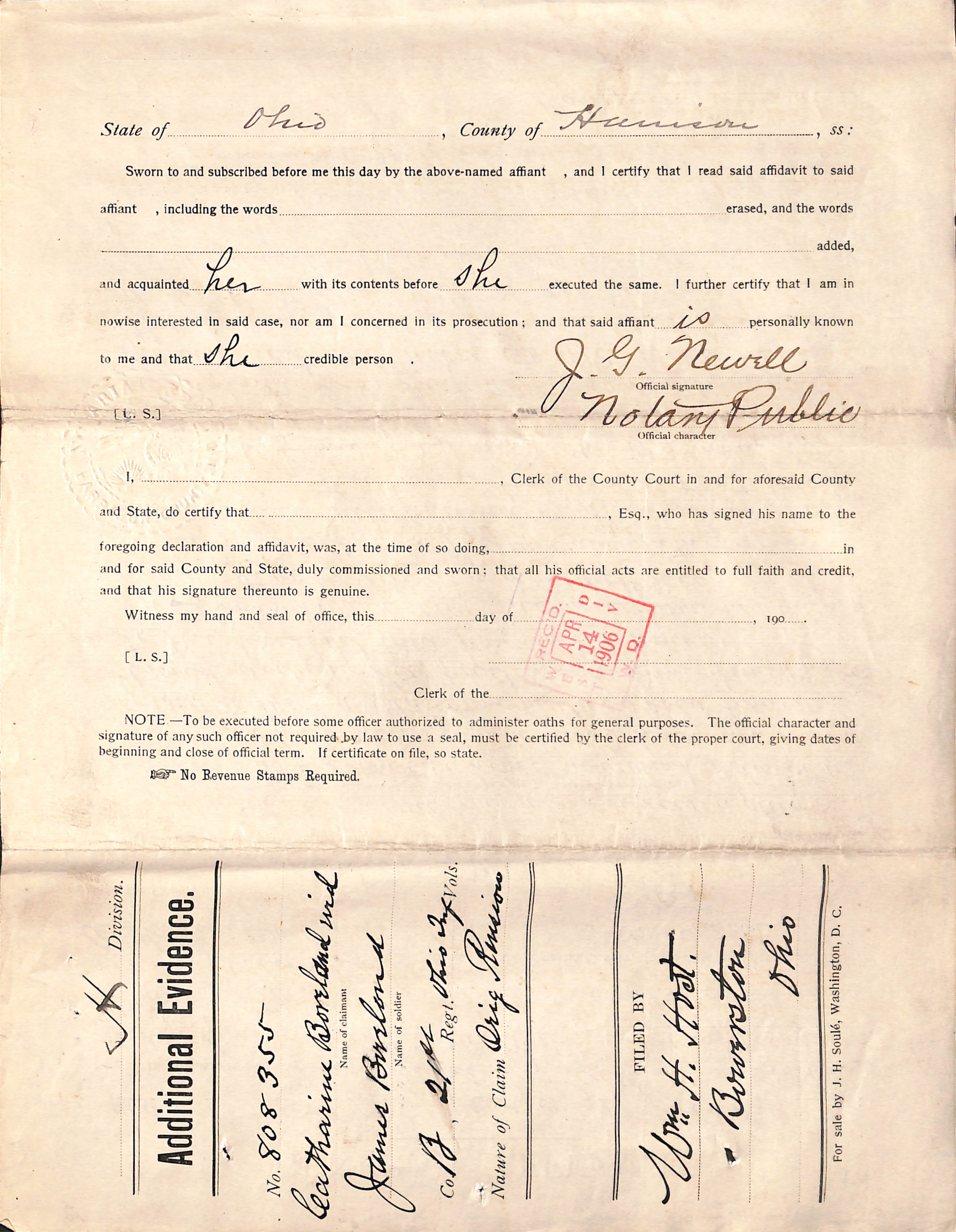
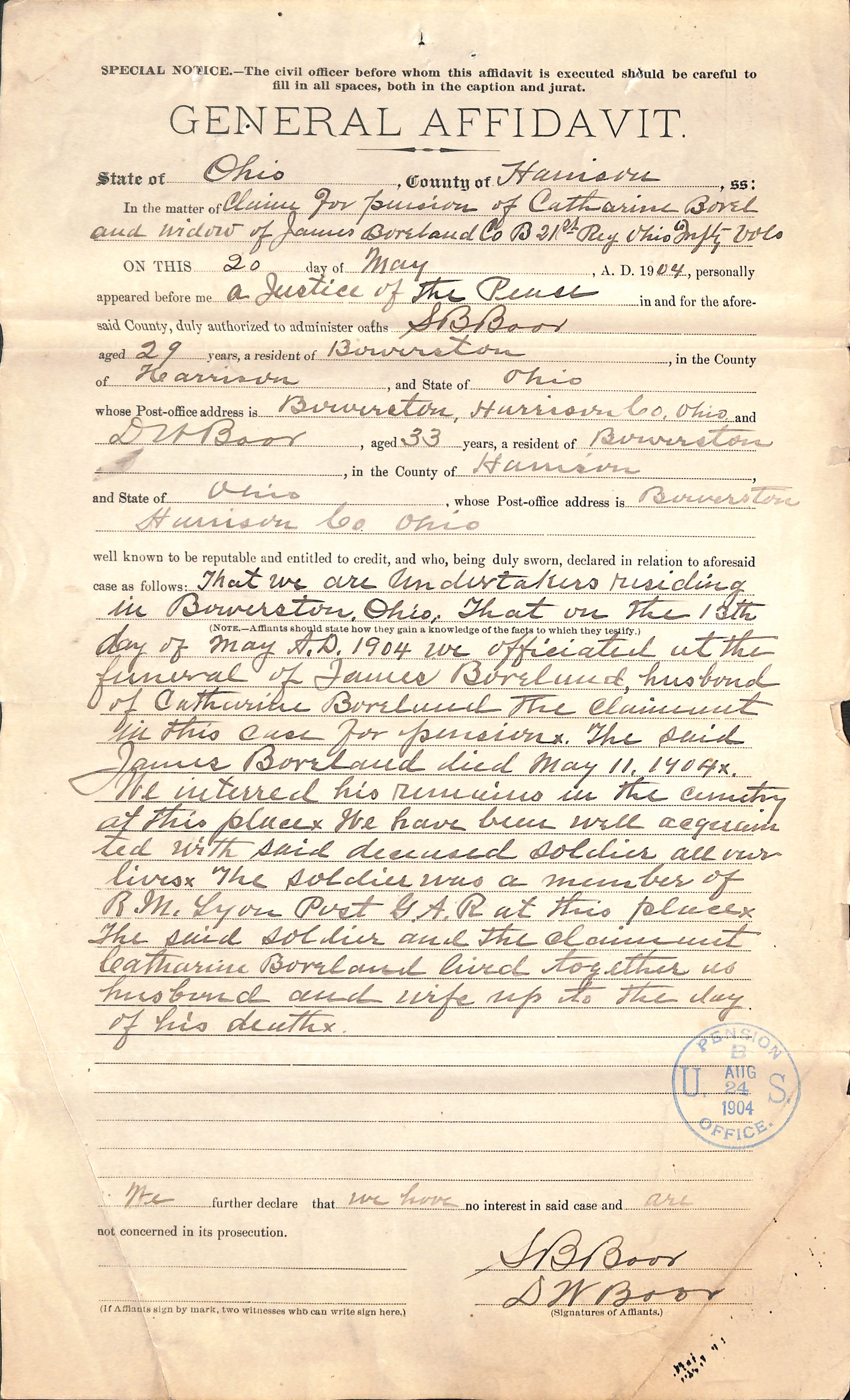
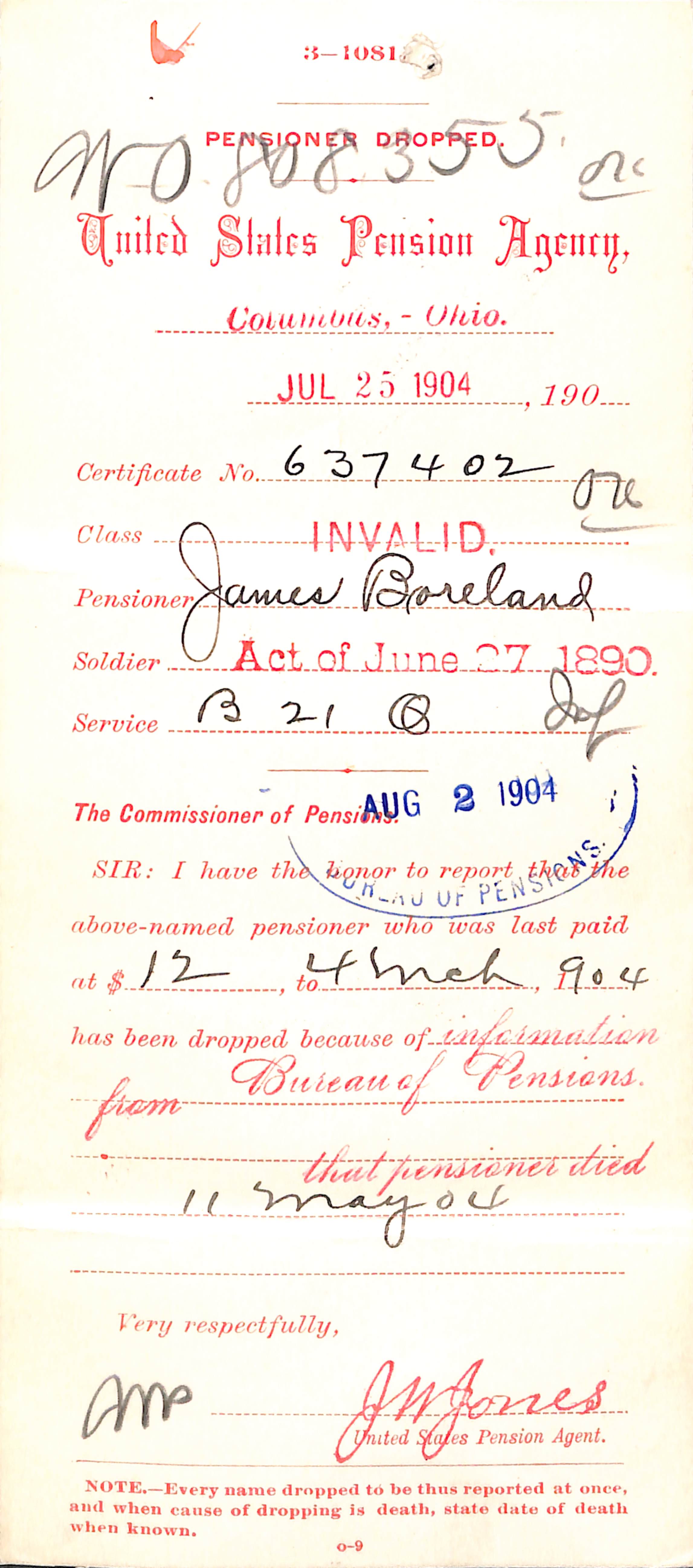
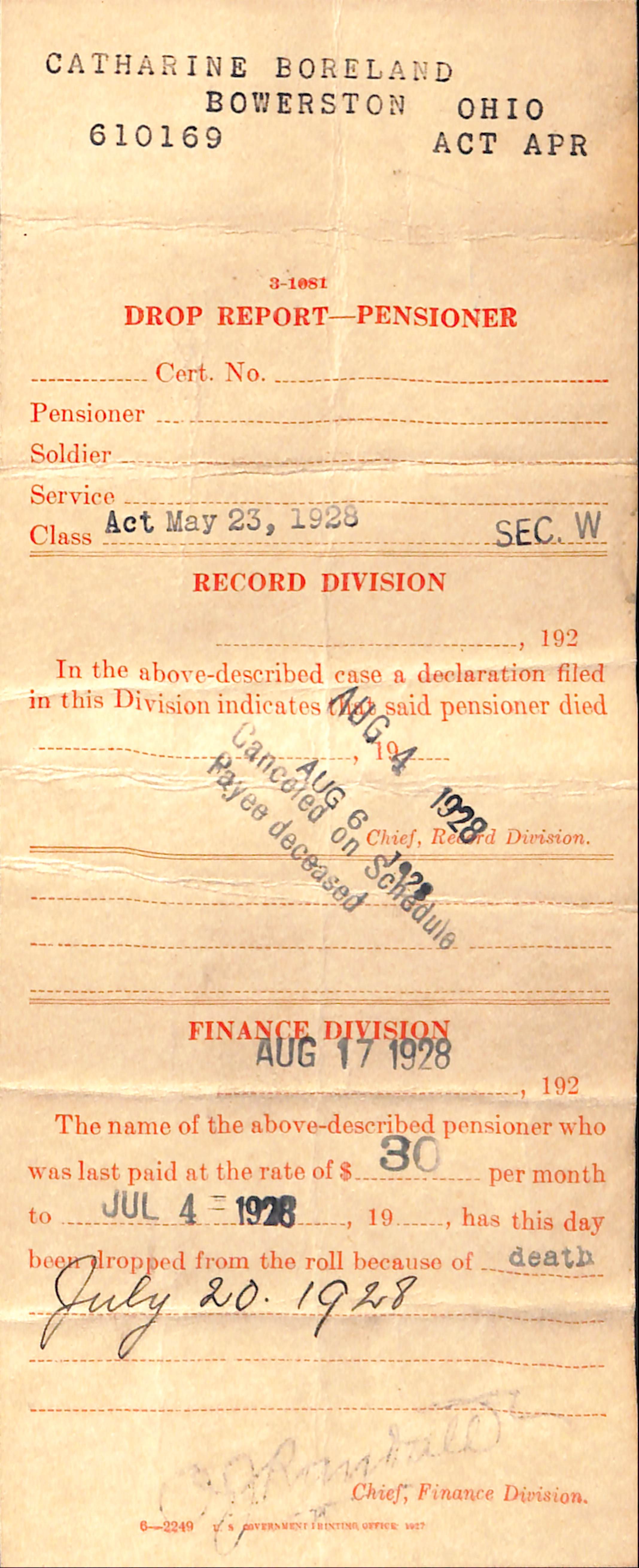
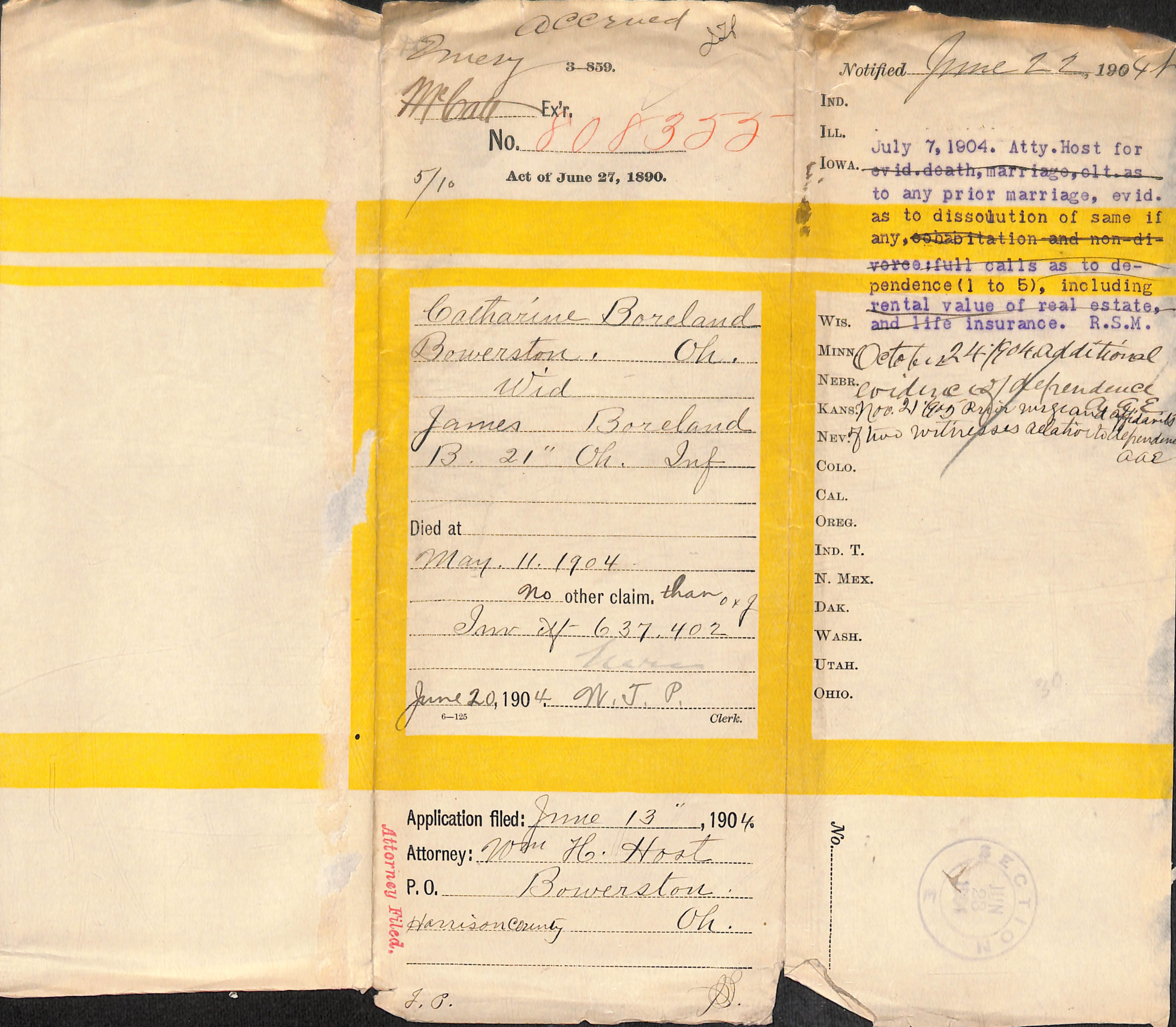
James Borland died May 11, 1904, and Catharine J. (nee Walker) Borland, James' widow, with the assistance of attorney Host, filed for a widow's pension. Pension certificate No. 610,169 indicates that she was granted a pension of $8 per month, commencing on June 13, 1904.
While Catherine's claim was processed fairly smoothly, there are an abundance of records on file,
which provide some historical information about her and the family18.
A brief summary of those facts is as follows:
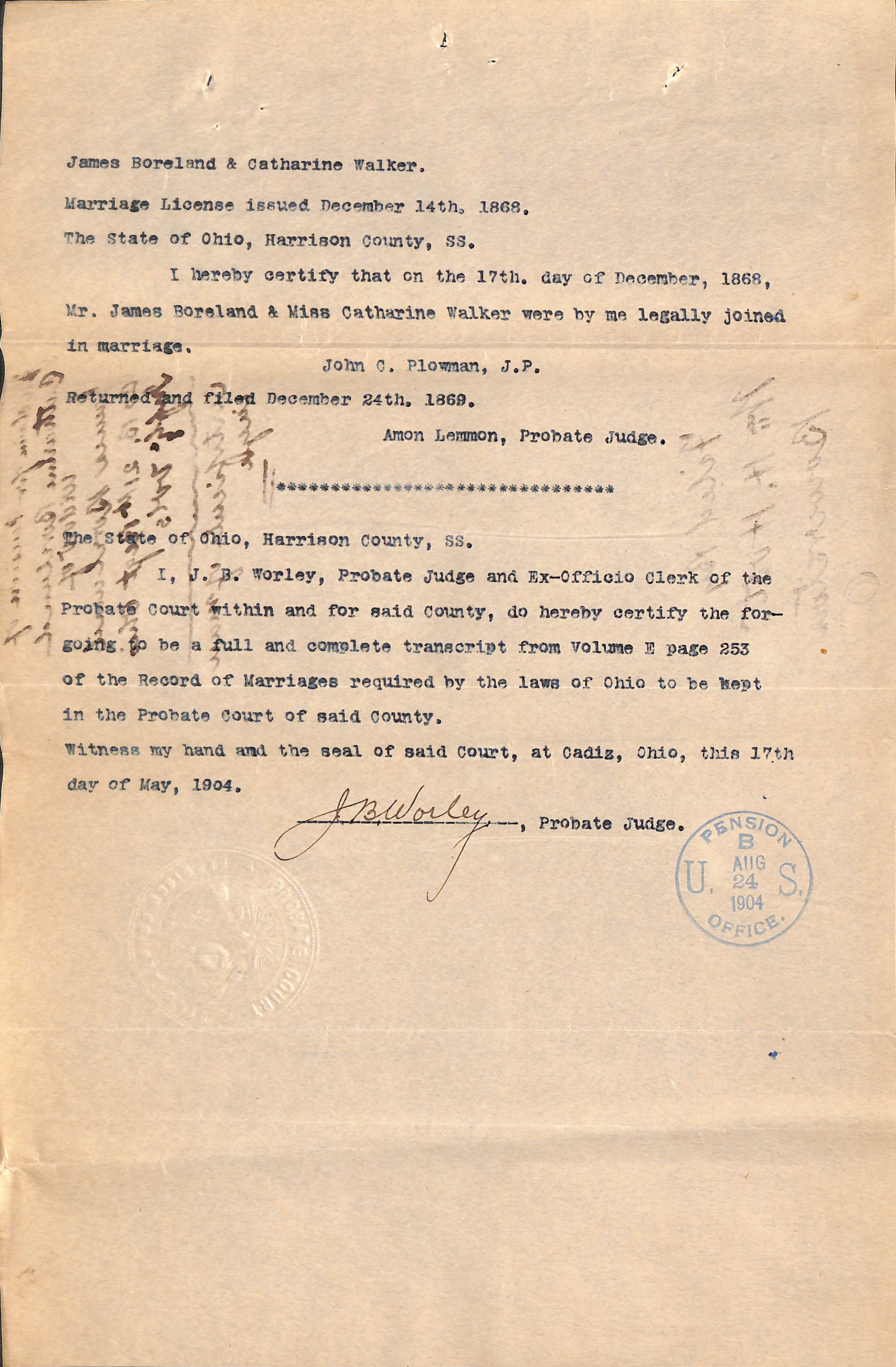
- James and Catherine were married December 17, 1868, by John C. Plowman, Justice of the Peace, in Harrison County, Ohio.
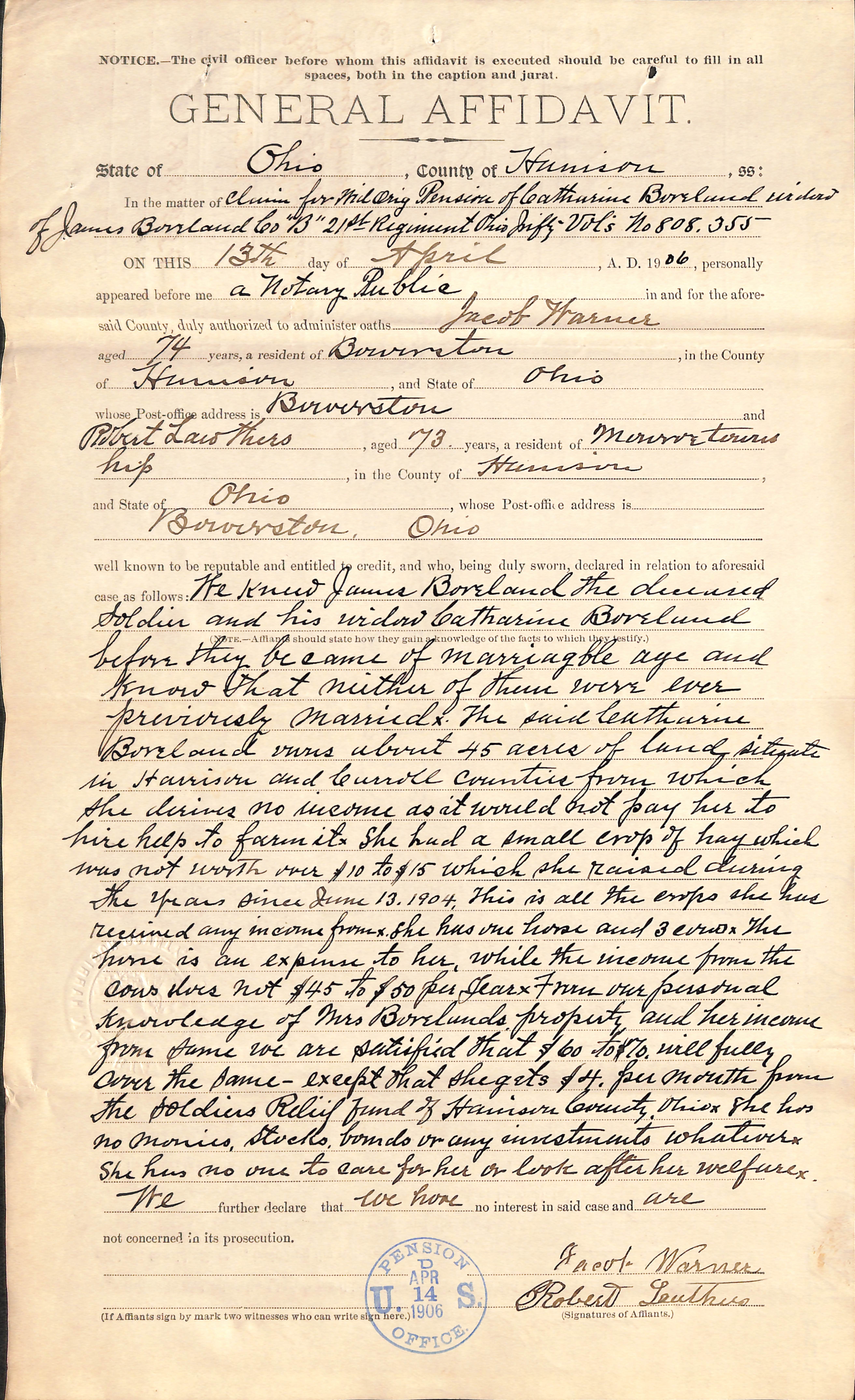
- Neither James nor Catherine had been previously married.
- Their daughter-in-law Edith L. Borland was listed as a witness on several of the documents on file. In 1904, she stated that she had known Catherine for 7 years.
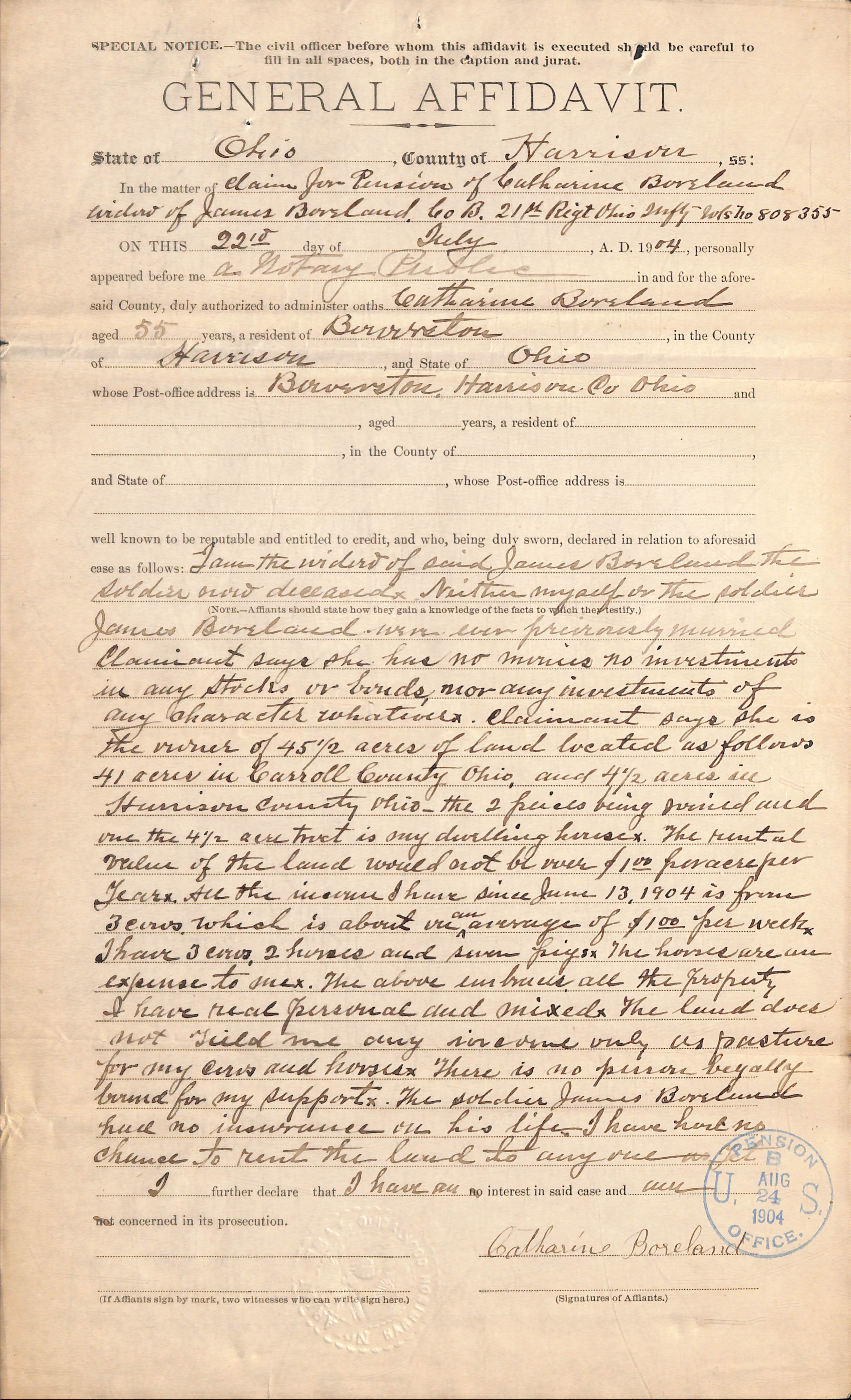
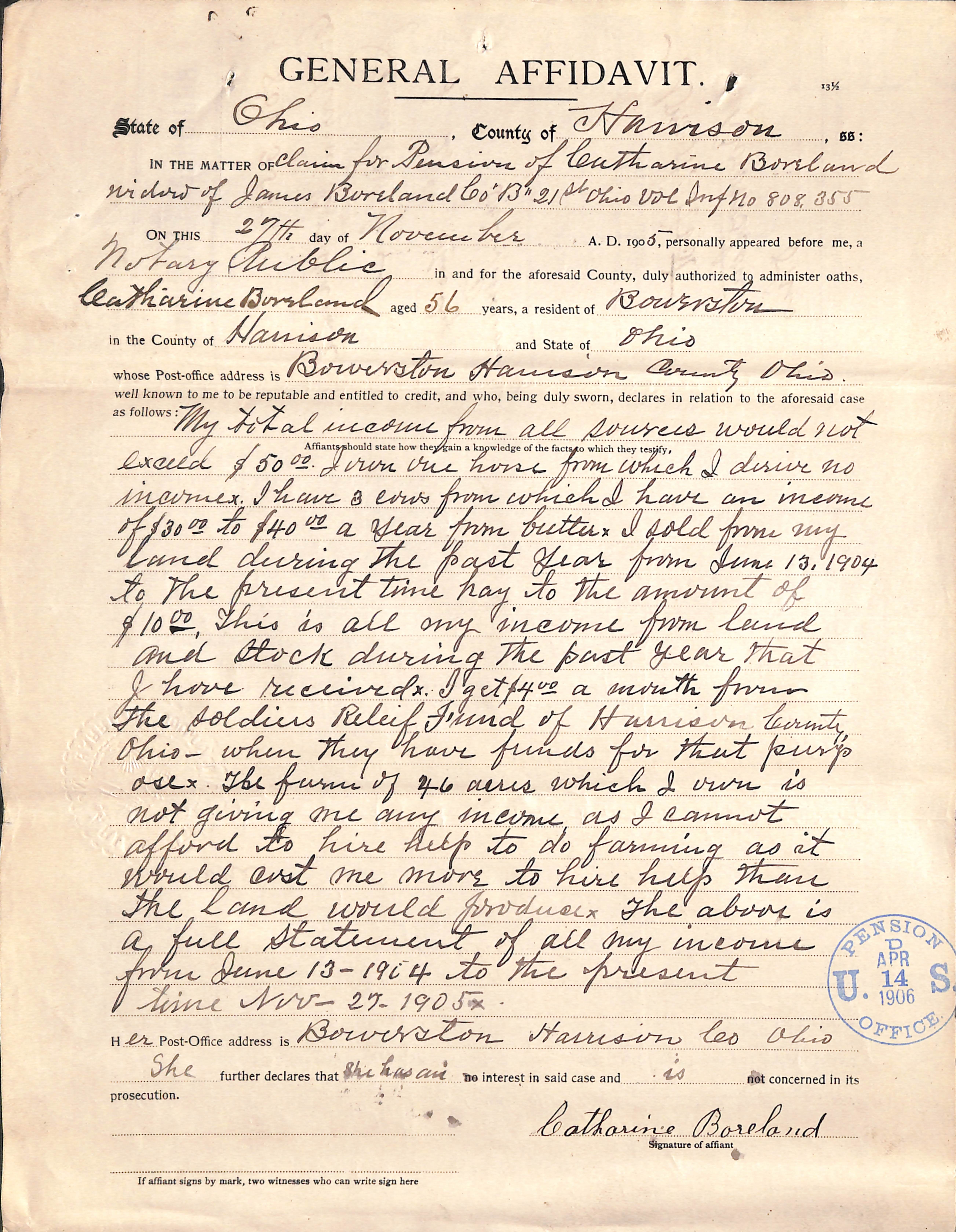
- In her application, Catherine claimed she had "no monies, no investments in any stocks or bonds, nor any investments of any character whatever.
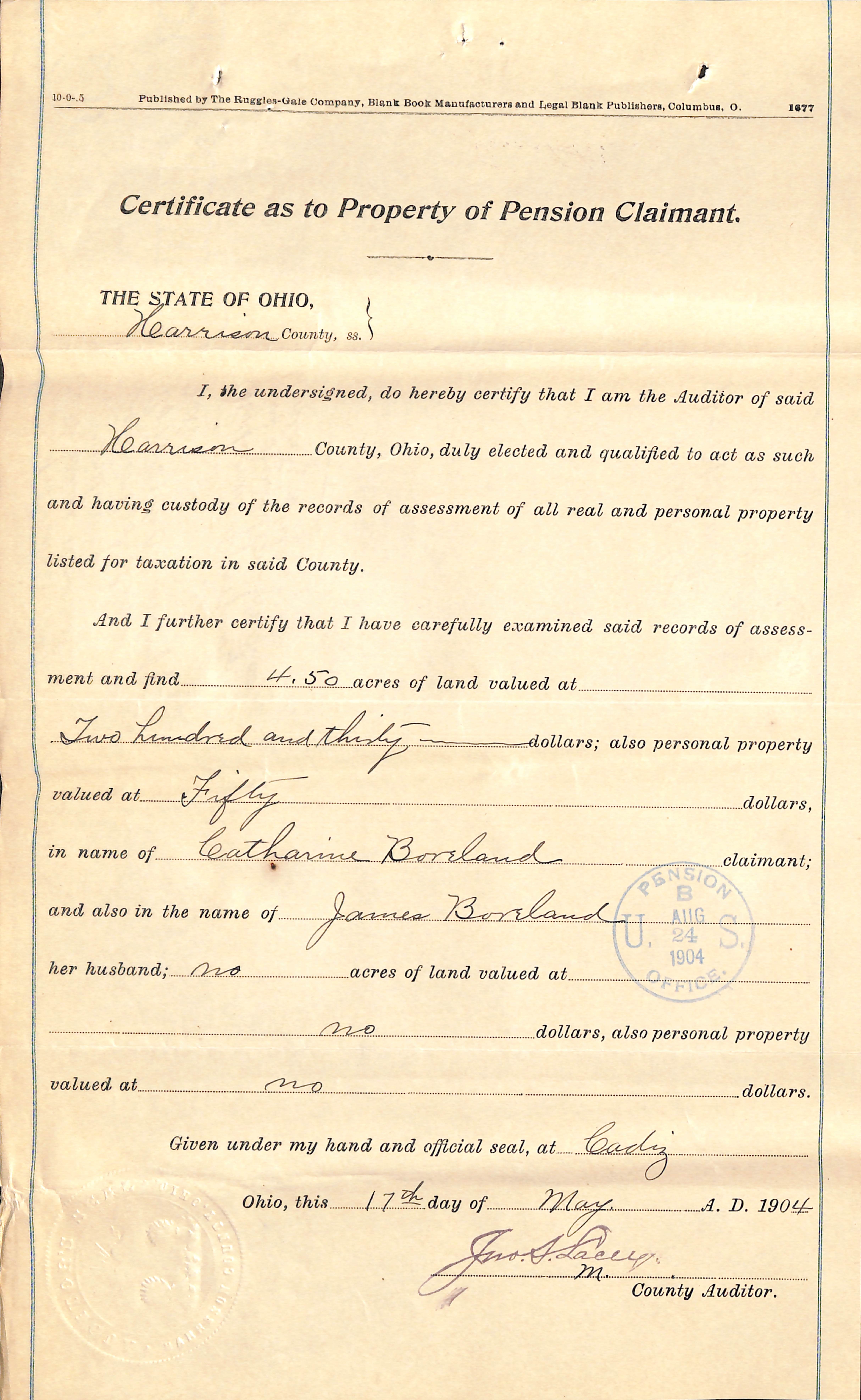
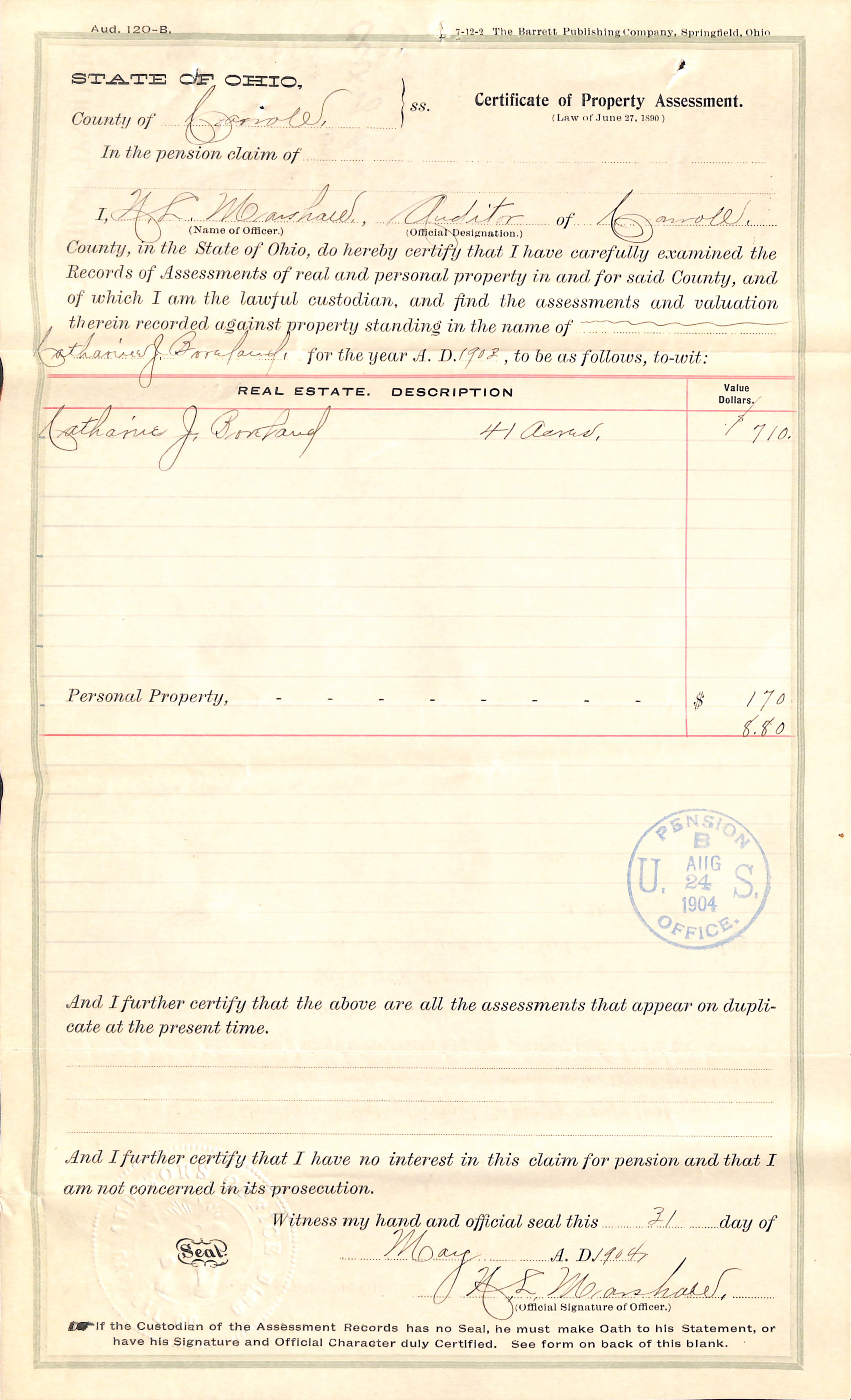
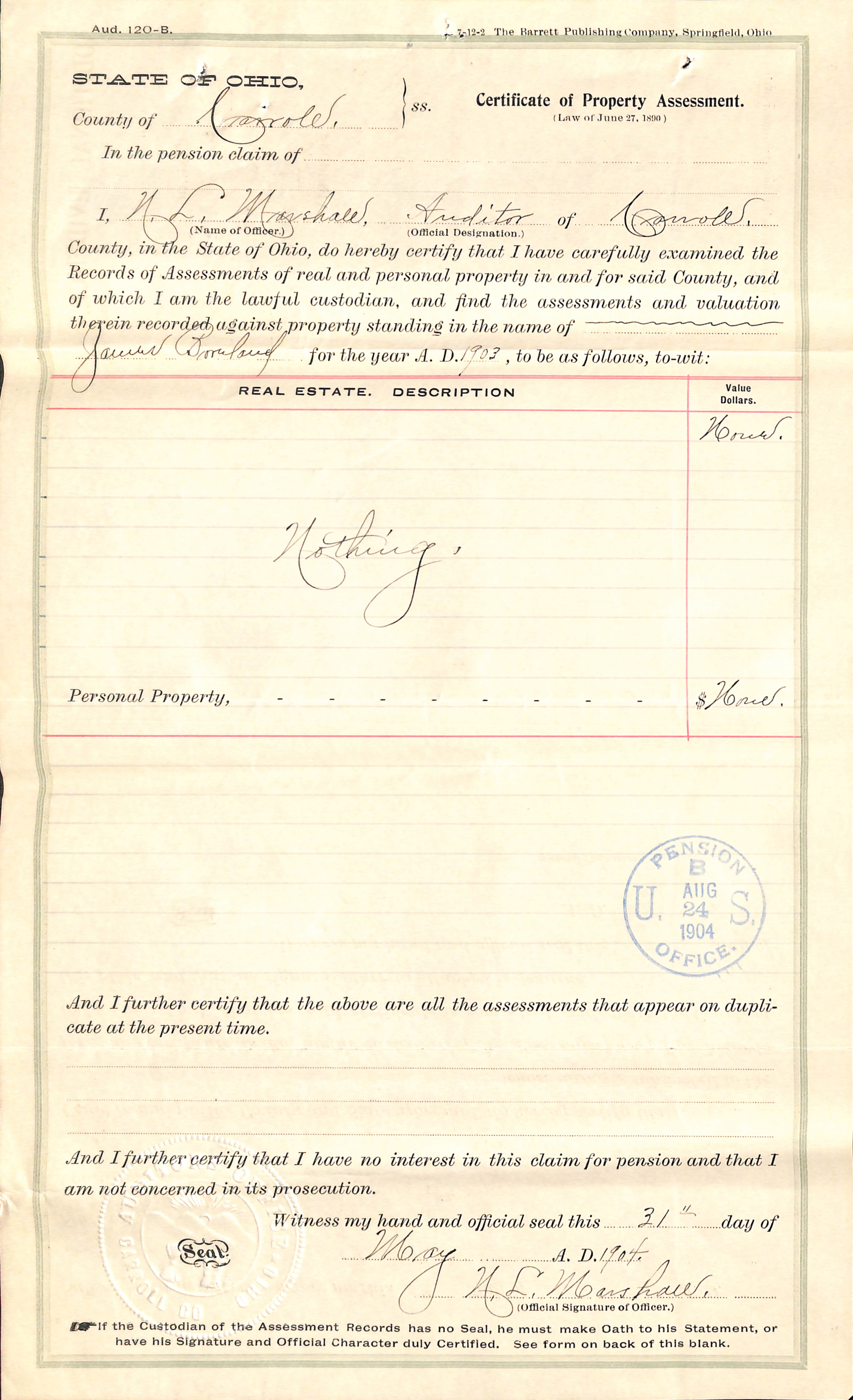
- Catherine owned 45 1/2 acres of land (41 acres in Carroll County and 4 1/2 acres in Harrison County, valued at $710 and $230 respectively).
- Catherine's income after James' death was primarily derived from 3 cows, from which she earned approximately $1 per week in butter sales. She also had a small crop of $10 to $15 worth of hay in 1904. She owned 2 horses and 7 pigs.
- James did not have a life insurance policy.
- Catherine was also receiving $4 per month from the Soldiers Relief Fund of Harrison County.
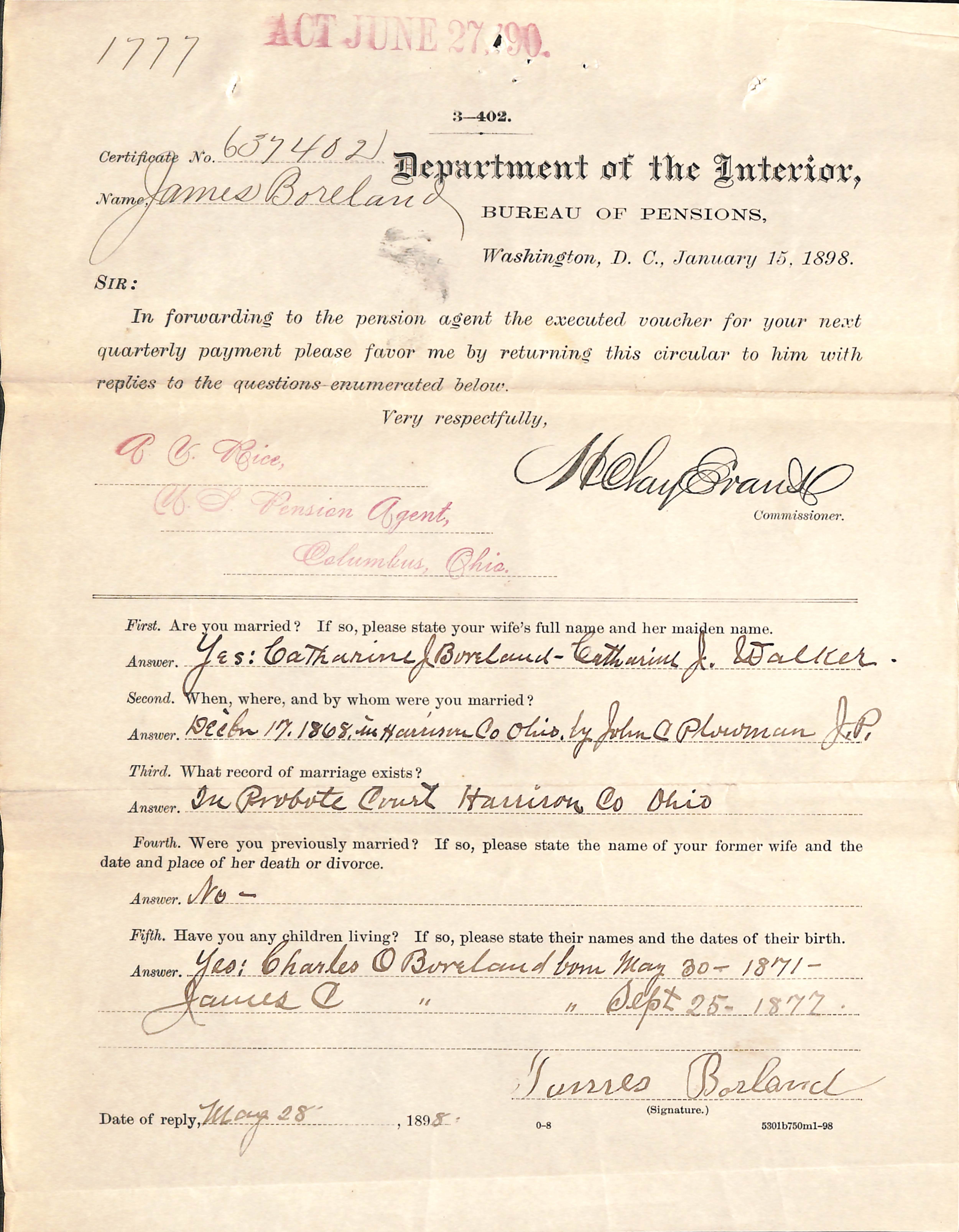
- James and Catherine's living children in 1898, per a statement on file by James Borland, were Charles O. Borland born May 30, 1871, and Jamse C. Borland, born September 25, 2877.
Conclusion
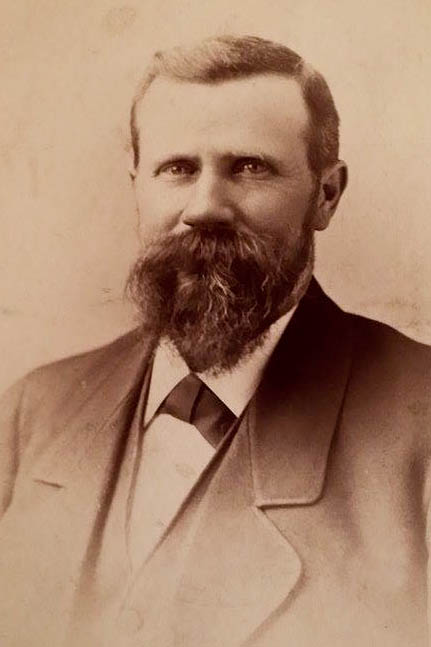
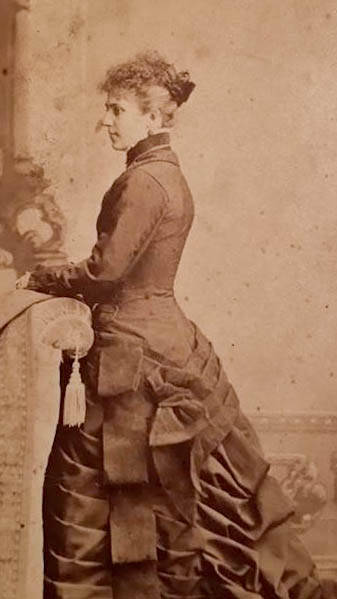
Civil War pension records can be an invaluable resource for genealogists, offering glimpses into the lives of ancestors beyond their military service. These documents often capture unique details about injuries, family life, and personal struggles not found in online vital records. For those interested in retrieving such records, I highly recommend Brian Rhinehart’s services at Civil War Records. Brian promptly located and retrieved the documents for this article, and the quality of the scans was excellent.
Image Gallery