Written February 15, 2026
This article is an update to Using DNA Match Clustering to Assist in Determining the Parents of My Ancestor Hannah Welch (November 2025).
The article Beyond Hannah Welch (November 2025) established key facts about Hannah Welch's life and origins. Hannah was born April 5, 1824, in Harford County, Maryland, as stated in the 1850 census. She grew up in Franklin Township, Harrison County, Ohio, having arrived there as a young child with her pioneering family. She married John Peregoy Smith on February 13, 1845, and they settled in neighboring Stock Township, Harrison County, where they raised ten children.
Hannah's mother was identified as Margaret, born around 1793 in Harford County, Maryland. Margaret married John Delong (widowed from a prior marriage to a Welch) in 1828; after John Delong's death, she remarried Nicholas Wheeler in 1841. The 1850 census confirms Margaret was born in Harford County, Maryland. Until 2026, Hannah's father—Margaret's first husband—remained unknown; no trace of him has been found in Ohio records, supporting the theory that he died in Maryland before Margaret migrated westward. Extensive research into Welch households in the region revealed that none of the local Welch families appeared to be from Harford County, and thus none could be confidently linked to Hannah's father.
The November 2025 article Using DNA Match Clustering to Assist in Determining the Parents of My Ancestor Hannah Welch applied genetic genealogy to Uncle Jeff Borland's Ancestry DNA matches in an effort to find additional clues to Hannah's parentage. Jeff is Weldon Earl Borland's son; Hannah Welch is Weldon's great-great-grandmother.
The analysis was based on the Leeds Method—clustering shared DNA matches to group them by the ancestors through which they relate to the test subject. Over several years, the author manually reviewed hundreds of Jeff's DNA matches, building out family trees where possible and using Ancestry's color-coding system to tag matches by which of Jeff's great-great-grandparents they appeared to descend from. Ancestry's SideView tool, which automatically sorts matches into paternal versus maternal, helped narrow the focus to paternal matches only.
At the great-great-grandparent level, Jeff's paternal matches were organized into clusters corresponding to each of Weldon's eight paternal great-great-grandparents. The Hannah Welch cluster contained 42 matches (with 12 known tested descendants of Hannah among Jeff's matches). In addition, 68 matches formed an "unknown" cluster—the "Tara Cluster"—that did not overlap with any known ancestral group.
The Hannah Welch cluster exhibited internal structure: it consisted of two sub-clusters connected by a single donor (Lloyd) who belonged to both. By process of elimination—the cluster did not overlap with John Peregoy Smith's known Smith and Peregoy clusters—the matches were attributed to Hannah rather than her husband.
Small sub-cluster (6 matches): Four of the six matches were from the same Fisher family in Harford County, Maryland. Their ancestry traced to Thomas Fisher (b. 1843) and Rachel (Bennington) Fisher, and back to grandparents Madison Fisher (b. 1814) and Eliza (Boyd) Fisher (b. 1815) of Dublin, Harford County, and on the maternal side Thomas Bennington (b. 1808) and Sarah (Barrett) Bennington (b. 1818), both born in Pennsylvania. This validated the cluster's assignment to Hannah, since Jeff's other paternal ancestors in that generation were not from Harford County. Madison or Eliza (Boyd) Fisher were proposed as possible younger siblings of Hannah's mother Margaret. The overlap with the Tara cluster also revealed a mother-daughter pair descended from Elizabeth M. (Welch) Busby (b. 1802), allegedly the daughter of Jacob Welch—a potentially related Welch family to explore.
Large sub-cluster (25 matches): No close relationships were identified within the trees of the 10 donors with public trees. The common ancestor was likely too far back to detect with the available data.
Theories discussed: The article explored how Margaret might have come to Ohio as a widowed single mother—possibly migrating with aligned families (Wheeler, Price, Smith, Busby) who had known each other in Baltimore and settled in Harrison County. Pedigree collapse among these families could explain why a separate cluster for Margaret was not observed. The article also noted ongoing work to reconstruct Hannah's genome using Borland Genetics tools.
We now have considerably more data to work with thanks to the release of Ancestry's new Pro Tools suite, which has enhanced matching and clustering options. Notably, Pro Tools can reveal the cM shared between shared matches within a cluster, providing deeper insight into how matches relate to one another. As of February 15, 2026, Jeff Borland has 68 DNA matches that appear to cluster with Hannah Welch's side of the family—nearly double the 42 matches identified in the original November 2025 analysis. The number of identified tested descendants of Hannah among those matches has also increased from 12 to 13.
I manually built trees for as many of the 68 kits as possible and expanded the trees of the matches from the previous study. I focused on shared lineages between DNA matches that matched one another by over 100 cM—even when they matched Jeff with as little as 20 cM—to identify likely common ancestors. I discovered that 5 of the matches (including Charlotte and James mentioned in the previous study) descended from John and Martha Jane (Barrett) McFadden. Martha Jane was born in 1782 in Maryland; the McFaddens first settled in Belmont County, Ohio, after leaving Maryland. I therefore concluded that she and Margaret were likely sisters, and that Sarah (Barrett) Bennington must have been their niece.
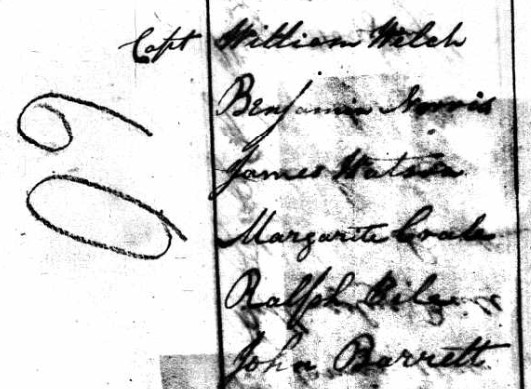
The next step was to find the Barrett family in the 1800 census of Harford County, Maryland. The following household fits the known facts:
| Category | Count |
|---|---|
| Name | John Barrett |
| Home in 1800 | District 3, Harford, Maryland |
| Free White Persons - Males - Under 10 | 1 |
| Free White Persons - Males - 16 thru 25 | 2 |
| Free White Persons - Males - 26 thru 44 | 1 |
| Free White Persons - Males - 45 and over | 1 |
| Free White Persons - Females - Under 10 | 1 |
| Free White Persons - Females - 10 thru 15 | 1 |
| Free White Persons - Females - 16 thru 25 | 2 |
| Free White Persons - Females - 45 and over | 1 |
Margaret (b. ~1793) would have been 7 in 1800, placing her in Females Under 10. Martha Jane (b. 1782) would have been 18, placing her in Females 16 thru 25. This household is the only Barrett family in the 1800 census of Harford County that has ticks in both of those categories—Females Under 10 and Females 16 thru 25—making it the only one that could plausibly contain both sisters.
The proximity of the Barrett and Welch households in the same district suggests that Margaret Barrett and William Welch may have known each other as neighbors before eventually marrying.
A review of Harford County marriage records reveals that William Welch married Elizabeth Horton on July 29, 1794. Thus in the 1800 census, William and Elizabeth would have been married six years and had young children, including a son Charles (born 1800).
By 1810, William Welch was enumerated in Havre de Grace, Harford County. His household comprised:
| Category | Count |
|---|---|
| Name | Wm Welch |
| Residence (6 Aug 1810) | Havre De Grace, Harford, Maryland |
| Free White Persons - Males - Under 10 | 1 |
| Free White Persons - Males - 26 thru 44 | 1 |
| Free White Persons - Females - Under 10 | 4 |
| Free White Persons - Females - 10 thru 15 | 2 |
| Free White Persons - Females - 16 thru 25 | 1 |
| Free White Persons - Females - 26 thru 44 | 1 |
| Free White Persons - Females - 45 and over | 1 |
A further discovery ties the Tara cluster to William's household. Eleven of the matches in what was previously called the Tara cluster descend from Charles Welch, born 1800 in Maryland. The 1850, 1860, and 1880 censuses all approximate his birth year as 1800. We know Charles lived to adulthood, marrying and having children; the male under 10 in William's 1800 household must therefore have been Charles, who was likely born early in 1800—William and Elizabeth's son. Charles settled in Adams County, Ohio; his descendants are known, and he could not have been the father of Hannah Welch.
Based on this information, I now conclude that Hannah's father was Captain William Welch himself and that Charles was her half-brother. Elizabeth Horton must have died in the 1810s, and William must have remarried Margaret Barrett. William fathered one more child by her—Hannah Welch, born in Harford County, 1824—prior to his death. After William's death, Margaret must have joined her sister Martha in Belmont County, Ohio, where she would have met her next husband, John Delong, who resided across the border in neighboring Harrison County, Ohio. Everything fits nicely.
Of the 55 matches that cluster with Hannah Welch's side of the family (not including her descendants), 44 cluster with Margaret Barrett—none of whom are her descendants—and 11 cluster with William Welch, all of whom are his descendants via Charles.
The discovery of Hannah's parents, William and Margaret (Barrett) Welch, now raises additional genealogical questions: the name of John Barrett's wife (Margaret's mother), the identity of Sarah (Barrett) Bennington's father, and what William Welch was the captain of—a sea captain, or perhaps the captain of a local militia?
Charles Welch's 1880 census entry states that his father was born in Wales. That explains the lack of DNA matches outside his 24 descendants—11 through Charles and 13 through Hannah. William's siblings, if he had any, did not immigrate to the United States and have descendants who have partaken in commercial DNA testing.