Introduction
My direct maternal great-grandmother, Eva (Douse) Rice, was born in Lithuania on December 23, 1882. At least, that was the date she celebrated as her birthday, although it may not have been her actual date of birth. Her father, John Douse (Jonas Daukša), was born in July 1859 and immigrated to the United States in 1889, settling initially in Shenandoah, Pennsylvania, where he worked in the region’s coal mines.
John was one of three Douse brothers who emigrated from Lithuania to Pennsylvania during the late nineteenth century. His brother Michael Douse (Mykolas Daukša) had arrived in 1882 and eventually operated a restaurant in Centralia, Pennsylvania. A third brother, Peter Douse (Petras Daukša), followed in 1891. By the turn of the twentieth century, all three brothers were living in Centralia, a thriving coal-mining community in Columbia County. These immigration dates are drawn from census records, as passenger arrival records have not yet been located for any of the three brothers.
There is also intriguing evidence that the brothers’ mother may have joined them in America. Although her name remains unknown and I have not identified her in any census, the Bloomsburg Morning Press reported on January 24, 1916, that a ninety-year-old woman identified as Mrs. E. Douse, described as one of the county’s oldest residents, had died in Centralia following an evacuation caused by a fire. Her identity has not been conclusively established.
Eva’s own journey to America is better documented. She immigrated as a young child with her mother and older sister, Mary Douse (Marijona Daukšaitė), who was born in June 1880. Unlike the three brothers, the women and children can be identified in a surviving passenger record. They sailed from Liverpool aboard the SS Arizona of the Guion Line, arriving in New York Harbor on September 22, 1890. Their mother was recorded on the passenger list as Alistae Douse, an unusual rendering of a name that may have been mistranscribed or anglicized. Unfortunately, the record identifies their European place of origin only as “Poland,” providing no village or parish that might help locate the family’s ancestral home.
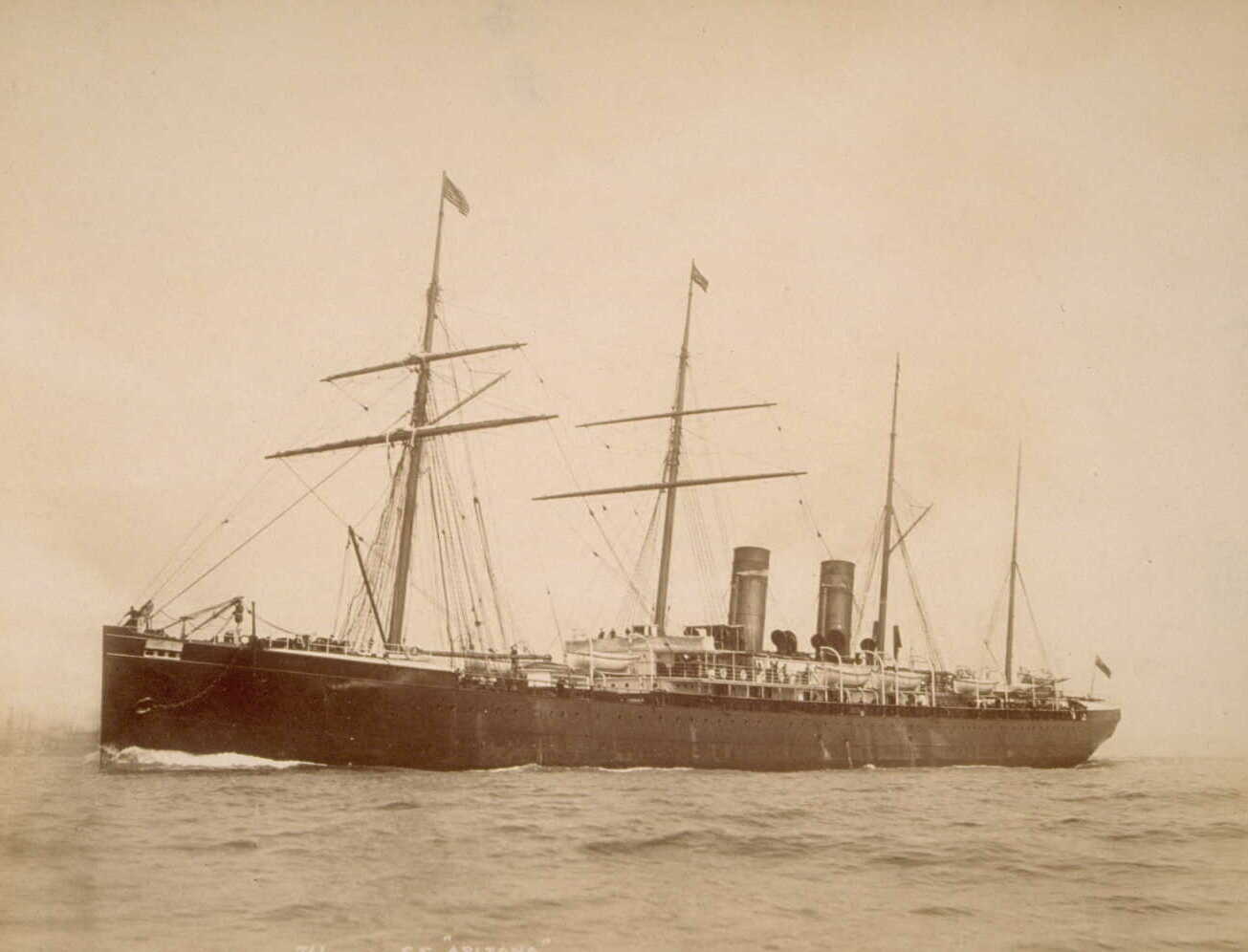
Eva’s mother appears to have died within a few years of the family’s arrival. By 1896, John Douse had remarried a woman named Anelė, whose maiden name is also unknown. John and Anelė had two children, Joseph Jacob Douse and Charles Douse, both born in Pennsylvania. Although I have not located a death record for Eva’s mother, John’s subsequent marriage establishes that she had died, or that the first marriage had otherwise ended, by that time.
As adults, Eva and her sister established families of their own. Mary married John Shotis (Jonas Šatys), and the couple eventually settled in Detroit, Michigan. Eva married Peter Rice, a Lithuanian-American whose family originated near Bartninkai in the Vilkaviškis district of the Marijampolė region of present-day Lithuania. Eva and Peter settled in Jersey City, New Jersey, where Peter operated a restaurant.
By 1920, John Douse was living with Eva and the Rice family in Jersey City. He was recorded as unmarried, suggesting that his second wife, Anelė, may also have died by that time. No death record has yet been found for John, leaving the final years of his life another unresolved chapter in the family’s history.
Despite the considerable amount of information I have assembled about the Douse family in America, two fundamental questions remain unanswered. What was the correct given name and maiden name of Eva’s mother, and where, precisely, did the Douse family originate?
The unusual name recorded for Eva’s mother on the 1890 passenger list has proved particularly troublesome. Without a reliable maiden name, identifying her parents or tracing her ancestry in European records is exceptionally difficult. Equally frustrating is the absence of a specific Lithuanian birthplace for John Douse and his brothers. The family’s origins may lie within the borders of modern Lithuania or in a neighboring, historically Lithuanian-speaking region of present-day Poland.
These questions represent what I consider the largest remaining brick wall in my ancestry. Traditional genealogical research has brought me this far, but the surviving American records have not provided the answers I need.
In this investigation, I intend to explore whether genetic genealogy can help identify Eva’s maternal family and pinpoint the Douse family’s ancestral home. By examining DNA matches, reconstructing ancestral relationships, and combining genetic evidence with documentary research, I hope to uncover clues that have remained hidden for more than a century.
An Inventory of Our Ancestry DNA Resources
Before beginning the genetic investigation, it is worth taking inventory of the DNA tests available among Eva Douse’s descendants and those of her extended family. Fortunately, we have a substantial number of tested relatives at Ancestry.com, representing several branches of the family. These tests provide an opportunity to identify and compare DNA matches that may lead us back to the Douse family’s origins in Europe.
I manage three particularly important DNA kits: that of my mother, Kathleen Borland, her sister Barbara, and my cousin Paula, who descends from Eva’s older sister, Mary (Marijona Daukšaitė) Shotis.
Beyond these three kits, another eleven Rice/Douse descendants have tested with Ancestry, not including my brother and me. Two additional Shotis/Douse descendants have also tested. Although I do not manage their kits, their presence in the Ancestry database is extremely useful. Their shared matches and known genealogical relationships can help identify clusters of individuals connected to the Douse family, even when I cannot directly examine all their DNA results.
There is also an important connection to another branch of the family. Joseph, a documented descendant of Michael Douse (Mykolas Daukša), appears among my mother’s Ancestry DNA matches. Michael was the brother of Eva’s father, John Douse (Jonas Daukša), so Joseph represents a separate line descending from the preceding generation of the Douse family. His matches may help distinguish DNA associated with the broader Daukša family from DNA inherited through Eva’s mother.
Not every branch of the family offers the same opportunities for genetic comparison. The third immigrant brother, Peter Douse (Petras Daukša), died without children. Eva’s paternal half-brother, Joseph Jacob Douse, had one child, a daughter named Valira Ann Douse, who died at the age of twelve, leaving no descendants. Her other paternal half-brother, Charles Douse, had two children who survived to adulthood, but I have not identified any of their descendants among the Ancestry DNA test-takers.
These gaps are unfortunate because descendants of John Douse’s second marriage would be particularly useful. They would share John’s ancestry with the descendants of Eva and Mary, but not the ancestry of Eva’s mother. Comparing those branches could help separate DNA inherited from the Daukša family from DNA inherited through Eva’s unidentified maternal family.
Nevertheless, the number of tested descendants already available gives us a promising foundation for the investigation. In particular, the presence of descendants of both Eva and Mary, together with a known descendant of their paternal uncle Michael, provides several opportunities to distinguish between different ancestral connections.
The challenge now is to make sense of the thousands of DNA matches associated with these kits.
For that purpose, I will begin by examining the Ancestry matches of the three relatives whose kits I manage: Kathleen, Barbara, and Paula. By comparing their shared matches and organizing those matches into genealogical clusters, I hope to isolate groups associated with the Douse family and, ultimately, identify connections that may reveal the origins of Eva’s parents.
Preliminary Cluster Assignments (≥25 cM)
To keep the first pass manageable, I limited this stage to Ancestry matches sharing at least 25 cM with the kit under study. The counts below summarize how those matches were sorted into working clusters and summary lines along Kathleen, Barbara, and Paula’s Lithuanian ancestral lines. Note: Margaret, daughter of Peter and Eva (Douse) Rice was the mother of Kathleen and Barbara. In the tables, Alistė is my working Lithuanian reading of the name recorded as Alistae Douse on the Arizona passenger list—not a separately documented identification.
| Assignment | Kathleen (Mom) | Barbara |
|---|---|---|
| Margaret Rice descendants | 3 matches | 3 matches |
| Margaret Rice singletons* (unresolved Rice vs. Douse) | 8 matches; highest 42 cM | 5 matches; highest 32 cM |
| Jurvic cluster (unresolved Rice vs. Douse) | 4 matches; highest 32 cM | 5 matches; highest 45 cM |
| Susevich cluster (unresolved Rice vs. Douse) | — | 2 matches; highest 30 cM |
| Gelgut cluster (unresolved Rice vs. Douse) | 3 matches; highest 26 cM | 2 matches; highest 26 cM |
| Peter and Eva (Douse) Rice descendants (excluding Margaret Rice descendants) | 11 matches | 12 matches |
| Peter Rice side (not Douse) | 78 matches; highest 143 cM | 64 matches; highest 116 cM |
| John Douse & Alistė descendants (excluding Eva Douse descendants) | 3 Shotis cousin matches | 1 Shotis cousin match |
| Eva Douse singletons* (unresolved John Douse vs. Alistė) | 1 match; 26 cM | 1 match; 26 cM |
| Stramik cluster (unresolved John Douse vs. Alistė) | 6 matches; highest 46 cM | 2 matches; highest 29 cM |
| Basgil cluster (unresolved John Douse vs. Alistė) | 5 matches; highest 31 cM | 4 matches; highest 38 cM |
| Jankauskas cluster (unresolved John Douse vs. Alistė) | 7 matches; highest 26 cM | — |
| John Douse side (not Alistė) | 3 matches; highest 29 cM | 3 matches; highest 70 cM |
| Alistė side (not John Douse) | 0 matches | 0 matches |
| Assignment | Matches / notes |
|---|---|
| Shotis / Daukša / Grigas / Vepatos descendants | 1 match |
| Unresolved Shotis/Douse vs. Grigas/Vepatos | 14 matches |
| Grigas/Vepatos side (not Shotis/Douse side) | 11 matches |
| Shotis/Daukša descendants (excluding Grigas/Vepatos descendants) | 1 match |
| Unresolved Shotis vs. Douse | 0 matches |
| Shotis side (not Grigas/Vepatos side) | 1 match |
| John Douse & Alistė descendants (excluding Mary Daukša descendants) | 6 Rice cousin matches; highest 109 cM |
| Unresolved John Douse vs. Alistė | Williams cluster (3 matches; highest 43 cM) |
| John Douse side (not Alistė) | 3 matches |
| Alistė side (not John Douse) | 0 matches |
* Singleton: a match for which there are no other ≥25 cM shared matches that cluster with it. It may be the tip of a deeper cluster had we used a lower cM threshold, but for these counts it is treated as a singleton.
Counts reflect working assignments at the beginning of this investigation and will be refined as trees and shared-match structure are reviewed.
The “John Douse side (not Alistė)” rows above deserve a brief review so that DNA from John’s Lithuanian ancestry is not mistaken for evidence about Eva’s mother. Kathleen’s three assigned matches all cluster with Joseph, the documented descendant of Michael Douse introduced earlier. One is the son of Edward Mazeski (1907–1975) of Shamokin, Pennsylvania; his attached tree names four Lithuanian-born grandparents with the surnames Mazauskas, Matulewicz, and Stashefskie (the fourth surname is not stated), but gives no villages and shows no documentary link to the Douse family. Kathleen’s other two John-side matches have no usable tree information. Barbara’s list overlaps that pattern: her largest John-side match at 70 cM is Joseph himself, the second is the same Mazeski son, and the third again has no tree. On Paula’s kit the three John-side matches are closely related to one another and share a Lithuanian-born ancestor recorded as Joseph J. Dowches, born about 1877, place of birth unknown. The spelling Dowches is presumably another Americanized form of Daukša rather than a separate surname. Taken together, these nine assignments confirm expected Daukša/Douse cousinship—especially through Joseph and the Dowches line—but they do not supply parishes, maiden names, or other specifics that would identify Alistė or pin down the family’s Old World origin.
The remainder of this article examines the clusters most likely to illuminate Eva’s mother and whether shared DNA should be attributed to John Douse or to Alistė: the Stramik, Basgil, and Jankauskas clusters from Kathleen’s and Barbara’s assignments, and the Williams cluster from Paula’s kit.
The Williams Cluster
On Paula’s preliminary inventory, the Williams cluster appears under “Unresolved John Douse vs. Alistė,” with three matches sharing at least 25 cM. Closer examination revealed that two of these matches, John and Taryn, also match Joseph, the known descendant of Michael Douse who appears among Kathleen’s matches. Joseph himself matches Paula at less than 25 cM, which explains his absence from the preliminary inventory.
I expanded John’s family tree and established that he, too, descends from Michael Douse. Furthermore, Taryn shares an amount of DNA with Joseph consistent with approximately a second-cousin relationship, strongly suggesting that she also descends from Michael. The third member of the Williams cluster has no attached family tree, leaving that individual’s connection unresolved.
I also examined Paula’s shared matches with John and Taryn, including matches below the original 25 cM threshold, hoping to identify additional family trees containing clues to the Douse family’s European origins. Unfortunately, none provided information about specific locations within Lithuania.
The Basgil Cluster
The next group I examined was the Basgil cluster, which ultimately grew to 31 matches as I expanded the analysis to include smaller matches below my original 25 cM threshold. The largest match in the cluster, sharing 38 cM with Barbara, descended from Joseph and Magdali (Kirvelaitis) Slankauskas, both born in Lithuania during the early 1890s. Unfortunately, the available family tree did not identify their birthplace more precisely. The second-largest match, at 34 cM, descended from Anthony and Catherine (Terzewicz) Kamantauskas, both born in the late 1840s. Once again, the family tree provided no specific location within Lithuania.
The third match, Tammy, shared 32 cM with Barbara and offered our first geographic clue. Tammy descended from Mary (Bazgelas) Turuta, born about 1865 in Brazavas, Lithuania, a village located approximately 14 miles from Bartninkai, the ancestral home of Peter Rice’s paternal Račius family (Rice being the Anglicization of Račius).
This discovery immediately caught my attention. Although it was entirely possible that the Douse and Rice families had originated in neighboring Lithuanian communities, the proximity of Brazavas to Bartninkai raised another possibility: perhaps this cluster did not belong to Eva Douse’s ancestry at all, but instead represented relatives of her husband, Peter Rice.
The fourth-largest match had only a small family tree, from which I could not establish any Lithuanian ancestry. I therefore continued down the list, examining smaller matches and expanding their family trees wherever possible.
At 21 cM, I encountered Ugnė, another Slankauskas descendant. Significantly, Ugnė also clustered with descendants of Mykolas and Ieva (Jutkevičiūtė) Račius, the paternal grandparents of Peter Rice. This was the first genetic evidence supporting my suspicion that the cluster belonged on the Rice side rather than the Douse side.
Further down the list, at 19 and 18 cM, I found two descendants of the Basgela/Miscavage family, whose surname had been anglicized to Basgil in the United States. Both descended from John Basgela, born about 1850 in Lithuania. At 9 and 8 cM, I identified two additional Basgil descendants, this time through the Basgela/Yurkonis family. Their common ancestor was William Basgela, born about 1860 in Lithuania.
Taken together with Mary (Bazgelas) Turuta, born about 1865 in Brazavas, these discoveries suggested a possible family group consisting of Mary, John, and William Basgela. Their approximate birth dates and shared surname make it plausible that they were siblings or otherwise closely related, although I have not yet established their exact relationships through documentary evidence.
The cluster also contained additional descendants of the Slankauskas and Kamantauskas families, reinforcing the interconnected nature of these Lithuanian immigrant families. Importantly, both descendants of William Basgela matched at least one of the Račius cousins, providing further genetic connections to Peter Rice’s paternal ancestry. By the time I completed my review, I had identified 31 matches belonging to the cluster. Not one of these matches shared DNA with a known Douse descendant who was not also descended from the Rice family. The combined evidence was becoming difficult to ignore. The geographic connection between Brazavas and Bartninkai, the matches to descendants of Mykolas and Ieva Račius, and the absence of matches to independent Douse descendants all pointed in the same direction.
What had initially appeared to be a promising Douse cluster was almost certainly a group of Rice-side cousins. Although this meant the Basgil cluster was unlikely to help identify Eva Douse’s mother or the Daukša family’s Lithuanian homeland, it was still a useful result. By recognizing and separating a substantial cluster belonging to Peter Rice’s ancestry, I could eliminate an entire group of matches from the immediate Douse investigation and concentrate my efforts on the remaining unresolved clusters.
The Stramik Cluster
The Stramik cluster appears in all three match sets—Kathleen’s, Barbara’s, and Paula’s. However, since Paula is a generation younger (my generation), there are no representative matches in the cluster that share 25 cM or more with her. That pattern is how we can be relatively certain that the Stramik cluster belongs on the Douse side and not the Rice side, since Paula is not a Račius/Rice descendant.
Three of the six largest matches to my mother in the Stramik cluster descend from the same couple, Tomas and Konstancija (Vasiliauskaitė) Stramik, both born in Lithuania during the early 1870s. Unfortunately, their family trees do not identify their Lithuanian birthplaces. Two of the remaining six matches have no attached family trees, while the sixth belongs to an individual who appears in both the Stramik and Basgil clusters.
Initially, this overlap seemed puzzling, particularly because I had already concluded that the Basgil cluster belonged to the Rice side of my ancestry. However, this match descends from Lithuanian immigrant families associated with Pennsylvania’s coal-mining communities on multiple ancestral lines. I suspect she is independently related to the Basgil family through her father and to the Stramik family through her mother. Her maternal family tree contains a particularly interesting ancestor: Jurgis Strampickas, born in 1836 in Igliškėliai, Lithuania. The surname Strampickas bears a striking resemblance to the Americanized Stramik, suggesting that the two families may share a common origin.
According to this match’s family tree, Jurgis was the son of Jokūbas Strampickas and Marijona (Kuncaitė) Strampickienė. Jurgis married Magdalena Kicaitė, who came from the neighboring village of Pridotkai. Magdalena’s parents were Simonas Kicas and Elzbieta (Zorskiūtė) Kicienė. For the first time in this cluster, I had identified specific Lithuanian villages associated with families that might be connected to my Douse ancestors.
Another potentially important clue came from Pam, who shares 15 cM with my mother and belongs to the Stramik cluster. Pam’s family tree identifies a Lithuanian grandmother named Mary (Dauksys) Rebinskas. The surname Dauksys is particularly interesting because of its resemblance to Daukša, the original Lithuanian surname of Eva’s father, Jonas Daukša. Although the two surnames are not necessarily interchangeable, their similarity raises the possibility that the connection between my family and the Stramik/Strampickas family runs through Jonas rather than Eva’s unidentified mother.
The geographic evidence made this possibility even more intriguing. Igliškėliai lies approximately eight miles from the village of Daukšiai, while Pridotkai is only about ten miles away. Suddenly, I had several potentially related Lithuanian families concentrated within a relatively small geographic area, including a village whose name closely resembles my family’s original surname.
This leads me to a working theory: the Daukša family may have taken its surname from the village of Daukšiai, or the village may have derived its name from an earlier Daukša family. Either possibility would suggest a longstanding connection between the surname and this particular region of Lithuania.
Of course, the DNA matches do not yet establish that Jonas Daukša or his brothers were born in or near Daukšiai, nor have I documented a genealogical connection between the Daukša and Strampickas families. Nevertheless, the combination of shared DNA, potentially related surnames, and several geographically concentrated Lithuanian villages provides a promising direction for further research. For the first time in this investigation, I have a specific area of Lithuania in which to begin looking for the Daukša family’s origins.
The Jankauskas Cluster
Because my mother shared larger amounts of DNA with members of the Jankauskas cluster than did the other kits, I used Kathleen’s results for this investigation. The preliminary table lists seven matches for her at ≥25 cM; by including shared matches below that cutoff, as I did for the Basgil cluster, the working group grew to 18 matches. None of those 18 overlap with the Rice side of the family or with the Stramik cluster. Its connection to Eva Douse is supported by Ramona, a documented descendant of Eva’s sister Mary (Douse) Shotis, who also shares matches within this cluster. Although I do not manage Ramona’s DNA kit and cannot examine her complete results, her presence provides an important connection to the Douse family independent of the Rice ancestry.
Unlike the clusters examined previously, the Jankauskas cluster was our first promising candidate for DNA inherited through Eva’s mother, Alistė, rather than through her father, Jonas Daukša.
The largest match in the cluster descends from Jonas and Margarita (Jankauskaitė) Čupas, a Lithuanian couple born in approximately 1845 and 1852, respectively. Their precise Lithuanian origins remain unknown. In America, the Čupas family adopted the surname Hooper. Their son Juozas Čupas, recorded as Joseph Czupas in American census records, immigrated to the United States and settled in Shenandoah, Pennsylvania. This immediately caught my attention because Shenandoah was also the first known American residence of Eva’s father, John Douse.
The second-largest match also descends from the Hooper family, while the third descends from another Lithuanian couple, Stephan and Mary (Wilcenskie) Sattardas, both born around 1861. I have not established a genealogical relationship between the Sattardas and Hooper families.
The fourth match descends from Rosalie (Jankowska) Silvenis, born about 1875 in Pennsylvania and believed to have been a daughter of William Jankauskas. The next two matches represent another Hooper descendant and another descendant of Rosalie, respectively. Already, the repeated appearance of the Hooper and Silvenis families suggested that these were not simply unrelated Lithuanian matches grouped together by chance.
The next match, Maureen, introduced another possible family connection. Her Lithuanian ancestry includes her grandmother Anastasia Derringe, who was born in Shenandoah, Pennsylvania. Although Maureen’s tree does not connect directly to the Hooper, Sattardas, or Silvenis families, Anastasia’s paternal grandmother was a woman named Mary, born in Lithuania around 1872, whose maiden name remains unknown. It is possible that Mary belonged to the Jankauskas family or was otherwise related to the Sattardas or Wilcenskie families, but that possibility remains unproven.
What made Maureen especially interesting was the amount of DNA she shared with other members of the cluster. She matches Mary, a Sattardas descendant, at 94 cM, and Billie, a Hooper/Jankauskas descendant, at 68 cM. These are substantial matches, suggesting relatively close genealogical relationships among at least some of the families represented in the cluster. Although I have not yet determined the precise connections, the shared DNA provides a reason to investigate these families together.
Further down the list, I encountered another descendant of Rosalie (Jankauskas) Silvenis, followed by Rachelle, who clusters with both the Hooper and Sattardas descendants. Rachelle has not traced her family tree far enough to establish a documentary connection to either family. However, she had also uploaded her DNA to FamilyTreeDNA, providing something unavailable through Ancestry’s shared-match interface: the chromosomal location of our match. Rachelle matches my mother on chromosome 2, from position 45,492,076 to 71,730,056, spanning 24.9 cM. Using the Borland Genetics database, I examined this region of my mother’s phased DNA and found that the corresponding segment is also represented in the DNA of my brother, myself, and my maternal aunt Debbie. This gives me a specific chromosome segment to investigate further, rather than relying exclusively on Ancestry’s shared-match relationships. As additional relatives or members of this cluster become available for segment comparison, this region may help establish which ancestral line transmitted the DNA and whether other matches share the same segment.
Returning to the Ancestry cluster, the next two matches were another Sattardas descendant and another descendant of Rosalie Jankauskas. Then I encountered Janna, whose family tree revealed an especially intriguing connection: she descends from two separate Jankauskas lines, one of which appears in Pennsylvania records under the anglicized surname Yonkoskie. Jankauskas is an extremely common Lithuanian surname, derived from the given name Jonas and broadly comparable to the English surname Johnson. Consequently, finding multiple families with this surname does not, by itself, establish that they are related. However, one of Janna’s ancestors was Joseph Vincent Jankauskas, born in 1888, whose father was named William Jankauskas. I suspect that Joseph Vincent was a brother of Rosalie (Jankauskas) Silvenis, whose father was also believed to be William Jankauskas. If that relationship can be established, it would connect two additional branches of the cluster to the same family.
The remaining matches continued the pattern. Another Hooper descendant was followed by another descendant of Anastasia Derringe. Near the bottom of the cluster were an additional Hooper descendant, another Rosalie Jankauskas descendant, and two distant matches whose family trees have not yet revealed connections to any of the identified branches.
By the end of the investigation, the cluster appeared to center on an interconnected group of Lithuanian families, particularly descendants of Margarita (Jankauskaitė) Čupas and William Jankauskas. The repeated Hooper and Silvenis matches, the possible connection through Janna’s ancestry, and the substantial DNA relationships involving the Sattardas and Derringe descendants all suggest that these families deserve further investigation as a group.
I suspect that Alistė, the first wife of John Douse, may have been a sister of both Margarita (Jankauskaitė) Čupas and William Jankauskas. If correct, this would explain why descendants of the Hooper and Silvenis families appear in a DNA cluster connected to descendants of Eva Douse and her sister Mary Shotis. It would also suggest that Alistė’s maiden name was Jankauskaitė, opening a new avenue for documentary research in Lithuania and Pennsylvania. This remains a hypothesis. I have not found a record naming Alistė’s parents, nor have I established that Margarita and William were siblings. The precise relationships among the Sattardas, Derringe, and Jankauskas families also remain unresolved. Furthermore, because Jankauskas is such a common surname, the proposed connections require stronger documentary and genetic evidence before they can be considered established.
Nevertheless, the Jankauskas cluster has produced something that was missing when I began this investigation: a plausible maiden name for Eva’s mother and a specific family network in which to search for her origins. Whether Alistė ultimately proves to have been a Jankauskaitė remains to be seen, but the evidence has given me a much more focused question to pursue.
Conclusion: A Mystery Still Waiting to Be Solved
When I began this investigation, I knew remarkably little about the Lithuanian origins of my great-grandmother Eva (Douse) Rice. I knew that she had immigrated to America as a child, that her father and uncles had settled in Pennsylvania’s coal-mining communities, and that her mother’s name appeared on the 1890 passenger list in the puzzling form Alistae. Beyond that, the trail had gone cold. I had neither a reliable maiden name for Eva’s mother nor a village in Lithuania where I could begin searching for the family.
The DNA investigation has not definitively answered either question, but it has given me something I did not have before: two specific, testable hypotheses.
- The Stramik cluster led me to the villages of Igliškėliai and Pridotkai, both near Daukšiai, a village whose name bears a striking resemblance to my family’s original surname, Daukša. The possibility that these families were connected, and that the Daukšas themselves originated in this region, deserves further investigation.
- The Jankauskas cluster provided a different kind of clue. Through the descendants of Margarita (Jankauskaitė) Čupas and William Jankauskas, I identified a network of Lithuanian immigrant families with genetic connections to descendants of Eva and her sister Mary. Several of these families settled in Shenandoah, Pennsylvania, where Eva’s father, John Douse, first lived after arriving in America. This has led me to suspect that Eva’s mother, Alistė, may herself have been a Jankauskaitė, perhaps a sister of Margarita and William.
And that possibility raises one more intriguing question: Who was my grandmother, Margaret (Rice) Szczesny, named for?
Until now, I had no particular reason to associate her name with anyone in the family. But if my hypothesis is correct, Eva would have had an aunt named Margarita (Jankauskaitė) Čupas living among the Lithuanian immigrant families of Pennsylvania. Could Eva have named her daughter Margaret in honor of this aunt, one of the relatively few relatives from her mother’s side of the family whom she may have known while growing up in America? It is an appealing possibility, although certainly not proof of the proposed relationship. Still, it is the sort of small family detail that takes on new significance when considered alongside the genetic evidence.
I am first and foremost a genetic genealogist. While I enjoy traditional genealogical research and have spent many years exploring historical records, my greatest expertise lies in using DNA to reconstruct ancestral relationships. I also recognize that many readers of this article possess skills in documentary research that far exceed my own, particularly those familiar with Lithuanian genealogy, historical parish records, and the challenges of tracing families across changing languages and national boundaries. That is why I am sharing this investigation, including the uncertainties and the hypotheses that remain unproven.
I would welcome help from anyone experienced in researching Lithuanian church records, particularly those covering Igliškėliai, Pridotkai, Daukšiai, and the surrounding communities. I would be especially interested in locating a marriage record for Jonas Daukša and Alistė Jankauskaitė, assuming my proposed identification of her maiden name is correct. Equally valuable would be baptismal records for their daughters, Marijona Daukšaitė, born around June 1880, and Ieva Daukšaitė, born around December 1882, or records establishing the parents and siblings of Margarita (Jankauskaitė) Čupas and William Jankauskas.
Of course, the names may appear in Polish, Russian, Latin, or other historical forms, and the family’s actual parish may lie outside the villages identified here. I would be grateful for leads that either support or contradict my working theories. Genetic evidence has brought me closer to questions that have persisted for generations, but it has not completed the story; perhaps a marriage entry, baptism, or other connection in a Lithuanian parish register will someday reveal with certainty who Alistė was and where the Daukša family came from. If you have experience researching these communities, recognize any of the families discussed here, or can point me toward relevant records, I would love to hear from you. The last piece may still wait on a century-old page, in a language I cannot easily read, for someone who knows where to look.